Paint, hardware, lighting and a faucet do the visual work. Here is how to split the budget, the lighting calculation that pays it back, and the lead and recall facts that decide whether the weekend goes well.
A note on what this article will not do. There is no federal source for what a gallon of cabinet enamel, a set of pulls or a mid-range faucet costs, and we are not going to invent numbers and present them as research. The Bureau of Labor Statistics does not even publish a consumer price index for paint. What follows is how to allocate a 500 dollar budget, what each move actually involves, and the four things that can turn a cheap refresh into an expensive mistake. You will supply the prices from your own shopping.
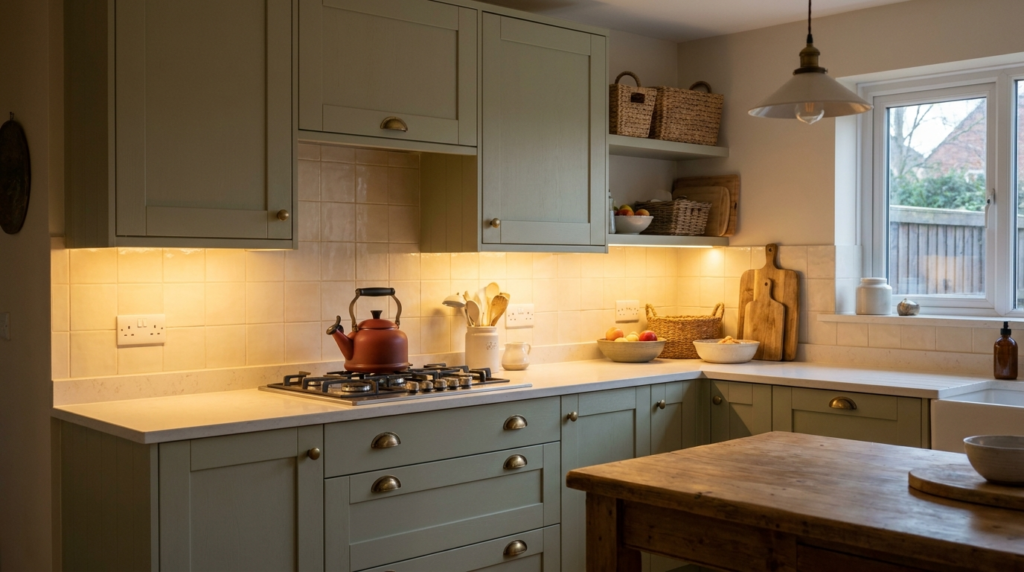
The strategy itself is sound and simple. Walk into any kitchen and your eye lands on cabinet fronts, hardware, the faucet and the light. Counters and appliances cost thousands. The four things you actually notice do not.
How to split the money
The shares below are a budgeting rule, not a price list.
| Element | Share of a 500 dollar budget | Why it sits there |
|---|---|---|
| Cabinet paint and preparation | 30 to 35 percent | Largest visual surface; most of the cost is materials you cannot skip |
| Lighting | 20 to 25 percent | Only element with a measurable running-cost return |
| Faucet | 20 to 25 percent | The thing your hands touch most; the one place not to buy the cheapest option |
| Hardware | 15 to 20 percent | Highest visual change per dollar, and fully reversible |
| Safety and testing | 5 to 10 percent | Lead test kit and respiratory protection if the house predates 1978 |
That last row is the one most guides omit, and it is the one this article is going to spend the most time on, because the difference between a cheerful weekend and a genuine health incident is decided there.
The paint, and the thing that must happen first
Painted cabinet doors have to be degreased, scuff sanded, primed and topcoated. The sanding is the step that matters, because of what may be underneath.
The CDC states that “lead-based paints were banned for residential use in 1978,” that “homes built in the U.S. before 1978 are likely to have some lead-based paint,” and that “common renovation activities (like sanding, cutting, replacing windows, and more) can create hazardous lead dust.” Approximately 29 million housing units have lead-based paint hazards, of which about 2.6 million are home to young children.
The EPA’s Renovation, Repair and Painting rule, which imposes lead-safe work practices, does not bind you in your own house. The agency says so directly: “the RRP Rule does not apply to homeowners doing RRP projects in their own pre-1978 homes. However, it does apply if you rent all or part of your home, operate a childcare center in your home or if you buy, renovate and sell homes for profit.”
Not being regulated is not the same as not being at risk, and the regulations that do exist tell you how seriously federal agencies take this work. OSHA’s construction lead standard presumes that paid workers are exposed above the permissible limit when performing “manual demolition of structures (e.g, dry wall), manual scraping, manual sanding, heat gun applications, and power tool cleaning with dust collection systems” on lead-containing coatings. That standard governs employees, not homeowners. But if a regulator assumes a professional sanding old paint is over the limit, the homeowner doing the same thing in a closed kitchen is not in a different physical situation.
The EPA’s guidance for do-it-yourself renovators is the practical version. Use “a spray mister or pump sprayer to mist areas before sanding, scraping, drilling, and cutting to keep the dust down.” Use “wet-dry sandpaper and/or a sanding sponge.” Wear “a disposable N-100 certified respirator,” which is a higher specification than the N95 most people have in a drawer. Contain the work area, because “the goal of your work area setup is to keep dust in your work area and keep family members and anyone not working on your DIY project out.” Clean up with a HEPA vacuum and damp cloths rather than a broom.
And the instruction that carries the most weight, from the CDC: “Keep children and pregnant women away from housing undergoing renovation and from participating in activities that disturb old paint or in cleaning up paint debris after work is completed.”
Testing, and a quirk worth understanding
The EPA recognises three lead test kits: LeadCheck, D-Lead and a kit produced by the State of Massachusetts. The recognition criteria contain an asymmetry most people miss. All three meet the standard for a reliable negative result, which requires a false negative rate of no more than 5 percent. None meets the criterion for a reliable positive. The regulated threshold is 1.0 mg per square centimetre or 0.5 percent by weight.
In practice that means a negative result from a recognised kit is genuinely informative, and a positive result tells you to proceed carefully rather than confirming anything. Either way, a positive result on cabinets in a pre-1978 house is a reason to consider a professional rather than a sander.
Fumes, as distinct from dust
The EPA notes that volatile organic compounds are emitted from “paints, paint strippers and other solvents,” that indoor levels run “2 to 5 times higher indoors than outdoors,” and that during activities such as paint stripping they may reach “1,000 times background outdoor levels.” Symptoms it lists include eye, nose and throat irritation, headaches, loss of coordination and nausea.
Its guidance is to “increase ventilation when using products that emit VOCs” and “open up windows to provide the maximum amount of outdoor air possible.” Painting doors outside or in a garage with the door open is not fussiness.
Federal VOC limits for architectural coatings do exist, at 40 CFR Part 59 Subpart D: 250 grams per litre for flat coatings and 380 for nonflat. Those are a national floor. Many states and air districts enforce considerably lower limits, and a low-VOC product is a genuine improvement over the federal maximum rather than marketing.
A protective mask note that matters here: OSHA distinguishes between “particulate respirators, which filter out airborne particles, and air-purifying respirators with cartridges/canisters which filter out chemicals and gases.” An N-100 handles lead dust. It does nothing for solvent vapour. Those are two different problems needing two different answers, and neither is a cloth mask.
The lighting, and the one calculation worth doing
This is the only part of the refresh that pays you back.
The FTC’s Lighting Facts label rule, at 16 CFR 305.23, requires packages to state brightness in lumens, estimated annual energy cost “based on the average initial wattage, a usage rate of 3 hours per day and 11 cents per kWh,” life in years, and colour appearance “as measured in degrees Kelvin” on a scale from 2,600 K at one end to 6,600 K at the other.
Use the FTC’s own convention to compare a 60 watt incandescent with a 9 watt LED of similar output. Three hours a day for 365 days is 65.7 kWh for the incandescent and 9.9 kWh for the LED. At the label’s 11 cents, that is 7.23 dollars against 1.08 dollars a year, a difference of 6.15 dollars per bulb. At the actual US residential average price for 2025, which the EIA puts at 17.30 cents per kWh, the same comparison is 11.37 dollars against 1.71, a difference of 9.66 dollars per bulb per year. The arithmetic is ours; the wattages are illustrative and the conventions and price are the FTC’s and the EIA’s.
Six fittings in a kitchen, and that is roughly 58 dollars a year. Over a decade it exceeds the entire budget in the title. DOE’s broader figure is consistent: “the average household saves about 225 dollars in energy costs per year by using LED lighting,” with lighting accounting for “around 15 percent of an average home’s electricity use.”
One thing you can no longer do is shop by the ENERGY STAR label. EPA finalised “the sunset of the ENERGY STAR specifications for lamps and luminaires effective December 31, 2024,” with recessed downlights continuing under a separate specification. The Lighting Facts label is now the tool. For reference, the retired ENERGY STAR lamp specification required a colour rendering index of 80 or above and permitted nominal colour temperatures of 2200, 2500, 2700, 3000, 3500, 4000, 5000 and 6500 K. There is no federal guidance on which of those suits a kitchen, and anyone telling you otherwise is expressing a preference.
If the lighting involves wiring
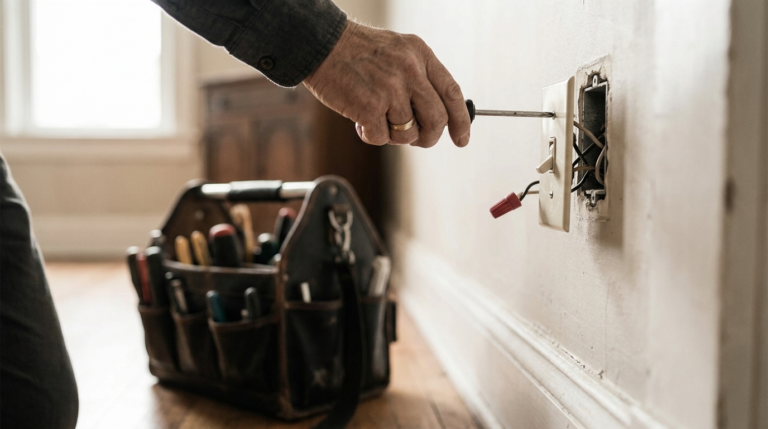
Kitchen countertop receptacles need ground-fault protection. HUD’s construction standards, at 24 CFR 3280.806, require that “ground-fault circuit-interrupter protection for personnel must be provided for receptacles serving countertops in kitchens,” excepting dedicated appliance outlets. Site-built homes are governed by the National Electrical Code as adopted by your state, with the same requirement.
A plug-in under-cabinet light avoids the question entirely, which on a 500 dollar budget is usually the right answer. If you are hardwiring, permits and licensing are set locally and there is no federal threshold. The CPSC’s own advice is to “have a licensed electrician check your home’s electrical system for hazards if it’s been more than 10 years since your last inspection.” Its 2020 to 2022 residential fire loss estimates attribute an annual average of 18,100 fires, 160 deaths and 670 injuries to electrical distribution equipment.
The faucet, where cheap has a documented cost
Two things to know before buying one online.
First, there is no such thing as a WaterSense kitchen faucet. The EPA states plainly that “EPA only has WaterSense labeling criteria for private lavatory (i.e., bathroom sink) and bar sink faucets,” and does not have criteria “for any other faucet type (e.g., kitchen, public lavatory faucets, metering faucets).” A water-efficiency claim on a kitchen faucet is the manufacturer’s, unverified by the programme most people assume covers it. The applicable federal rule is the DOE efficiency standard at 10 CFR 430.32(o), which caps kitchen faucets and replacement aerators at 2.2 gallons per minute at 60 psi. Note that DOE proposed rescinding the amended faucet standards in May 2025, so confirm the current figure if it matters to you.
Second, and more seriously: in May 2025 the CPSC announced recalls of three separate brands of kitchen faucet, all sold through a single online marketplace, all for the same reason. Roughly 24,000 BASDEHEN, about 50,000 KICIMPRO and about 29,000 VFAUOSIT faucets were recalled for lead leaching into drinking water. That is roughly 103,000 units across three unfamiliar brand names.
This is the one line item where the cheapest option carries a documented, federally recorded hazard, and it is the reason the faucet gets a fifth of the budget rather than whatever is left.
One thing worth knowing that is not on the list
If your range hood recirculates rather than venting outside, it is not doing the job you think it is. DOE’s Building America guidance is unambiguous: “Recirculating fans that draw air through a filter and discharge it back into the room are not acceptable.” It recommends venting “directly to the outside, not into an attic, crawlspace, or space between floors,” with intermittent fans rated at 100 cfm or more.
Converting a recirculating hood to a ducted one is not a 500 dollar job and does not belong in this article. It belongs on the list of things to know about your kitchen, and it matters more to the air you breathe than the colour of the cabinets.
The honest limit of a refresh
Paint, hardware, lighting and a faucet will change how a kitchen looks and how it feels to use. They will not fix a layout that does not work, counters that are failing, or a hood that vents into the room. A refresh makes a functional kitchen pleasant. It does not make a dysfunctional one work.
And the caution at the top stands. If the house predates 1978 and the cabinets have original paint, the honest version of this project includes a test kit, a respirator, plastic sheeting and possibly the conclusion that you should pay someone. That is not what a weekend project article is supposed to say. It is what the CDC and EPA documents say, and they are the ones with the dust measurements.
General information, current as of September 2026, and not personalised advice. Standards and recalls change; check the primary sources and consult qualified professionals about work in your own home.
Frequently asked questions
Do I need to follow the EPA lead rule in my own home?
No. EPA states the Renovation, Repair and Painting rule does not apply to homeowners working on their own pre-1978 home, though it does apply if you rent it out or flip houses. The dust risk is the same either way.
Are home lead test kits reliable?
Partly. The three EPA-recognised kits meet the standard for a reliable negative result but not for a reliable positive, so a negative is informative and a positive means proceed carefully.
Is ENERGY STAR still on light bulbs?
No. EPA sunset the lamps and luminaires specifications at the end of 2024. Use the FTC Lighting Facts label instead.
Does a recirculating range hood help air quality?
No. Department of Energy guidance states that recirculating fans discharging back into the room are not acceptable.
Sources
- Environmental Protection Agency, Lead Renovation, Repair and Painting Program
- Environmental Protection Agency, Lead-Safe Renovations for DIYers
- Environmental Protection Agency, Lead Test Kits
- Centers for Disease Control and Prevention, Lead in Paint
- Environmental Protection Agency, Volatile Organic Compounds and Indoor Air Quality
- Occupational Safety and Health Administration, lead in construction standard
- Occupational Safety and Health Administration, Respiratory Protection
- Environmental Protection Agency, WaterSense bathroom faucets
- Federal Trade Commission, Lighting Facts label rule, 16 CFR 305.23
- Department of Energy, Lighting Choices to Save You Money
- Energy Information Administration, electricity prices
- ENERGY STAR, lighting specification sunset memo
- Consumer Product Safety Commission, KICIMPRO kitchen faucet recall
- Consumer Product Safety Commission, residential fire loss estimates 2020 to 2022
- Department of Energy Building America Solution Center, kitchen exhaust fans