Most DIY electrical advice ignores the permit question. Where the line actually falls, why it varies by state, and what unpermitted work does to an insurance claim.
The honest answer is narrower than most homeowners want to hear. You can safely replace a light fixture, a switch, or a receptacle on a circuit you have proved is dead. Almost everything else that involves adding, extending, or re-routing wiring is either legally restricted where you live, or requires a permit and an inspection, or both. And the point at which the law draws that line is not a national rule. It is set by your state and then modified again by your city or county.
That last fact is the one that gets skipped. Articles that tell you homeowners can do their own electrical work are describing one jurisdiction and presenting it as a general truth. What follows is an attempt to give you the line, the reasoning behind it, and the permit question that decides whether your work is legal and insurable.
The code is national. The permission is not.
The National Fire Protection Association publishes NFPA 70, the National Electrical Code. NFPA states that the NEC is used in all fifty states. The 2026 edition was issued by NFPA in August 2025, following the 2023 edition, and the code is revised on a three-year cycle.
But the NEC is a model standard. It has no legal force until a state or a local government adopts it, and jurisdictions adopt different editions at different times, often with local amendments. Your county may still be enforcing the 2020 edition while a neighbouring county has moved to 2023. The NEC itself acknowledges this: enforcement rests with what the code calls the authority having jurisdiction, which in practice is your local electrical inspector or building department.
Separately, and this is the part that trips people up, the NEC says almost nothing about who is allowed to do the work. Licensing and homeowner exemptions are creatures of state law and municipal ordinance. Some states let an owner-occupier pull a permit and wire their own single-family home. Some restrict it sharply. Some do not allow it at all on rental or multi-family property even when the owner lives in one unit.
Two real examples of how much this varies
Washington State’s Department of Labor and Industries publishes a guide for property owners doing electrical work on residential property. It states that only property owners or licensed electrical contractors can purchase an electrical permit. It requires an inspection to be requested before any electrical work is covered, and no later than three business days after the work is finished or one business day after any part of the installation has been energised, whichever comes first. It warns that failing to obtain a permit before starting work can carry a fine of up to 2,000 dollars, that each day and each location can count as a separate violation, and that electrical power may be disconnected for non-compliance.
Minnesota’s Department of Labor and Industry runs a homeowner electrical permit system of its own, applied for online, with the inspection requirement determined when the permit is evaluated.
Those are two states that explicitly accommodate homeowner work, and even they impose a permit, a deadline, and an inspection. The reasonable inference is not that DIY electrical work is broadly permitted. It is that where it is permitted, it is permitted under supervision. Assume nothing about your own jurisdiction until you have asked your building department directly.
A three-question test before you touch anything
This is the rule to apply. Answer all three before you start.
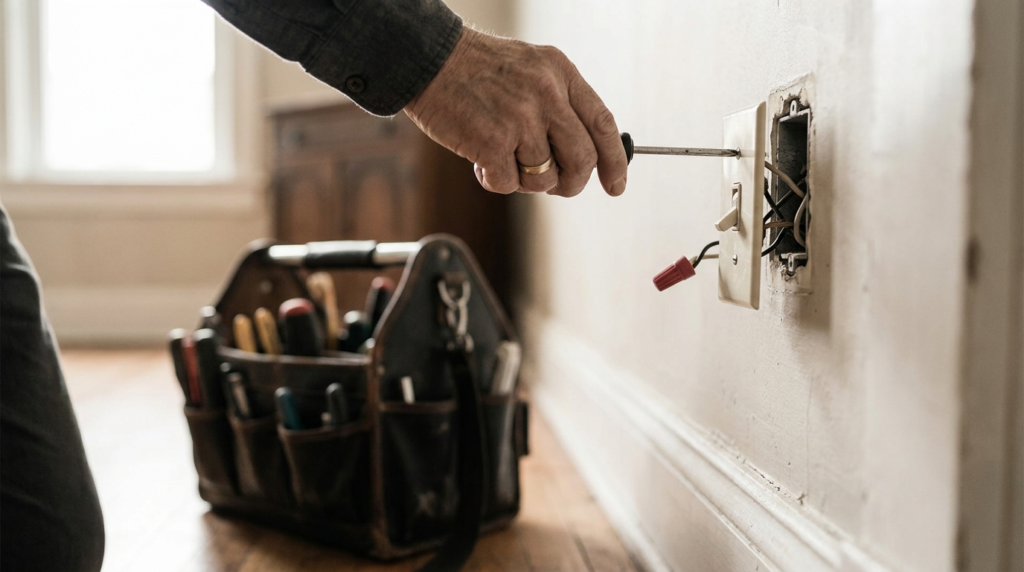
- Am I adding to the system, or replacing part of it in kind? Swapping a failed switch for an identical switch on existing wiring is replacement. Running a new cable, adding an outlet, extending a circuit, or changing what a circuit feeds is addition. Addition almost always triggers a permit and often triggers upgraded protection requirements on the whole circuit.
- Can I make this completely dead, and prove it with a tester? If the answer involves working on anything upstream of the main breaker, on the service entrance, in the meter base, or on a panel’s incoming lugs, stop. Those parts stay live when the main breaker is off. This is not a skill gap that reading fixes.
- Would a failure here be invisible? A loose connection inside a wall, an overfilled box, an undersized conductor, or a missing ground does not announce itself. It fails years later, in a cavity, with nobody watching. This is precisely the failure mode inspections exist to catch, and precisely why an unpermitted job carries risk long after it appears to work.
Where the line actually falls
The table below is a general guide, not a legal determination for your address. Permit requirements in the middle column are the common pattern, not a guarantee.
| Task | Permit typically required | Reasonable position |
|---|---|---|
| Replacing a light fixture on existing wiring | Usually no | Competent homeowner, circuit off and tested |
| Replacing a switch or receptacle like for like | Usually no | Competent homeowner, circuit off and tested |
| Replacing a standard receptacle with a GFCI device | Varies | Competent homeowner, but check local rules first |
| Installing a ceiling fan where a fan-rated box already exists | Usually no | Competent homeowner |
| Adding a new receptacle or extending a circuit | Usually yes | Permit and inspection; many owners should hire out |
| Adding a new branch circuit from the panel | Yes | Licensed electrician in most jurisdictions |
| Installing a 240-volt circuit for a range, dryer, or EV charger | Yes | Licensed electrician |
| Replacing or upgrading the service panel | Yes | Licensed electrician, no exceptions worth taking |
| Anything on the service entrance, meter, or utility drop | Yes | Licensed electrician and the utility |
| Knob-and-tube or aluminium branch-circuit remediation | Yes | Licensed electrician with specific experience |
The retrofit trap
Here is a consequence of the code that surprises people who thought they were doing something small. The National Electrical Code, at section 210.12, requires arc-fault circuit-interrupter protection in specified dwelling areas, and it applies that requirement to branch circuit wiring that is modified, replaced, or extended, with a limited exception for short extensions that add no outlets or devices. Section 210.8 requires ground-fault circuit-interrupter protection at a long list of dwelling locations, and the list has grown across recent editions.
The practical effect is that adding one outlet to an old bedroom circuit can oblige you to bring that circuit up to current protection standards. That is not an inspector being difficult. It is the code operating as written. It is also a reason unpermitted work so often fails later scrutiny: the work was done to the standard of the original installation rather than the current one.
The 2026 NEC continues this direction of travel. Among its changes are a requirement that the service disconnect for one- and two-family dwellings be at a readily accessible outdoor location on or within sight of the dwelling, and expanded emergency disconnect marking requirements. If your jurisdiction adopts the 2026 edition, panel work you were planning may involve more than you budgeted for.
Permits, inspections, and the insurance question
A permit does two things. It puts a third party with no financial stake in the job in front of your work before it is concealed, and it creates a record that the work was done and approved. The second is worth as much as the first when you sell the house or file a claim.
On insurance, be careful with what you read. Standard homeowners policies are contracts, and whether a particular loss is covered turns on the policy wording and on state law, not on a general rule about permits. What is true is that policies commonly exclude losses arising from faulty workmanship, and that an insurer investigating a fire will look at what caused it. If the cause is traced to unpermitted, uninspected wiring, you have handed the insurer a straightforward basis to contest or deny the claim, and you have no inspection record to rebut it. You may also face a separate problem: rebuilding to current code after a loss can cost more than the policy’s base dwelling coverage, which is why ordinance or law coverage exists as an endorsement.
We could not find a credible national figure for how often claims are denied specifically over unpermitted work, and you should be sceptical of any article that quotes one. The honest framing is that unpermitted work converts a covered loss into an argument you might lose.
What the data actually supports
The case for caution does not rest on scare statistics, but the numbers are worth stating accurately. NFPA’s report on home electrical fires, authored by Richard Campbell and published in March 2019, found that local fire departments responded to an estimated average of 35,150 home fires involving electrical distribution and lighting equipment each year in 2012 through 2016, causing an annual average of 490 civilian deaths, 1,200 civilian injuries, and 1.3 billion dollars in direct property damage. The Electrical Safety Foundation International puts home electrical fires at roughly 51,000 per year, using a broader definition.
On shock and electrocution, the Consumer Product Safety Commission’s report Electrocutions Associated With Consumer Products: 2011-2020, by Hanway, Massie and Seebruck and published in November 2023, estimated between 50 and 110 consumer-product electrocution deaths per year over that decade and found statistical evidence of an increasing trend in the age-adjusted electrocution death rate. Within the reported cases, installed wiring accounted for 33 and electrical boxes or outlets for 16.
Two things follow. Electrocution from household wiring is genuinely rare in absolute terms, so the honest risk argument is not that you will be killed changing a receptacle. The stronger argument is the fire one, because bad connections are common, cheap to make, and invisible for years.
ESFI’s own position is unambiguous. It recommends hiring a qualified, licensed electrician for any electrical work in the home, and warns against attempting any project beyond your skill level. That is a foundation funded by the electrical industry, so weigh it accordingly, but the underlying point stands on its own.
If you hire out
Ask for the licence number and verify it with the state board rather than accepting a card. Ask who is pulling the permit, and make it a condition of payment that the permit is pulled in the contractor’s name and the final inspection passed. Keep the approved permit with your closing documents. Withhold final payment until inspection sign-off, not until the lights work.
Where these figures come from
- National Fire Protection Association, NFPA 70, National Electrical Code, 2023 and 2026 editions, including sections 210.8, 210.12 and 230.70
- National Fire Protection Association, Home Electrical Fires, Richard Campbell, March 2019
- US Consumer Product Safety Commission, Electrocutions Associated With Consumer Products: 2011-2020, November 2023
- Electrical Safety Foundation International, Do-It-Yourself Electrical Safety and Home Electrical Fires
- Washington State Department of Labor and Industries, Electrical Work on Residential Property
- Minnesota Department of Labor and Industry, Electrical permits for homeowners
The line is not really about skill. Plenty of homeowners could learn to wire a circuit correctly. The line is about who carries the consequence when it is wrong, and about the fact that a concealed mistake produces no feedback until it produces a fire. If you are not willing to pull the permit and have the work inspected, that is usually a sign you already know the answer.
General information, current as of September 2026, and not personalised advice.
Frequently asked questions
What tool makes DIY electrical dramatically safer?
A non contact voltage tester, about 15 dollars. Breaker off, then test at the wires anyway, every time. Mislabeled panels are common enough to make testing non negotiable.
Do small electrical jobs need permits?
Rules vary by city. Simple replacements often do not; new circuits and panel changes almost always do. One call to your local building department settles it.