The cheapest effective fixes for indoor air are not purchases, and the EPA has said so for decades. Seven that work, plus the popular categories the evidence does not support.
The answer most people do not want: the cheapest effective improvements to indoor air are not purchases. They are stopping things that pollute and moving polluted air out of the building. The Environmental Protection Agency has said this consistently for decades. In its guidance on improving indoor air quality, the EPA states that usually the most effective approach is to eliminate individual sources of pollution or reduce their emissions, and that source control is more cost-efficient than increasing ventilation because ventilation raises energy costs.
Air cleaners come third in that hierarchy, and the EPA is blunt about their limits: they are generally not designed to remove gaseous pollutants, and no air cleaner or filter will eliminate all of the air pollutants in a home. Most of the money spent on home air goes to the third tier while the first two are neglected.
Seven things, roughly in order of value per dollar.
1. Remove the source you actually control. Cost: nothing
The clearest case is indoor smoking, because the evidence on partial measures is definitive. The CDC cites the 2006 Surgeon General’s report: eliminating smoking indoors fully protects nonsmokers, while separating smokers from nonsmokers, cleaning the air and ventilating buildings cannot eliminate exposure. The American Society of Heating, Refrigerating and Air-Conditioning Engineers has concluded that no engineering approach, including advanced dilution ventilation or air cleaning, should be relied on to control the health risks. No filter solves this. There is only not doing it indoors.
The same logic applies to solvents, aerosols and strong cleaning products. The EPA’s material on volatile organic compounds reports that levels of several organic compounds average two to five times higher indoors than outdoors, and that during and for several hours after activities such as paint stripping, levels may reach a thousand times outdoor background. Buying smaller quantities, using products outdoors, and ventilating hard while doing so are free.
2. Use the kitchen exhaust fan every single time, and check where it goes. Cost: nothing, if one exists
Cooking is the largest routine pollution event in most homes, and most people run the hood only when something burns. The EPA’s guidance on combustion sources recommends exhaust fans vented outdoors over gas cooking surfaces, and states flatly: never use a gas stove to heat your home. It also notes that a persistent yellow-tipped flame indicates a maladjusted burner and higher emissions, and suggests asking the gas company to adjust it until the flame tip is blue.
The word that matters is vented. The Department of Energy’s Energy Saver home ventilation fact sheet, published in 2021, states that kitchen and bathroom vents should lead directly outside and never into the attic. A recirculating hood, the kind with a charcoal pad that blows straight back into the room, does essentially nothing for combustion gases. Look in the cabinet above the hood. If there is no duct, the hood is decorative.
3. Ventilate deliberately rather than by accident. Cost: nothing
The EPA cites ASHRAE Standard 62.2-2016 as the residential benchmark: homes should receive 0.35 air changes per hour, and not less than 15 cubic feet per minute per person. Few people can measure this at home, which is fine, because the practical version is simple: run the bathroom fan during and after showers, run the kitchen fan during and after cooking, and open windows on opposite sides of the house when weather and outdoor air allow.
One caution the DOE states directly: without proper ventilation, an insulated and airtight house seals in pollutants such as carbon monoxide and moisture. ENERGY STAR, the joint EPA and DOE program, estimates that homeowners save an average of 15 percent on heating and cooling costs by air sealing and adding insulation. Weatherizing is worth doing, but sealing a house without adding ventilation makes the air worse, and that trade is rarely mentioned when the work is sold.
4. Buy a humidity gauge and act on it. Cost: roughly the price of lunch
The EPA’s Mold Course guidance states that indoor relative humidity should be kept below 60 percent, ideally between 30 and 50 percent, and notes that low humidity also discourages dust mites and cockroaches. It is specific about wet materials: buildings and furnishings must be dried, or allowed to dry, within 24 to 48 hours in order to avoid mold growth.
A cheap hygrometer converts a vague worry into a number. If the number is above 60, the fix is usually a dehumidifier, an exhaust fan actually being used, or finding a leak. No air purifier addresses humidity.
5. Upgrade the filter already in your furnace. Cost: 15 to 40 dollars
The EPA’s Guide to Air Cleaners in the Home, second edition, August 2018, recommends a furnace or HVAC filter rated at least MERV 13, or as high as the system will accommodate. The EPA’s indoor air filtration fact sheet repeats the MERV 13 minimum and notes that mechanical filters such as HEPA trap smoke particles effectively and do not produce ozone.
The qualifier matters. A denser filter restricts airflow, and some older systems cannot tolerate MERV 13 without strain. Check the manual. The second qualifier matters more: the system filters only while the fan runs, so a filter in a furnace that runs two hours a day is filtering two hours a day. Many thermostats have a fan circulation setting that runs it longer.
6. Build or buy a box-fan filter, and keep it clean. Cost: 40 to 80 dollars
This is the one piece of hardware with genuinely strong public evidence behind it. EPA research published in November 2022 found that do-it-yourself air cleaners can effectively reduce smoke concentrations in a laboratory setting, and measured clean air delivery rates for several designs: a box fan with one one-inch MERV 13 filter reached 111, a cardboard shroud raised that to 156, one four-inch filter with a shroud reached 248, and a four-filter cube reached 401.
Three conditions come with it. Use a box fan from 2012 or later, which the EPA specifies because newer fans have fused plugs and thermal cutoffs; Underwriters Laboratories tested five fan models in 2021 and observed no fire hazards in the scenarios tested. Use MERV 13 filters, because smoke particles are very small. And replace the filters, because the EPA found DIY air cleaners were almost completely ineffective with dirty filters.
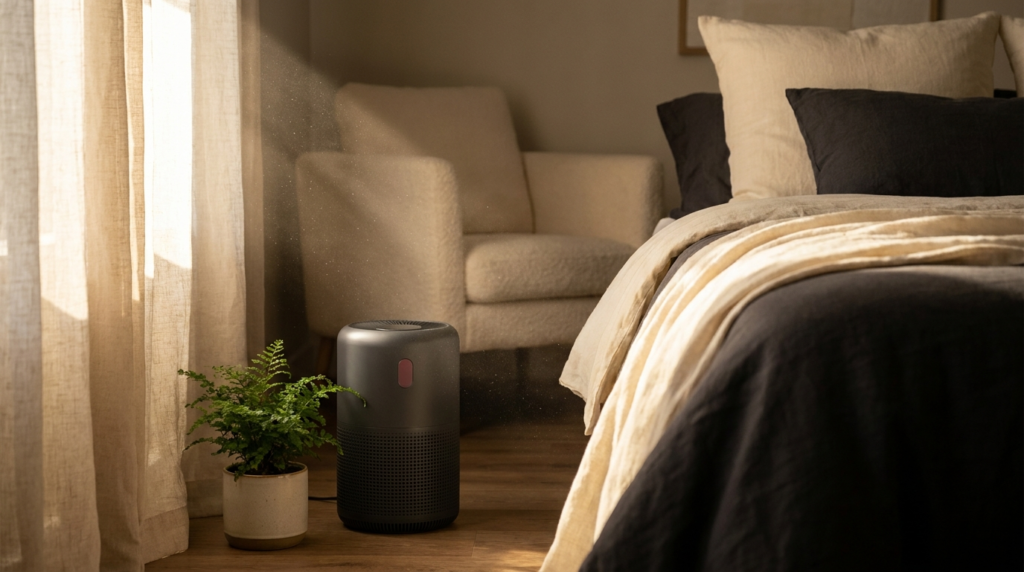
For a commercial unit, the EPA’s sizing rule is a clean air delivery rate for smoke of at least two-thirds of the room area in square feet. A 300 square foot room wants a smoke CADR of at least 200.
7. Test for radon once, and fit a carbon monoxide alarm. Cost: a test kit and an alarm
Radon is invisible and common, and the only way to know is to measure. The EPA’s A Citizen’s Guide to Radon advises fixing a home at 4 picocuries per liter or higher, and estimates that radon causes about 21,000 lung cancer deaths per year in the United States. Many state radon programs distribute test kits free or near free. No purifier addresses radon.
On carbon monoxide, the EPA’s position is unusual: a CO detector is a backup, not a replacement for having fuel-burning appliances inspected by a trained professional at the start of every heating season. The EPA notes that laboratory-tested detectors have varied in performance, with some failing to alarm even at high CO levels. Fit one anyway, follow the placement instructions, and do not treat it as the whole plan.
What to do first, by the problem you actually have
| The problem | Cheapest thing that works | Rough cost | What will not fix it |
|---|---|---|---|
| Cooking smells and haze, gas stove | Ducted range hood on high, every time, plus a cracked window | Nothing if ducted | Recirculating hood; air purifier in another room |
| Wildfire smoke outdoors | Windows shut, MERV 13 in the HVAC with fan running, box-fan filter in the occupied room | 50 to 100 dollars | Ionizers; opening windows for fresh air |
| Musty smell, visible mold | Find the water source, dry within 24 to 48 hours, hold humidity under 60 percent | 15 dollars, more if there is a leak | Any air cleaner; ozone treatment; duct cleaning |
| Dust and pet dander | MERV 13 filter, longer fan runtime, portable unit sized to the room | 60 to 150 dollars | Houseplants; scented products |
| Chemical smell after painting or new furniture | Maximum ventilation for as long as the smell lasts | Nothing | Filters, not designed to remove gases |
| Worry with no specific symptom | Radon test and a CO alarm, both risks you cannot smell | 30 to 60 dollars | A large purifier bought instead of measuring |
| Someone smokes indoors | They stop, or they go outside | Nothing | Every engineering control, per the CDC and ASHRAE |
What is sold that the evidence does not support
Ozone generators. The EPA is explicit: at concentrations that do not exceed public health standards, ozone has little potential to remove indoor air contaminants. It also notes that ozone can damage the lungs, that relatively low amounts can cause chest pain, coughing and shortness of breath, and that the Food and Drug Administration limits ozone output from medical devices to 0.05 parts per million. The EPA tells consumers to avoid air cleaners and furnace filters that intentionally produce ozone.
Ionizers, plasma, photocatalytic oxidation, hydroxyl generators and UV devices. The EPA’s Guide to Air Cleaners in the Home states that research has not yet shown that technologies such as plasma, photocatalytic oxidation or ultraviolet light can remove gases effectively, and that electrostatic and ionizing devices may have the potential to emit ozone. The EPA’s filtration fact sheet lists these categories as not recommended for smoke. This is a fast-growing segment of the market and the weakest part of the evidence base.
Houseplants. The claim traces to a 1989 NASA experiment in sealed chambers. A 2019 analysis by Cummings and Waring in the Journal of Exposure Science and Environmental Epidemiology reviewed a dozen studies spanning thirty years and calculated that it would take between 100 and 1,000 plants per square meter of floor space to match the air cleaning capacity of a building’s air handling system, or of a couple of open windows. Keep plants. Do not count them as filtration.
Routine duct cleaning. The EPA states that duct cleaning has never been shown to actually prevent health problems, and that it does not recommend cleaning ducts routinely, only as needed, such as when there is visible mold or a pest infestation.
Air fresheners and scented products. These add volatile organic compounds to a room. They remove nothing.
The part nobody advertises
Indoor air is mostly determined by the building, the fuel burned inside it, the moisture in it and the outdoor air around it. Those are expensive and slow to change. The cheap interventions above are real and worth doing, and none will make a poorly ventilated apartment beside a highway equivalent to a well ventilated house in clean air. Spending 300 dollars on a purifier is often a way of buying the feeling of having addressed a structural problem. The fan above the stove, used consistently, will probably do more.
Where these figures come from
Environmental Protection Agency: Improving Indoor Air Quality; Guide to Air Cleaners in the Home, second edition, 2018; indoor air filtration fact sheet; Ozone Generators That Are Sold as Air Cleaners; Sources of Combustion Products; Volatile Organic Compounds Impact on Indoor Air Quality; Mold Course Chapter 2; A Citizen’s Guide to Radon; Protect Your Family and Yourself from Carbon Monoxide Poisoning; Should You Have the Air Ducts in Your Home Cleaned; and EPA research on DIY air cleaners for wildfire smoke, November 2022. Department of Energy, Energy Saver home ventilation fact sheet, 2021. ENERGY STAR. ASHRAE Standard 62.2-2016, as cited by the EPA. Centers for Disease Control and Prevention on ventilation and secondhand smoke, citing the 2006 Surgeon General’s report. Cummings and Waring, Journal of Exposure Science and Environmental Epidemiology, 2019.
General information, current as of September 2026.
Frequently asked questions
Do houseplants clean indoor air?
Not meaningfully at realistic quantities; the famous studies used sealed chambers. Plants are lovely, but filtration and ventilation do the actual work.
What about ionizers and plug in air fresheners?
Skip both. Some ionizers generate ozone, a lung irritant, and fresheners add fragrance chemicals to the air you were trying to clean. HEPA filtration is the proven mechanism.