EPA WaterSense says nine percent of homes have leaks wasting 50 gallons or more a day, and a dye test that colours the bowl within 10 minutes tells you the flapper is the cause.
The short version: Nearly every running toilet is one of three parts: the flapper or flush valve seal, the fill valve, or the water level set against the overflow tube. You can tell which in about two minutes with food colouring and your ears, and two of the three are a cheap part and fifteen minutes of work. The Environmental Protection Agency, through its WaterSense programme, states that the average household’s leaks waste more than 9,300 gallons a year, that nine percent of homes have leaks wasting 50 gallons or more per day, and that fixing easily corrected household leaks can save about 10 percent on a water bill. The single most common avoidable cause is also the least discussed: in-tank cleaning tablets containing bleach or chlorine, which manufacturers say will destroy tank components and void the warranty.
What it costs, and the two-minute diagnosis
The numbers worth knowing
EPA WaterSense reports that household leaks waste nearly 1 trillion gallons nationwide each year, and the average household’s leaks more than 9,300 gallons annually, about 180 gallons a week. Toilets are the largest single indoor use: WaterSense puts them at nearly 30 percent of average indoor water consumption.
The Water Research Foundation’s Residential End Uses of Water, Version 2, published April 2016 and based on 23,749 single-family accounts across 23 study sites, measured average indoor use at 138 gallons per household per day, of which leaks accounted for 17.8 gallons per day, or 13 percent of indoor use. That study also found the average flush volume was 2.6 gallons, well above the 1.6 gallons per flush WaterSense gives as the federal standard, because older fixtures remain in service.
The dye test
This is the diagnostic that settles it. Take the tank lid off and put a few drops of food colouring, or a dye tablet, into the tank water. Do not flush. EPA WaterSense guidance is precise: if the colour shows up in the bowl within 10 minutes without flushing, you have a leak.
A positive dye test points at the flapper or the flush valve seat, because that is the only path from tank to bowl. A negative dye test with a toilet that still runs points at the fill valve or the water level, because water is going over the overflow tube rather than past the flapper.
Listening to the refill cycle
The sound tells you nearly as much. A toilet that cycles on for ten or twenty seconds every few minutes when nobody has used it, sometimes called ghost flushing, is losing water past the flapper slowly enough that the fill valve tops the tank up periodically. One that runs constantly and quietly without ever cycling off is usually spilling into the overflow tube: the fill valve never senses a full tank because the tank never fills.
| Symptom | Likely cause | Fix |
|---|---|---|
| Dye reaches the bowl within 10 minutes | Worn flapper or flush valve seal | Replace the flapper with the model specified for that toilet |
| Intermittent refill every few minutes, no other symptom | Slow flapper leak, or a chain too short holding the flapper ajar | Replace flapper; adjust chain to about half an inch of slack |
| Constant quiet running, dye test negative | Water level set above the overflow tube | Lower the float so the water sits below the tube rim |
| Runs constantly, level already correct | Fill valve failed to shut off | Replace the fill valve |
| Handle sticks or must be held down | Stiff or corroded lift arm, or a degraded seal | Free the arm, replace the seal or the flush lever |
| New flapper still leaks | Pitted or scaled flush valve seat | Seat repair kit, or replace the flush valve |
| Water in the bowl rises and falls with no refill | Cracked overflow tube or cracked tank | Replace the flush valve assembly or the toilet |
The three repairs
Shut off and drain first
Every one of these starts the same way, and Fluidmaster’s fill valve installation instructions set out the sequence: turn off the water supply, turning the shutoff clockwise; flush the toilet; and remove excess water from the tank with a sponge. If the shutoff under the tank is seized, close the main supply rather than forcing it, because an old multi-turn stop can shear.
Take the lid off and put it flat on the floor, not balanced on a rim. Vitreous china lids crack and are often harder to replace than the parts you came for.
The flapper, the chain and the seat
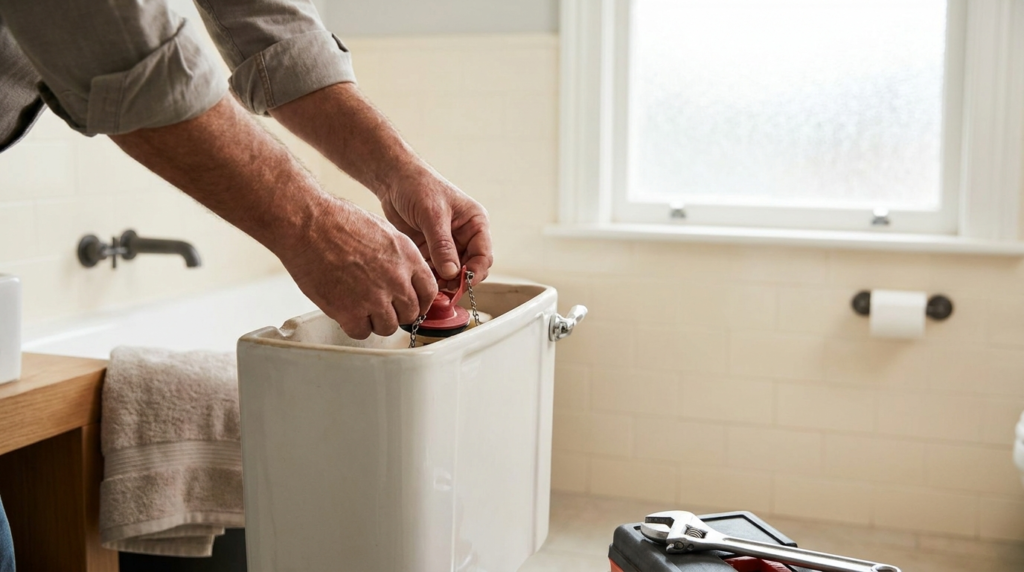
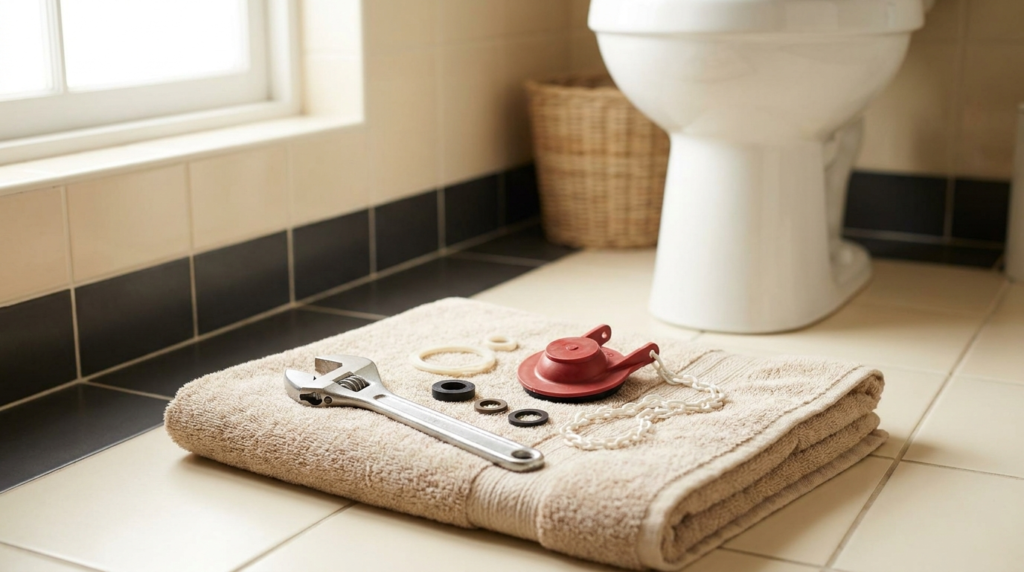
The flapper is a rubber or silicone disc that seals the outlet at the bottom of the tank. EPA WaterSense notes that when a toilet leaks, the cause is often an old, faulty flapper, and that it is usually best to replace the whole flapper rather than attempt a repair. Unhook the chain, slide the old flapper’s ears off the pegs on the overflow tube, and fit the replacement. Match the part to the toilet rather than buying a universal one: flappers come in two- and three-inch sizes and shapes specific to particular flush valves, and the wrong one seals imperfectly from the day it goes in.
Then check the chain. Too much slack and the flapper will not lift far enough for a full flush; too little and the chain holds the flapper fractionally open, which produces exactly the intermittent refill described above. Aim for roughly half an inch of slack with the flapper seated, and clip off surplus chain so it cannot fall under the flapper.
If a new, correctly matched flapper still leaks, the problem is the seat it closes against. Run a finger around the rim of the flush valve opening. If it feels pitted, gritty or scaled rather than smooth, the seal cannot form. Korky notes that degraded seals also make the handle stiff and hard to lift, which is a useful secondary sign.
The fill valve and the water level
The fill valve refills the tank after a flush and shuts off at a set level. The overflow tube is the safety device: if the valve fails to shut off, water goes down the tube into the bowl instead of over the rim onto the floor. That is why the relationship between the two matters, and why most tanks carry a marked water line.
Fluidmaster’s installation instructions give both numbers. The critical level mark on the valve, marked C.L., must be positioned one inch above the top of the overflow pipe, which the instructions attribute to the plumbing code requirement; this is an anti-siphon provision to stop tank water being drawn back into the supply. The water level itself should be set half an inch below the top of the overflow pipe.
If water is trickling into the overflow tube, the level is too high, and adjusting the float down usually solves it. On a modern float-cup valve this is a screw or a clip on the valve shank; on an older ballcock it is the arm. If the level is correct and the valve still will not shut off, replace the valve. A fill valve is a single nut under the tank, a supply line and a refill tube, and it is the most forgiving of these repairs.
Why in-tank cleaning tablets destroy flappers
This deserves its own section because it is both common and avoidable. Fluidmaster’s instructions state, in capitals, not to use in-tank drop-in toilet bowl cleaners containing bleach or chlorine, warning that they will result in damage to tank components, may cause flooding and property damage, and will void the Fluidmaster warranty. Kohler’s toilets and seats limited warranty is equally direct: unless used properly with a Continuous Clean unit, in-tank toilet cleaners will void the warranty.
The mechanism is simple: a tablet sitting in the tank keeps chlorine in permanent contact with the rubber seals, hardening and cracking them. Korky notes that flapper life depends on the water and on whether chemical tablets are used in the tank, and that most of its flappers carry a five-year warranty, with premium models at ten. If you have replaced a flapper twice in a few years, check for a tablet. Clean the bowl, not the tank.
When the repair becomes a bigger job
A pitted flush valve seat can sometimes be recovered with a seat repair kit, which bonds a new smooth surface over the damaged one. If that fails, the flush valve assembly has to come out, which means removing the tank from the bowl: disconnect the supply, undo the tank bolts, lift the tank off, replace the assembly and the tank-to-bowl gasket, and reseat it. That is a half-day job and the point at which many people reasonably stop.
A cracked overflow tube is worse, because it drains the tank continuously and no flapper will fix it. It is part of the flush valve, so the repair is the same tank-off job. A hairline crack in the tank or bowl itself is not repairable; replace the toilet.
Two variations change the parts but not the logic. Dual-flush toilets typically use a canister or tower valve with a seal around its base rather than a hinged flapper, and the seal is replaced by lifting the canister out; the diagnostic is identical, but the part is specific to the model. Pressure-assist toilets have a sealed pressure vessel inside the tank, so there is no standing tank water to dye and no flapper; a running pressure-assist unit is usually a failed cartridge or flush valve, and these are manufacturer-specific enough that the service documentation for that unit is the right starting point.
The decision rule: replace parts if the toilet is otherwise sound and the dye test points at the flapper or fill valve, because those are inexpensive parts and a short job. Replace the toilet if you have to take the tank off to reach a failed flush valve seat on an old fixture, if the tank or bowl is cracked, or if the toilet predates the current standard and uses closer to 6 gallons a flush. EPA WaterSense puts the saving from replacing older, inefficient toilets with WaterSense labelled models at nearly 13,000 gallons and more than $170 a year for a household, and $3,400 over the lifetime of the toilets.
Call a plumber if the shutoff will not close or weeps once disturbed, if the bolts holding the toilet to the floor are corroded through, if there is movement or water at the base, or if the supply line is old rigid pipe rather than a flexible connector. Those failures flood rooms; a leaking flapper only wastes water.
The misconception: that a running toilet is just a trickle
The common assumption is that a quietly running toilet is a nuisance rather than an expense, because the visible flow looks trivial. The published figures do not support that reading. EPA WaterSense states that nine percent of homes have leaks wasting 50 gallons or more per day, and the Water Research Foundation measured leaks at 17.8 gallons per household per day on average across nearly 24,000 homes, which is more than an eighth of all indoor use.
The second half of the misconception is that a leak will announce itself. It will not. A flapper leaking slowly enough that the fill valve tops the tank up every twenty minutes is nearly silent, produces no visible movement in the bowl, and can run for months. This is exactly why the dye test exists and why it is worth doing on every toilet in the house once a year, whether or not you have heard anything.
Where these figures come from
Leak volumes, the proportion of homes with significant leaks, the 10 percent saving on water bills, the 10-minute dye test window, the 1.6 gallons per flush federal standard, the 30 percent indoor share and the replacement savings figures are from the Environmental Protection Agency WaterSense programme, in its Fix a Leak Week and residential toilets guidance. Indoor use, leak volumes per household and average flush volume are from the Water Research Foundation, Residential End Uses of Water, Version 2, April 2016. Shutoff and draining steps, the critical level mark position, the water level setting and the warning on in-tank cleaners are from Fluidmaster fill valve installation instructions. The warranty position on in-tank cleaners is from the Kohler Toilets and Seats Limited Warranty. Flapper warranty periods and the effect of tank chemicals are from Korky support documentation.
General information, current as of September 2026, and not personalised advice. Shut off the water supply before any repair, and consult a licensed plumber if you are unsure.
Frequently asked questions
Do in-tank cleaning tablets damage toilets?
Chlorine tablets sitting in the tank degrade rubber parts, flappers first. If you like them, expect to replace flappers more often; bowl-only cleaners avoid the issue.
Why does the toilet run for a few seconds randomly at night?
That phantom flush is a slow flapper leak refilling the tank. Run the dye test; the fix is almost always a new flapper or a chain adjustment.
Are parts universal across toilet brands?
Mostly yes for standard two-piece toilets. Note your flush valve size, commonly two or three inches, and bring a photo of the tank internals to the store.