EPA's 15 percent savings estimate covers attic sealing, attic insulation, crawl space floors and rim joists, not windows; the 25C federal tax credit ended after 31 December 2025.
The short version: Sealing air leaks almost always beats adding insulation as a first move, because uncontrolled air movement carries heat out of a house faster than conduction through a wall does, and because sealing costs a fraction as much per unit of improvement. The EPA estimates that sealing and insulating together save an average of 15 percent on heating and cooling costs, and the measures behind that estimate are attic air sealing, attic insulation, insulation over crawl spaces and sealing accessible rim joists. Windows are not on that list. Several items that dominate autumn checklists online are marginal, and one of them, closing registers in unused rooms, has been measured to increase energy use. The federal tax credit that paid for much of this work ended for property placed in service after 31 December 2025.
Why sealing comes before insulation
Insulation slows conductive heat flow. It does close to nothing about air that moves. If warm indoor air rises through gaps at the top of your walls into the attic, and cold outdoor air is drawn in at the bottom of the house to replace it, fiberglass laid over those gaps does not stop the flow; it filters it. Worse, air moving through batt insulation carries moisture into cold cavities where it condenses.
The dollars-per-degree comparison is stark. ENERGY STAR’s project guidance puts a do-it-yourself attic air sealing job at under $100 in materials over one to three days, against over $2,000 professionally. Attic insulation costs several times that and rarely delivers its rated value if the plane beneath it leaks.

What the 15 percent number actually rests on
The most quoted figure in home weatherization is the EPA’s estimate of 15 percent savings on heating and cooling costs, which the agency also expresses as about 11 percent of total energy costs. It is worth knowing what is behind it, because it is often repeated as though it applied to any house and any measure. EPA’s published methodology models a typical US home built between 1970 and 1989 at about 1,700 square feet, using Beacon Residential energy modeling software. The modeled improvements are a 25 percent reduction in total air infiltration plus insulation added to 2012 International Energy Conservation Code levels, in three places: attics, floors over crawl spaces, and accessible basement rim joists. EPA states savings are higher in the North than the South and range roughly 5 to 18 percent by climate zone and by whether you measure whole-house or heating and cooling energy alone.
So the honest version: 15 percent off the heating and cooling portion of the bill, for a house of that vintage, from that specific package of work, with real variation by climate. Still a good return. Not a guarantee, and not what you get from caulking a few window frames.
The leaks that actually matter
The instinct is to look for drafts at eye level. The physics says look up and down. Warm air rises, leaves through the top of the enclosure, and pulls replacement air in at the bottom. Those two planes are where the money is.
The attic plane
ENERGY STAR’s attic air sealing guidance lists the sites in rough order of payoff: dropped soffits open to the attic, cavities behind and under kneewalls, the attic hatch, chases around furnace flues and ducts, recessed light housings, and holes drilled for wiring and plumbing. It is explicit about sequence: plug the big holes first. EPA recommends completing attic air sealing before insulating, not after.
Two deserve extra attention. Wall top plates, the framing at the top of interior partition walls, are usually open to the cavity below and form a continuous unsealed path through the house. And older recessed lights not rated for insulation contact must be sealed with an airtight enclosure or replaced with IC-rated housings; burying a non-IC can in loose fill is a fire hazard, not an upgrade.
The basement and crawl space plane
Rim joists, the band of framing where the floor structure meets the foundation wall, are typically uninsulated, unsealed and accessible. Sealing and insulating them sits on EPA’s short list behind the 15 percent estimate for good reason. The same goes for plumbing and wiring penetrations through the subfloor and the sill plate seam.
Ducts in unconditioned space
If your ducts run through an attic, crawl space, garage or unconditioned basement, they may be the single largest loss in the house. ENERGY STAR states that about 20 to 30 percent of the air moving through a typical duct system is lost to leaks, holes and poorly connected joints. That is conditioned air you paid for, delivered to a space you do not occupy, and it depressurizes the house and pulls outdoor air in through every other gap.
Ranking the work
| Measure | Effort | Indicative cost band | Evidence strength |
|---|---|---|---|
| Attic air sealing (soffits, top plates, chases, hatch, penetrations) | High, awkward, dirty | Under $100 DIY; $1,000 to $3,000 professional | Strong. Named in EPA’s savings methodology. |
| Sealing and insulating ducts in unconditioned space | Moderate to high | $300 DIY materials; $1,000 to $4,000 professional | Strong. ENERGY STAR quantifies 20 to 30 percent duct air loss. |
| Attic insulation to code depth, after sealing | Moderate | $1,500 to $4,000 professional | Strong, conditional on sealing first. |
| Rim joist sealing and insulation | Moderate, DIY-friendly | $100 to $500 DIY | Strong. In EPA’s modeled package. |
| Annual heating system service and combustion safety check | Low, book a technician | $120 to $300 | Moderate for energy, strong for safety. |
| Water heater tank blanket and pipe insulation | Low | $30 to $80 | Moderate. DOE quantifies 7 to 16 percent water heating savings. |
| Weatherstripping exterior doors, sealing attic hatch perimeter | Low | $20 to $100 | Moderate. Small leak area, but cheap and improves comfort. |
| Foam gaskets behind outlet and switch plates | Low | $10 to $30 | Weak. Tiny share of total leakage. |
| Interior plastic film over windows | Low | $20 to $60 | Weak to moderate. Comfort gain in single-glazed houses; small overall effect. |
| Closing supply registers in unused rooms | Low | Free | Negative. Measured to increase energy use. |
The decision rule: work top-down and biggest-hole-first. Do attic air sealing, then duct sealing if ducts run outside the conditioned space, then attic insulation, then rim joists. Only after all four are done should you spend money on windows, and if your budget covers exactly one thing this autumn, make it the attic plane.
Measuring rather than guessing
A blower door is a calibrated fan mounted in an exterior doorway that depressurizes the house to a standard pressure, typically 50 pascals, and measures the airflow needed to hold it. The result quantifies total leakage, so you can compare before and after rather than trust an impression. Paired with an infrared camera it also locates leaks, because depressurizing pulls cold air through every gap.
A professional assessment normally includes the blower door, a thermographic scan, an inspection of insulation levels, and combustion safety testing on gas appliances. That last item is not optional: tightening a house changes its pressure balance, and an atmospherically vented furnace or water heater can backdraft combustion gases into the living space. Look for auditors certified by the Building Performance Institute or RESNET, and be wary of free assessments from firms that sell only one product.
What is actually available in 2026
This is where recycled checklists are now wrong, so be careful with anything written before mid-2025.
The federal Energy Efficient Home Improvement Credit under Internal Revenue Code section 25C, which covered insulation, air sealing materials, doors, windows, heat pumps and energy audits, was terminated by Public Law 119-21, enacted 4 July 2025. The IRS states the credit is not allowed for any property placed in service after 31 December 2025, and that the section 25D Residential Clean Energy Credit ended for expenditures made after the same date. If you are budgeting autumn 2026 work around a 30 percent federal credit, it no longer exists.
What remains is fragmented. The DOE Home Energy Rebates, the HOMES and HEAR programs funded under the Inflation Reduction Act, are administered state by state and rolling out unevenly. The Building Performance Association’s state factsheet dated June 2026 reports that twelve states and the District of Columbia had launched programs, that DOE issued updated guidance on 1 June 2026 creating a path for the remaining states and territories, and that operating states had until 31 August 2026 to conform. Household caps are generally $14,000, with Georgia and North Carolina reaching $16,000 depending on income and modeled savings. Whether a program is open where you live, and whether air sealing and insulation are covered, has to be checked with your state energy office.
Utility rebates are often the more reliable route and rarely get mentioned nationally. Many gas and electric utilities fund insulation, air sealing and duct sealing directly, sometimes with a subsidized audit attached.
The Weatherization Assistance Program
For income-qualified households this is the most substantial and least publicized option in the country. DOE’s Weatherization Assistance Program has served more than 7.2 million families since 1976 and weatherizes roughly 32,000 homes a year with DOE funds. DOE reports average annual savings of $372 or more per household from a national program evaluation, and its June 2022 fact sheet gives an average cost of $4,695 per unit. Applications run through state agencies and local providers; waiting lists are common, and renters may be eligible with landlord consent.
The misconception worth correcting
The belief that will cost you the most money is that windows are where the heat goes and replacement windows are the responsible autumn purchase.
Windows feel cold because glass is cold; radiant loss to a cold surface is uncomfortable long before it is expensive. But window area is a modest share of enclosure area, and replacement windows are among the most expensive measures per unit of energy saved, with simple paybacks that frequently run past two decades. EPA’s own 15 percent modeling package does not include windows at all. It includes attics, crawl space floors and rim joists. If you are replacing failing windows for comfort, noise or appearance, that is legitimate; just do not file it under energy savings.
The second thing to stop doing is closing supply registers in unused rooms. Iain Walker of Lawrence Berkeley National Laboratory tested this in report LBNL-54005, November 2003. Closing registers raised supply boot leakage from about 5 percent to 55 percent of air handler flow, and energy use rose in every configuration tested, with gas consumption up 19 to 39 percent when three registers were closed.
Two cheap measures that do earn their place
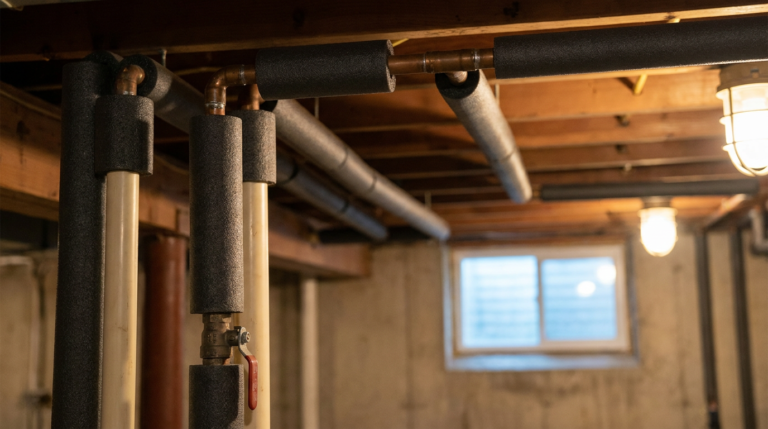
Insulating a water heater tank is one. DOE states that a tank blanket reduces standby heat losses by 25 to 45 percent and saves 7 to 16 percent on water heating costs, with another 4 to 9 percent from insulating underneath an electric tank. DOE warns not to set the thermostat above 130 degrees F on an electric water heater fitted with a blanket, because the wiring may overheat. Do not blanket a gas water heater without following the manufacturer’s instructions on clearances to the burner and flue.
The other is annual heating system service before the season starts. It matters less for efficiency than the marketing suggests, and a great deal for a cracked heat exchanger, a blocked flue or a carbon monoxide problem you would otherwise meet in January.
Where these figures come from
The 15 percent heating and cooling savings estimate, the 11 percent whole-bill figure, the 25 percent infiltration reduction assumption, the 2012 IECC insulation target, the 1970 to 1989 model home and the 5 to 18 percent climate zone range come from the EPA ENERGY STAR methodology for estimated savings from sealing and insulating. Attic leak site priorities, the plug-the-big-holes-first guidance, the sealing-before-insulating sequence and the cost estimates come from ENERGY STAR’s attic air sealing project guidance; the 20 to 30 percent duct loss figure from ENERGY STAR duct sealing guidance. Weatherization Assistance Program figures, including 7.2 million families since 1976, about 32,000 homes a year and average savings of $372, come from the US Department of Energy, with the $4,695 average cost per unit from the DOE WAP fact sheet of June 2022. Water heater insulation savings come from DOE Energy Saver. The section 25C and 25D termination dates come from IRS guidance on Public Law 119-21, enacted 4 July 2025. Home Energy Rebates status comes from the Building Performance Association state factsheet dated June 2026. Register closing measurements come from Iain Walker, Register Closing Effects on Forced Air Heating System Performance, Lawrence Berkeley National Laboratory, November 2003.
General information, current as of September 2026, and not personalised advice.
Frequently asked questions
What is the single best task if I only do one?
Seal and weatherstrip the leaky doors and the attic hatch. It is cheap, permanent, and improves comfort immediately along with the bills.
Do window insulation film kits work?
Yes, meaningfully, on single-pane and drafty windows. The shrink film adds an insulating air layer for a few dollars per window and comes off cleanly in spring.
Is closing vents in unused rooms a good idea?
Generally no. Forced-air systems are balanced for the whole house, and closing vents raises duct pressure, which can reduce efficiency and stress the blower.