The Bureau of Labor Statistics put painters median pay at $23.75 an hour in May 2025, yet labour is 60 to 90 percent of a room-painting quote because preparation, not rolling, dominates the hours.
The short version: For a typical 12 by 14 foot bedroom with 8 foot ceilings, you are buying about 366 square feet of paintable wall, which needs roughly two gallons for two coats. Doing it yourself costs about $300 to $400 in materials the first time and 14 to 17 hours of actual work. Hiring it out runs roughly $300 to $1,000 for walls only and $600 to $2,000 with ceiling and trim, according to the 2026 HomeGuide cost guide. The reason for that gap is not the paint. The Bureau of Labor Statistics put the median wage for painters in construction and maintenance at $23.75 an hour as of May 2025, and Angi’s 2026 guide estimates labor at 60 to 90 percent of a painting job’s cost. Within that labor, preparation dominates. Rolling paint on a wall is the fastest part of the job.
Measuring the room and doing the coverage arithmetic
Almost every bad paint estimate starts with a bad area calculation. The method is simple and worth doing properly.
Paintable wall area
Measure the perimeter of the room, multiply by ceiling height, then subtract openings. For a 12 by 14 foot room, the perimeter is 52 feet. At 8 feet high that is 416 square feet of gross wall. Subtract a standard door at about 20 square feet and two 3 by 5 foot windows at 15 square feet each, and you have 366 square feet of paintable wall. The ceiling, if you are painting it, is a separate 168 square feet.
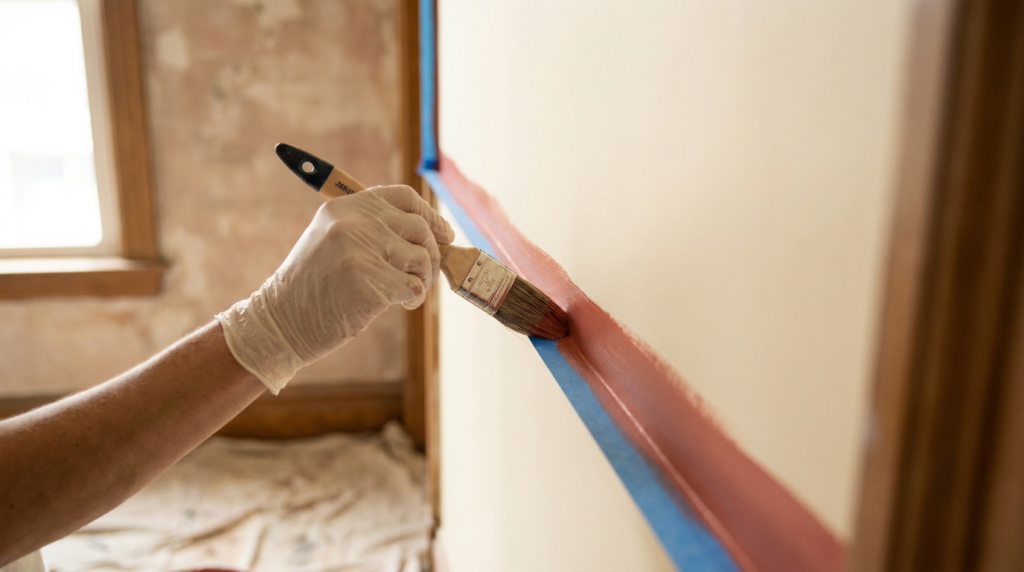
Do not subtract openings smaller than a door individually. The rule of thumb among estimators is to deduct doors and windows and ignore everything else, because the extra cutting-in around small obstructions consumes the paint you would have saved.
Label coverage versus real coverage
Manufacturers typically state 350 to 400 square feet per gallon, and the Angi 2026 guide cites 300 to 400 square feet. That figure assumes a smooth, sealed, previously painted surface and an experienced hand with a roller. It drops sharply on bare or new drywall, which drinks the first coat, on heavily textured walls such as knockdown or orange peel, where the effective surface area is larger than the measured area, and on unprimed patched areas, which flash differently.
For the bedroom above, two coats over 366 square feet is 732 square feet of coverage. At the optimistic 400 figure that is 1.8 gallons; at a realistic 350 it is 2.1 gallons. Buy two gallons and expect to want a quart in reserve. Buying a third full gallon to be safe is how people end up with a basement shelf of half-used paint.
Materials, and why the prices move
Paint pricing is regional and genuinely volatile, and there is a primary source that shows it. The Bureau of Labor Statistics producer price index for paint and coating manufacturing stood at 300.4 in January 2020 and 450.0 in August 2026 on its June 1983 base, a rise of roughly 50 percent over that period. Year on year it moved from 426.1 in August 2025 to 450.0 in August 2026, about 5.6 percent. Any per-gallon figure you read has a shelf life.
On retail prices, a survey published by the painting contractor Carolina ReNew recorded listed prices from manufacturer and big-box retailer websites on 15 August 2026 in the Charlotte area: builder and contractor grade lines from about $18 to $24 a gallon, mid-tier from about $30 to $85, and premium lines from about $101 to $131, with a median across 30 interior lines of $52.98. HomeGuide’s 2026 guide gives a wider band of $15 to $50 for latex and $15 to $30 for primer. The spread is real, not measurement error: a paint-store gallon and a big-box gallon are different products at different prices.
A worked DIY materials list for the example bedroom
| Item | Quantity | Typical 2026 cost |
|---|---|---|
| Wall paint, mid-tier interior latex | 2 gallons | $60 to $170 |
| Ceiling paint, flat white | 1 gallon | $25 to $45 |
| Trim enamel | 1 quart | $18 to $35 |
| Stain-blocking primer (if needed) | 1 gallon | $15 to $30 |
| Painter’s tape | 2 rolls | $12 to $20 |
| Canvas drop cloths | 2 | $30 to $50 |
| Roller frame, covers, tray, liners | Set | $30 to $50 |
| Angled sash brush, 2.5 inch | 1 | $15 to $25 |
| Extension pole | 1 | $15 to $30 |
| Spackle, sanding sponge, caulk and gun | Set | $25 to $40 |
| Total | $245 to $495 |
Roughly $110 of that is reusable tooling you buy once. The second room costs meaningfully less than the first.
Sheen
Flat and matte hide surface defects best and clean worst. Eggshell and satin are the usual choice for bedroom and living room walls, tolerating a wipe without throwing light across every imperfection. Semi-gloss and gloss belong on trim, doors and bathrooms. The cost implication is direct: the higher the sheen, the more visible your patching, so choosing satin over flat quietly raises the prep hours required to get an acceptable result.
The labor side, and the misconception about where money goes
The widespread assumption is that a painting quote is mostly the paint, with a markup. It is not, and the numbers say so. Angi’s 2026 guide puts labor at 60 to 90 percent of total project cost and quotes painter rates of $20 to $50 an hour; HomeGuide gives the same $20 to $50 band for painters and $50 to $80 for handymen.
Note the gap between those rates and what a legitimate crew must charge. The Bureau of Labor Statistics reported a median wage of $23.75 an hour, or $49,400 a year, for painters in construction and maintenance as of May 2025, across about 326,900 jobs. That is the painter’s take-home rate. Add payroll taxes, workers compensation, liability insurance, vehicles, and unbillable time between jobs, then overhead and profit, and the billable rate a licensed and insured company needs is typically two to three times the wage. When a quote lands well below that arithmetic, something has been left out of the scope, the insurance, or both.
Prep dominates, not rolling
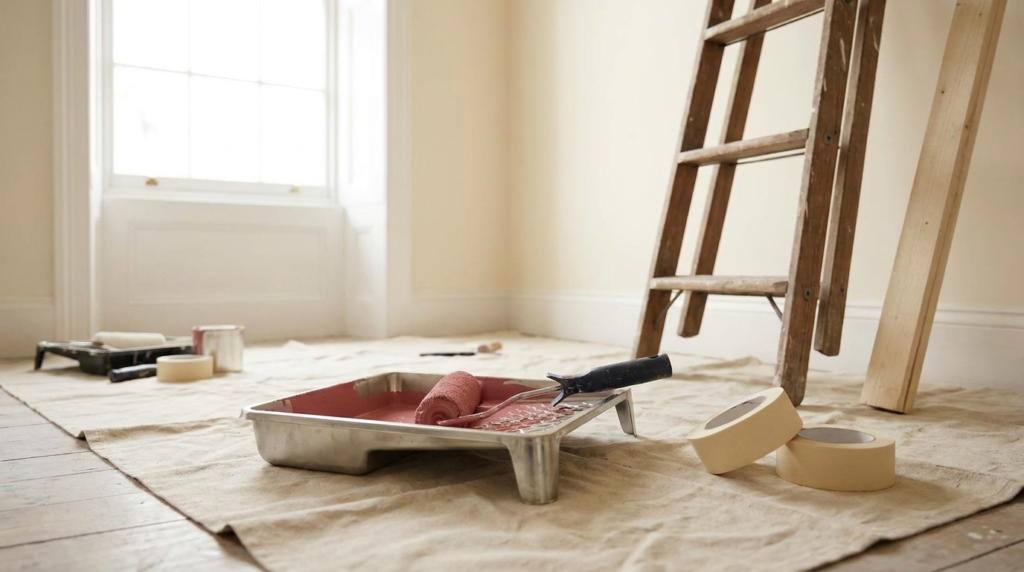
For the example bedroom, a realistic DIY breakdown is four to six hours moving and covering furniture, patching, sanding, caulking and masking; four to five hours cutting in and rolling two coats on the walls; about two hours on the ceiling; three hours on trim; and an hour of cleanup. That is 14 to 17 hours. Only a third of it involves putting paint on a wall. A professional crew is faster, but the ratio is similar, which is why quotes scale with condition rather than square footage.
Put those two sides together and the DIY saving is clearer than the usual framing suggests. Roughly $300 in materials against a $700 mid-range quote leaves about $400 saved across 15 hours, or a little under $27 an hour of your own weekend, before you account for the mistakes a first-timer makes and the fact that you own the result either way. That is a reasonable trade for many people and a poor one for others, which is the honest answer. It is not a poor trade on the second and third rooms, where the tooling is already bought and the hours drop.
Primer: necessary, and upsold
Primer is genuinely required on new or bare drywall, bare wood, glossy or slick surfaces, water stains, smoke damage, and after significant patching. It is also the right answer for a dramatic color change, particularly going from a deep saturated color to a light one, where a tinted gray primer will save you a third coat of expensive finish paint. It is not required when you are repainting a sound, clean, previously painted wall in a similar color with a quality self-priming paint. If a quote includes full-wall priming on an intact repaint in a near-identical shade, ask what it is for.
The cost drivers people underestimate
Ceiling height is the big one: above about 10 feet you move from a pole and a step stool to staging or ladders, and the time cost is more than proportional. Trim complexity is next, since crown molding, chair rail, six-panel doors and divided-light windows are all hand-brushed; HomeGuide puts trim at $1 to $4 per linear foot. Wallpaper removal at $0.80 to $3.00 per square foot can exceed the cost of the painting itself, and often reveals damaged drywall paper underneath. Drywall repair, dark-to-light color changes needing three coats, and unpainted closets discovered mid-job all land in the same category. HomeGuide also notes minimum project fees of $250 to $500 or more, which is why a single small room rarely gets a proportionate price.
The decision rule: do it yourself if the ceilings are 8 or 9 feet, the walls are sound, there is no wallpaper, and you are not making a drastic color change. Hire it out if any one of these is true: ceilings above about 10 feet, wallpaper to strip, significant drywall repair, or a home built before 1978 where painted surfaces will be disturbed. That last condition is regulatory, not aesthetic. The Environmental Protection Agency’s Renovation, Repair and Painting Rule, in effect since April 2010, requires firms working on pre-1978 housing that disturbs painted surfaces to be certified and to use lead-safe work practices.
Reading and comparing quotes
Aggregator averages are a sanity check, not a budget. Angi’s 2026 guide puts the average room at around $1,100 with a $200 to $2,000 range and quotes $2 to $6 per square foot; HomeGuide gives $300 to $1,000 for walls only, $600 to $2,000 including ceiling and trim, and $1 to $3 per square foot of surface area. Those per-square-foot figures are not measured on the same basis, which is exactly the problem with comparing quotes by rate.
Compare scope instead. A written quote should state the number of coats, what surfaces are included, whether ceilings and trim are in or out, the specific product line and sheen, what patching and caulking is included and what counts as an extra, how furniture and floors will be protected, and who supplies materials. A low bid usually omits one of these: it is one coat rather than two, or trim is excluded, or “prep” means a quick dust rather than filling and sanding, or the crew is uninsured. Ask for a certificate of insurance and a workers compensation certificate directly from the insurer, not a photocopy, and get three quotes on the same written scope so the numbers are actually comparable.
Where these figures come from
Wage and employment data are from the Bureau of Labor Statistics Occupational Outlook Handbook entry for painters, construction and maintenance, reflecting May 2025 median pay of $23.75 an hour and $49,400 a year across about 326,900 jobs. Paint price movement is from the Bureau of Labor Statistics producer price index for paint and coating manufacturing, June 1983 base, readings for January 2020, August 2025 and August 2026. Retail per-gallon prices are from a price survey published by the painting contractor Carolina ReNew, recording listed prices on 15 August 2026 in the Charlotte area, which is a contractor survey rather than a government series. Project cost bands, coverage rates, trim and wallpaper removal rates and minimum project fees are from the 2026 HomeGuide and Angi cost guides, which are consumer marketplace aggregators reporting their own contractor data, not independent measurement. Lead-safe work requirements are from the Environmental Protection Agency Renovation, Repair and Painting Rule, in effect since April 2010.
General information, current as of September 2026, and not personalised advice. Material and labour prices vary widely by region and change quickly; get local quotes before budgeting.
Frequently asked questions
How much paint do I need?
A gallon typically covers roughly 350 to 400 square feet in one coat, per manufacturer guidance printed on the can. Measure wall length times height, subtract large openings, and plan for two coats.
Is it worth painting the ceiling at the same time?
If the ceiling shows stains or the room has not been painted in many years, yes. Doing it later means re-taping and re-covering the entire room a second time.
Do I need to prime every time?
No. Prime over bare drywall, patches, stains, glossy surfaces, and dramatic color changes. A quality paint-and-primer product handles ordinary repaints in a similar color.