The risk does not peak with infant seats. Federal data shows half of children aged 8 to 12 killed in crashes were unrestrained. The four stages, the installation errors found most often, and a five-point test for leaving the booster.
The single most useful fact about child car seats is that the risk does not peak where parents think it does. Infant seats get installed carefully, checked by a technician, and photographed. The dangerous years are seven to twelve, when the booster gets abandoned early, the child rides with an adult seat belt that does not fit, and nobody is taking photographs any more.
The Centers for Disease Control and Prevention, citing 2023 observational data, reports that less than 4 percent of children under age 1 were not buckled up, 6 percent of children aged 1 to 3, 13 percent of children aged 4 to 7, and 16 percent of children aged 8 to 12. The same pattern shows up far more starkly in fatal crash data for 2023: among children killed in crashes, 27 percent of those aged 0 to 3 were not buckled up, 37 percent of those aged 4 to 7, and 50 percent of those aged 8 to 12.
This article covers the four stages and the criterion for moving between them, the installation errors that the national misuse study found most often, and the test for when a child is actually ready for a seat belt.
The scale of the problem, in federal numbers
The National Highway Traffic Safety Administration’s Traffic Safety Facts publication for 2024 data reports that of the 39,254 traffic fatalities in the United States that year, 1,032, or 3 percent, were children aged 14 and younger. An estimated 160,850 children were injured in traffic crashes in 2024.
Of the 677 child passenger vehicle occupants killed in traffic crashes that year, restraint use was known for 585, and of those, 229, or 39 percent, were unrestrained.
The effectiveness numbers are what make that figure painful. NHTSA reports that child safety seats reduce fatal injury by 71 percent for infants under 1 year old in passenger cars and by 54 percent for toddlers aged 1 to 4 in passenger cars. In light trucks the corresponding reductions are 58 percent and 59 percent. A correctly used seat roughly halves to two-thirds the chance of a child dying in a crash that kills people, which is a larger single-intervention effect than almost anything else available in a car.
The four stages, and the criterion for leaving each one
Every stage transition is a downgrade in protection. A forward-facing harness protects less than rear-facing. A booster protects less than a harness. A seat belt alone protects less than a booster. The rule that follows from that is to stay in each stage until the child exceeds its limits, not until a birthday arrives.
The Centers for Disease Control and Prevention sets out the stages as follows. Rear-facing from birth until age 2 to 4, buckled in a rear-facing seat with a harness until the child reaches the maximum weight or height limit of that seat. Forward-facing with a harness after outgrowing the rear-facing seat and until at least age 5. A booster seat after outgrowing the forward-facing seat and until the seat belt fits properly, which usually occurs when children are aged 9 to 12. Then the seat belt. And throughout: keep children properly buckled in the back seat until age 13.
NHTSA frames the same progression by age ranges: rear-facing from birth to 3, forward-facing from 1 to 7, booster from 4 to 12, and seat belt from 8 and up. The ranges overlap deliberately, because the deciding factor is the child’s size against the seat’s stated limits rather than their age.
| Stage | Typical span | Leave it when | Most common misuse found in the national study |
|---|---|---|---|
| Rear-facing with harness | Birth to age 2 to 4 | The child exceeds the seat’s stated maximum height or weight for rear-facing use, not when their feet touch the seat back | Incorrect recline angle: 16 percent of rear-facing infant seats, 12 percent of rear-facing convertibles |
| Forward-facing with harness and top tether | Roughly age 1 to 7, until at least age 5 | The child exceeds the harness height or weight limit printed on the seat | Loose installation: 17 percent of forward-facing seats |
| Belt-positioning booster | Roughly age 4 to 12 | The adult lap and shoulder belt fits correctly without it, usually at age 9 to 12 | Improper lap belt position: 9 percent of highback boosters, 12 percent of backless |
| Seat belt alone, back seat | From the point the belt fits | Front seat from age 13 | Unbuckled: 16 percent of children aged 8 to 12 observed in 2023 |
On rear-facing specifically: bent legs and feet braced against the vehicle seat back are not a reason to turn a child around. Children sit cross-legged comfortably and leg injuries in rear-facing crashes are not the concern. The seat’s own printed limits are the criterion.
Installation, where nearly half of seats fail
NHTSA’s National Child Restraint Use Special Study, published in June 2015 as DOT HS 812 157 from field data collected between June and August 2011, estimated overall misuse at 46 percent. That study is the most recent national measurement of its kind, and while it is now over a decade old, the categories of error it identified have not changed, because they follow from how the hardware works.
Four rules carry most of the weight.
Lower anchors or the seat belt, never both
NHTSA is explicit: every car seat needs to be installed using either the lower anchors or a seat belt to secure it in place, never both. Using both is a common instinct and it is wrong, because the two systems load the seat differently in a crash and the combination is not what either was tested for.
The lower anchor weight limit, which almost nobody knows about
Lower anchors have a combined weight limit. NHTSA states the formula directly: the lower anchor weight limit equals 65 pounds minus the weight of the car seat.
So a 25 pound convertible seat on lower anchors is rated for a child up to 40 pounds. Above that, the installation must switch to the vehicle seat belt. A heavy seat with a growing child is the usual way families end up over the limit without ever being told there was one. The number is printed in both the car seat manual and the vehicle manual; check it when the child passes about 35 pounds.
Use the top tether forward-facing
The top tether is the strap that runs from the top of a forward-facing seat to an anchor point behind or above the vehicle seat. It limits how far the seat and the child’s head pitch forward in a frontal crash. It is frequently left unused because the anchor is hidden under a flap, behind a seat back, or on the rear shelf, and because the seat feels tight without it. Forward-facing installations without a tether are a known weak point. Find the anchor in the vehicle manual and use it.
Check for movement at the belt path
Grip the seat at the belt path, where the belt or lower anchor strap passes through the seat shell, and pull. The industry standard is that it should not move more than an inch side to side or front to back. Testing by grabbing the top of the seat shell is misleading, because plastic flexes; the belt path is where the installation either holds or does not.
And on harness fit: rear-facing, the harness straps should come from slots at or just below the child’s shoulders; forward-facing, at or just above. The chest clip belongs at armpit level, because its job is to position the straps, not to restrain the body. Straps should be tight enough that you cannot pinch a horizontal fold of webbing at the collarbone.
The test for leaving the booster
This is the decision where the most protection gets given up earliest, usually because a nine-year-old finds the booster embarrassing and the parent concludes the child is big enough.
The Centers for Disease Control and Prevention defines proper seat belt fit precisely: the lap belt lies across the upper thighs, not the stomach, and the shoulder belt crosses the center of the shoulder and chest.
Here is a readiness check built from that definition, to run in the actual vehicle the child rides in, with the booster removed. All five have to be true at once.
- The child sits all the way back against the vehicle seat back, without slouching forward to get comfortable.
- The knees bend naturally at the front edge of the seat cushion, with the lower legs hanging down rather than sticking straight out.
- The lap belt lies flat across the tops of the thighs or the hip bones, and not across the soft part of the abdomen.
- The shoulder belt crosses the middle of the shoulder and the center of the chest, not the neck and not the upper arm.
- The child can hold that position for the whole journey, including while asleep, without sliding down or pushing the shoulder belt behind their back.
A child who fails any one of these is safer in a booster, and the fifth item is the one that fails most often in practice. Note also that the test is vehicle-specific: a child may pass in a car with a short seat cushion and fail in one with a deep cushion or a high belt anchor, so a child can genuinely need a booster in one family car and not the other.
The reason the lap belt position matters so much is mechanical. Across the hips, the belt loads the pelvis, which is strong bone. Across the abdomen, it loads soft tissue and the lumbar spine. That is the specific injury pattern a booster exists to prevent, and it is why “the belt reaches around him” is not the same as “the belt fits him”.
Buying decisions that actually matter
Car seats sold in the United States must meet the same federal safety standard, which means the cheapest compliant seat passes the same crash test as the most expensive one. Price buys convenience: easier installation, better fabrics, longer harness limits, no-rethread harness adjustment, a load leg.
That has a direct implication. A moderately priced seat that you install correctly every time beats an expensive seat that is awkward in your specific vehicle. The decisive question when buying is whether it fits your car and whether you can get a solid installation in under five minutes, because a seat that is hard to install is a seat that eventually gets installed badly.
Four other considerations:
- Register the seat. Fill in the card or register online with the manufacturer, who can then contact you directly about recalls and safety notices. Car seats are recalled reasonably often and there is no other route by which the notice reaches you. This is the same habit worth applying to the vehicle itself, since checking a car for open recalls takes a few minutes and most owners never do it.
- Respect the expiration date. Seats carry a manufacture date and a useful life stamped on the shell, typically six to ten years depending on the maker. Plastic degrades with heat cycling, and standards change. An out-of-date seat is not a bargain.
- Be careful with used seats. A used seat is acceptable only when you know its full history, it has never been in a crash, it is not expired, it has all its original parts and labels, and it is not subject to an open recall. If you cannot verify all five, do not use it. NHTSA publishes a used car seat safety checklist covering exactly this.
- Skip aftermarket accessories. Strap covers, head supports, seat protectors and inserts that did not come with the seat were not crash-tested with it. If the manufacturer did not supply it, it does not belong in the belt path or against the harness.
Two seasonal mistakes
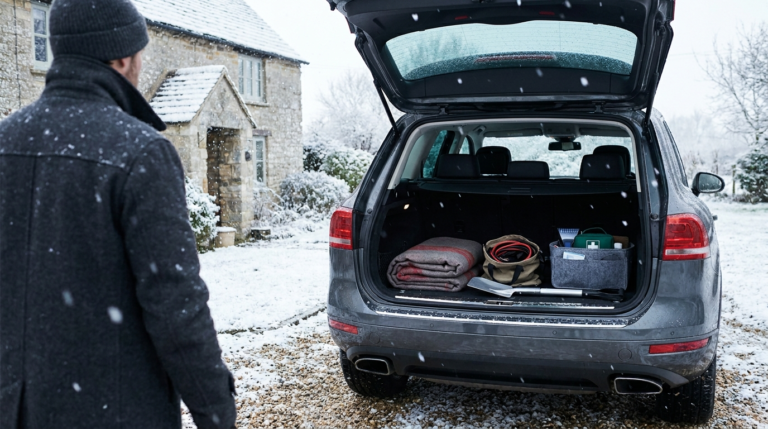
Bulky winter coats are the first. A thick coat compresses in a crash, which leaves slack in a harness that felt tight when it was buckled. The fix is to harness the child in indoor clothing, tighten properly, and then lay the coat over the top of the buckled harness, or put it on backwards over the straps. This belongs on the same list as the rest of the winter driving preparation worth doing before the first freeze.
The second is heat. A seat left in a closed car in summer reaches temperatures that can burn skin on buckles and metal parts, and a dark towel over the seat when parked prevents it. More seriously, children die in hot cars every year, and the mitigation is behavioural rather than technical: put something you cannot leave behind, a phone or a work badge, in the back seat next to the child, every single time.
Get it checked, and the honest limits of that
Certified child passenger safety technicians inspect and correct installations, usually free, at fire stations, hospitals, health departments and police stations. NHTSA maintains a directory of inspection stations by location. For a first seat, or the first forward-facing installation, or a new vehicle, this is twenty minutes well spent and it is the most reliable way to discover you have been doing something wrong.
What a technician cannot do is make the next five years easy. The reason misuse runs near half is not that parents do not care; it is that correct use requires re-reading limits every few months, re-tightening a harness after every coat change, and holding a line about the booster against a child who does not want one. The checks drift. The stages get rushed.
So the realistic goal is not perfection. It is to get the three highest-stakes things right consistently: the seat is actually tight at the belt path, the harness is actually snug against the child rather than against a coat, and the child stays in the stage they still need rather than the one they have outgrown socially. The federal data says the last of those is where most of the remaining risk now sits, and it is the one no inspection station can fix for you.
Where these figures come from
- National Highway Traffic Safety Administration, Traffic Safety Facts, 2024 Data: Children
- National Highway Traffic Safety Administration, Car Seats and Booster Seats guidance
- National Highway Traffic Safety Administration, Results of the National Child Restraint Use Special Study, DOT HS 812 157, June 2015
- Centers for Disease Control and Prevention, Child Passenger Safety: About, and Risk Factors for Child Passengers
General information, current as of October 2026, and not a substitute for your car seat and vehicle owner manuals. Follow the manufacturer’s stated limits, check your state’s law, and have the installation inspected by a certified child passenger safety technician.