Tread depth, tire pressure, battery and glass carry almost all the winter safety benefit, and the dashboard warning light is not the check you think it is.
The honest answer: four things carry almost all of the winter safety benefit, and all four fit into one afternoon. Tread depth, tire pressure, battery condition, and glass you can see through. Everything else on the usual checklist is either a refinement or a myth that survived because it sounds sensible.
The National Highway Traffic Safety Administration cites 2023 figures of 320 fatal crashes and 22,293 injury crashes during snow or sleet. Winter crashes are mostly about a vehicle that could not stop or turn in the distance available, which is a tire and visibility problem first.
Start with tread depth
NHTSA states that tires should be replaced when the tread is worn to 2/32 of an inch, and describes the penny test: insert a penny with Lincoln head upside down and facing you, and if the top of the head is visible, the tire needs replacing.
That is the regulatory floor, not the winter threshold. AAA research published in 2018 compared tires worn to 4/32 of an inch against new tires and found wet stopping distance increased by an average of 87 feet for a passenger car and 86 feet for a light truck, about 43 percent. A vehicle on worn tires braking from 60 mph was still doing roughly 40 mph where the one on new tires had stopped. AAA recommends replacing at 4/32.
The decision rule: measure all four tires with a tread depth gauge at the outer edge, center and inner edge. If any tire reads 4/32 of an inch or less anywhere across its width, replace it before winter. If it reads 4/32 to 6/32, it will likely need replacing before spring, so buy now rather than during a storm week.
While the gauge is out, inspect sidewalls for cuts, bulges and cracks, as NHTSA advises. Check age too: NHTSA notes that some manufacturers recommend replacing tires six to ten years old regardless of tread wear, and that the last four digits of the Tire Identification Number give the week and year of manufacture.
Winter tires, without the sales pitch
Winter tires are not mainly about tread pattern. They are about a rubber compound that stays flexible at low temperature, where all-season compounds stiffen and lose grip. The industry commonly cites about 45 degrees Fahrenheit as the crossover point, though that is a rule of thumb rather than a measured threshold. Tires certified for severe snow service carry a three-peak mountain and snowflake symbol. Whether the swap pays depends on how many weeks the roads are cold, not on snowfall.
Tire pressure: the cheapest job of the afternoon
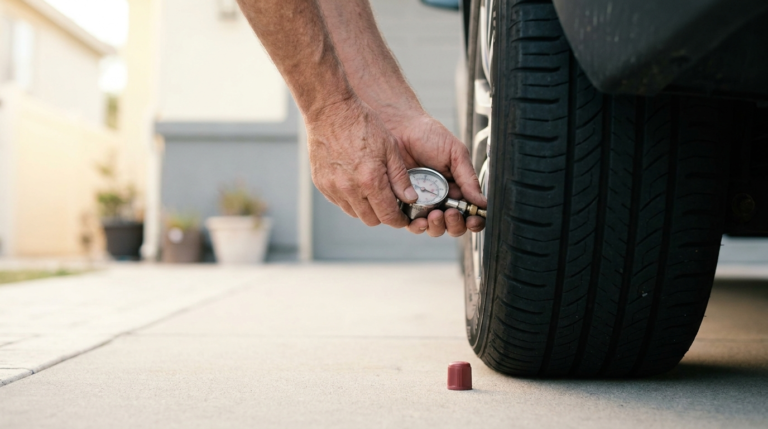
NHTSA advises filling tires to the manufacturer specification in the owner manual or on the door frame label, not the maximum molded into the sidewall, and checking monthly when the tires are cold, meaning not driven for three or more hours.
Cold makes this urgent rather than routine. AAA states that for every 10 degree drop in temperature tires can lose about 1 psi, within a broader range of 1 to 2 psi per 10 degrees Fahrenheit. Tire Rack expresses the same physics as roughly a 2 percent change per 10 degrees, about 1 psi for a typical passenger car tire.
The worked example: why the warning light is not enough
Take a vehicle with a placard pressure of 35 psi, set correctly on an autumn day at 70 degrees Fahrenheit.
- A cold morning at 10 degrees Fahrenheit is a 60 degree drop.
- At roughly 1 psi per 10 degrees, that is about 6 psi lost.
- The tire is now at about 29 psi, which is roughly 17 percent below placard.
Now look at what triggers the dashboard warning. Under Federal Motor Vehicle Safety Standard No. 138, the low tire pressure telltale must illuminate within 20 minutes when a tire is 25 percent or more below the manufacturer recommended cold inflation pressure. Twenty-five percent below 35 psi is 26.25 psi.
So the tire at 29 psi is meaningfully underinflated and the warning light is not required to come on. The tire pressure monitoring system is a blowout-prevention backstop, not a maintenance tool. Use a gauge.
The corollary: when the light comes on during the first hard cold snap, it is usually reporting real underinflation, not malfunctioning. Inflate rather than resetting and ignoring.
Battery: less supply, more demand, at once
NHTSA notes that in cold weather gasoline and diesel engines take more battery power to start. AAA puts numbers on it: at zero degrees Fahrenheit a car battery loses about 60 percent of its power, while a cold engine needs roughly twice the current to start. AAA gives a typical lifespan of three to five years, closer to three as vehicles carry more electronics, and reports that dead batteries drive the largest share of cold-weather roadside calls.
Less capacity and more demand at once is why batteries fail in January. The cold did not break the battery. It exposed one already weak in September.
The afternoon job: have the battery, charging system and belts inspected, as NHTSA recommends. Most auto parts retailers load-test a battery free in minutes, and that tells you what a visual check cannot. If the battery is four years old or more and tests marginal, replace it on your schedule rather than the weather schedule.
Electric vehicle drivers should plan around range instead. Department of Energy and Environmental Protection Agency guidance reports range falling roughly 41 percent in mixed driving at 20 degrees Fahrenheit compared with 77 degrees. Precondition the cabin while still plugged in.
Glass, wipers and washer fluid
NHTSA advises replacing worn wiper blades and filling the reservoir with high quality winter fluid containing de-icer before winter arrives, and suggests heavy-duty blades in snowy regions. Washer fluid is sold with different freeze ratings, and summer fluid turns to slush exactly when a passing truck coats the windshield in salt spray, so buy fluid rated well below the coldest temperature you expect and run the old fluid down first. Replace blades that chatter or streak: a blade smearing salt film in low winter sun removes forward visibility for seconds.
The National Weather Service is blunt about the related habit: make sure the vehicle is completely clear of ice and snow before starting. That means windshield, windows, mirrors, lights and roof. Snow on the roof slides forward onto the windshield under braking, which is the moment you need to see most.
Never pour hot water on a frozen windshield. The thermal shock can crack glass, and the water refreezes into a harder layer than the frost you started with. Use a scraper and the defroster.
The warm-up idle myth
The widely repeated advice to let a modern car idle for five or ten minutes before driving is wrong, and the reason matters.
Department of Energy and Environmental Protection Agency fuel economy guidance states that warming up a vehicle before a trip lowers fuel economy, because idling gets zero miles per gallon, and that most manufacturers recommend driving off gently after about 30 seconds. The engine warms faster while being driven, bringing cabin heat on sooner and cutting fuel cost and emissions.
The advice made sense for carbureted engines, which ran badly until warm. Fuel injection has handled cold starts for decades. What is true: the first 30 seconds let oil pressure establish, and the first few miles should be driven gently until the temperature gauge moves. That warms engine, transmission, tires and brakes together. Idling warms only the engine, slowly, while burning fuel.
The same guidance explains a related complaint: fuel economy for a gasoline car is about 15 percent lower at 20 degrees Fahrenheit than at 77 degrees in city driving, short trips of three to four miles can be 24 percent worse, and hybrids 30 to 34 percent worse. That is chemistry, not a fault.
There is one exception, and it is a safety rule rather than a mechanical one. If the vehicle is stranded in snow, NHTSA advises clearing the exhaust pipe and running the engine only sporadically, never for long periods with the windows up. The National Weather Service is more specific: stay in the vehicle, run the motor about ten minutes each hour, open a window slightly for fresh air, and clear snow from the exhaust pipe to avoid carbon monoxide poisoning. After the snow stops, raise the hood to signal for help.
What actually belongs in the kit
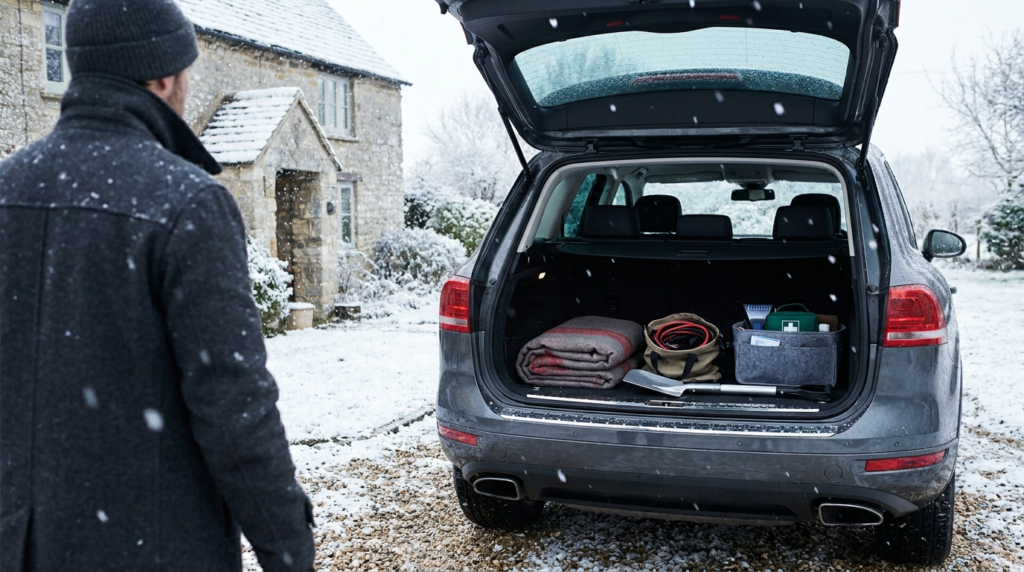
NHTSA lists snow shovel, broom, ice scraper, sand or kitty litter, jumper cables, flashlight, flares or markers, a first aid kit including a tourniquet, blankets, phone and charger, water, food and medicine. The list is short because it is built around one scenario: stationary in the cold for hours with no help nearby.
| Item | What it is for | Note |
|---|---|---|
| Blankets, hat, gloves, warm layer | Staying warm with the engine off | The core of the kit |
| Phone charger or power bank | The charged phone the NWS calls the lifeline | Check it works |
| Ice scraper and snow brush | Clearing all glass before moving | Used most often |
| Small shovel | Clearing the exhaust pipe and wheels | Safety-critical |
| Sand or cat litter | Traction under a spinning wheel | Cheap, effective |
| Jumper cables or jump pack | The commonest cold failure | Learn the order |
| Flashlight | Roadside work in the dark | Check batteries yearly |
| Water, food, medicine | Long waits, prescriptions | Rotate food each autumn |
| Flares or reflective markers | Being seen by other traffic | Rural and fast roads |
| First aid kit | Injury before help arrives | Include a tourniquet |
Two more NHTSA points get overlooked. Floor mats should be correctly fitted and secured with the manufacturer retention clips, because a mat that slides forward can foul the accelerator or brake pedal. And heavy coats interfere with harness fit in a child car seat: use thin layers, secure the harness, then add the coat.
Two more myths worth retiring
- Letting air out of tires improves winter traction. It does not meaningfully help on snow and it degrades handling, braking and tire life. NHTSA guidance is to inflate to the manufacturer specification, and cold already pushes pressure down without help.
- All-wheel drive makes a vehicle safe in winter. It helps a vehicle accelerate from rest and does nothing for braking distance or cornering grip, both decided by the tires. A confident start out of the driveway on tires worn to 3/32 of an inch sets up an uncontrolled stop later.
The afternoon, in order
- Measure tread depth on all four tires and inspect sidewalls and date codes.
- Check cold pressures with a gauge against the door frame placard, spare included.
- Have the battery load-tested, and the charging system and belts inspected.
- Replace chattering or streaking wiper blades and refill with winter-rated fluid.
- Restock the kit, check flashlight batteries and rotate the food.
- Check floor mats are correctly fitted and clipped.
Where these figures come from
- National Highway Traffic Safety Administration, Winter Weather Driving Tips and TireWise guidance
- Federal Motor Vehicle Safety Standard No. 138
- AAA, Tread Lightly research on worn tire stopping distance, 2018
- AAA, guidance on tire pressure and temperature, and on cold weather batteries
- Tire Rack, technical guidance on temperature and inflation pressure
- United States Department of Energy and Environmental Protection Agency, Fuel Economy in Cold Weather
- National Weather Service, winter weather safety and wind chill guidance
One thing this checklist does not fix
A well-prepared vehicle shortens stopping distances and keeps you comfortable if you get stuck. It does not make an icy road safe, and National Weather Service advice for hazardous winter weather still begins with staying off the roads when possible. At zero degrees Fahrenheit with a 15 mph wind, the wind chill is minus 19 degrees, at which exposed skin freezes in 30 minutes.
An afternoon of preparation buys margin, not immunity. The driver who does all six items above and then drives 55 mph on packed snow has spent that margin before leaving the neighborhood.
General information, current as of September 2026, and not personalised advice.
Frequently asked questions
Do all wheel drive cars need winter tires?
AWD helps you accelerate; it does not help you stop or corner on ice. Braking grip comes from rubber, which is why winter tires transform safety in snow climates regardless of drivetrain.
What belongs in a winter emergency kit?
Jumper cables or a jump pack, blanket, gloves and hat, flashlight, phone charger, ice scraper, small shovel, traction aid like sand or litter, water, snacks, and any critical medications.