Berkeley Lab measured under 5 percent system energy penalty for MERV 10 to 13 filters, with the 20 percent penalties confined to MERV 16 in leaky, heavily loaded systems.
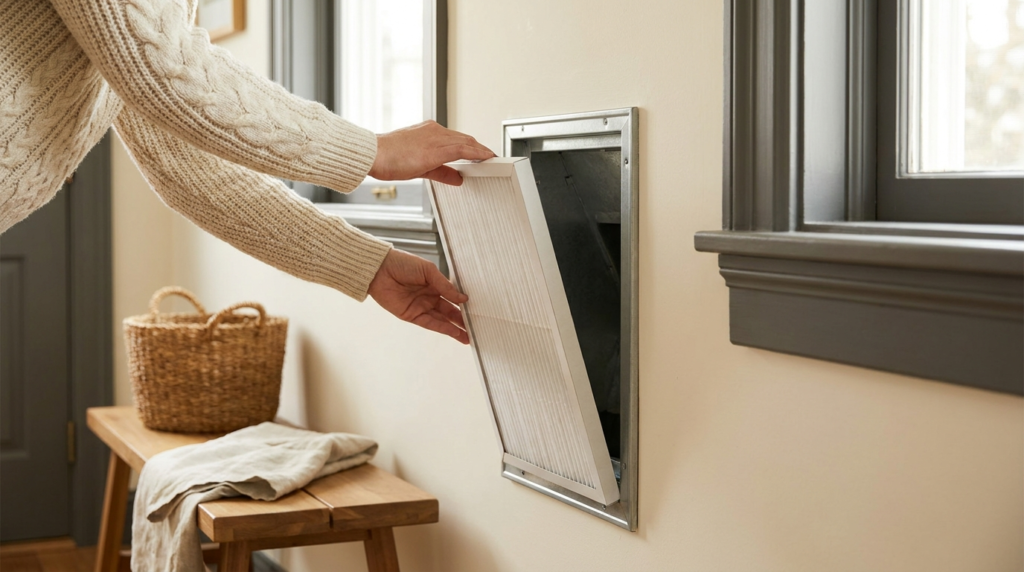
The short version: The filter in your furnace or air handler was put there to protect the equipment, not your lungs. Air quality is a genuine secondary benefit and for many households a valuable one, but the ordering explains almost everything confusing about filter advice, including why a cheap filter is sometimes the right answer. The MERV scale, defined under ASHRAE Standard 52.2, is the only rating that means the same thing on every box. MPR and FPR are private scales owned by a manufacturer and a retailer respectively and are not directly comparable to each other or to MERV. The fear that a higher-MERV filter will damage your system is real at the top of the scale and substantially overstated in the middle of it, and federal laboratory measurements exist to say so.
What the filter is actually for
A forced-air system pulls a large volume of household air across a heat exchanger or an evaporator coil several times an hour. Without filtration, the dust in that air settles on surfaces where it does specific damage: it insulates the coil so heat transfer drops, it packs into the fins so airflow drops, it collects on the blower wheel so the fan moves less air for the same power, and it accumulates in the ductwork. A coil that has been fouled for years cannot be restored by cleaning alone.
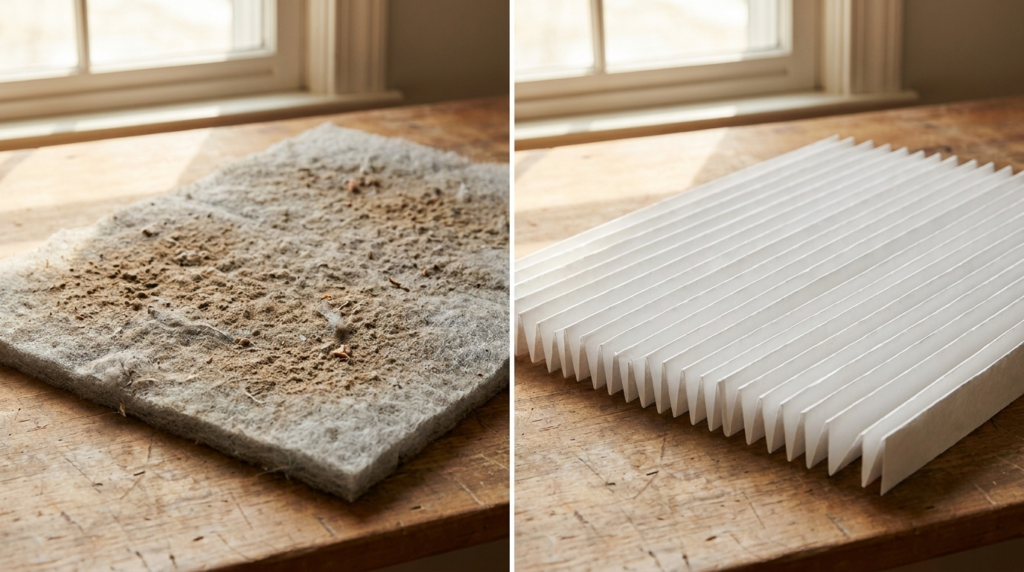
That is the original design intent, and it explains the low end of the scale. A MERV 4 fiberglass panel captures very little of what anyone would call pollution. It is quite good at stopping lint, carpet fiber, hair and the coarse debris that clogs a coil, and it does so with minimal resistance to airflow. As equipment protection, it works.
Air quality is the second job, not the first
Filtration in the return duct does reduce indoor particle concentrations, and the effect is largest for the fine particles that matter most for health. But it only works while the blower runs, which with a single-stage furnace may be a small fraction of the hours in a mild month. A household that wants continuous particle reduction needs either a system set to circulate at low fan speed, or a portable air cleaner sized for the room.
Why does the ordering matter practically? Because when the two jobs conflict, the equipment wins. A filter that protects your health but restricts airflow enough to freeze the coil or trip the furnace limit switch has not improved anything.
Reading the rating honestly
MERV under ASHRAE Standard 52.2
MERV stands for Minimum Efficiency Reporting Value, and it comes from ANSI/ASHRAE Standard 52.2, the method of testing general ventilation air-cleaning devices for removal efficiency by particle size. The EPA describes MERV as reporting a filter’s ability to capture particles between 0.3 and 10 micrometers.
The test is more demanding than most people realize. Particle counts are taken across twelve size channels six separate times: once with a clean filter, then again after each of five loadings of standard synthetic test dust. Those twelve channels are grouped into three composite ranges, E1 covering 0.3 to 1.0 micrometers, E2 covering 1.0 to 3.0, and E3 covering 3.0 to 10.0. The reported MERV reflects the worst performance observed across the loading steps, not the best. The residential scale runs from MERV 1 to MERV 16.
One wrinkle is worth knowing. Many pleated filters rely on an electrostatic charge on the media, and that charge can dissipate in service. ASHRAE 52.2 Appendix J adds an optional conditioning step that discharges the media before testing, producing a second number reported as MERV-A. Where a MERV-A figure is published and sits well below the MERV figure, the filter’s real-world performance after a few weeks is closer to the MERV-A number.
| MERV band | E1 (0.3-1.0 um) | E2 (1.0-3.0 um) | E3 (3.0-10 um) | What it actually captures |
|---|---|---|---|---|
| 1 to 4 | not rated | not rated | under 20 percent | Lint, carpet fiber, hair, large dust. Equipment protection only. |
| 5 to 8 | not rated | 20 to 70 percent | 70 to 95 percent | Mold spores, dust mite debris, cement dust, most visible household dust. |
| 9 to 12 | not rated | 35 to 80 percent | above 90 percent | Legionella-scale particles, humidifier dust, lead dust, much pollen and larger combustion residue. |
| 13 to 16 | 50 to 95 percent | 90 to 95 percent | about 95 percent | Fine combustion particles, wildfire smoke, bacteria, particles carrying respiratory droplets. |
MPR and FPR are not the same currency
MPR, or Microparticle Performance Rating, is 3M’s proprietary scale for its Filtrete line. It runs from 100 to 2800 and, as 3M describes it, reports the filter’s ability to capture particles between 0.3 and 1.0 micrometers. That is the E1 band only. A scale built on a single size range can rank two filters differently than a scale that weighs three.
FPR, or Filter Performance Rating, belongs to The Home Depot and is used on filters sold there. It takes values of 4, 7, 9 and 10, labeled Good, Better, Best and Premium. Allison Bailes, writing for Green Building Advisor on 28 May 2020, describes the FPR formula as weighting large particle capture at 60 percent, small particle capture at 30 percent, and weight gain over the filter’s life at 10 percent, and documents that the retailer’s own conversion claims have been inconsistent, with FPR 10 products appearing against both MERV 8 and MERV 13 equivalents in different listings.
Neither scale is fraudulent. Both are private, both were designed partly as marketing instruments, and neither is independently verifiable the way a MERV figure tested to ASHRAE 52.2 is. If a box shows only MPR or FPR, there is usually a MERV figure in the fine print; that is the number to compare across brands.
Does a high-MERV filter damage your system?
This is the question the internet gets most consistently wrong in both directions. There is measurement to work from.
What the Berkeley measurements showed
Iain Walker, David Faulkner, Darryl Dickerhoff and William Turner of Lawrence Berkeley National Laboratory published field measurements on California homes in 2013, under the title Energy Implications of In-Line Filtration in California Homes. They measured pressure across filters in occupied houses and tracked what happened on upgrade.
The findings are specific. Baseline filters produced pressure drops ranging from 16 to 173 pascals, averaging 71. Swapping in a MERV 16 filter produced 16 to 300 pascals, averaging 149, which is roughly double. In systems with conventional PSC blower motors, MERV 16 reduced airflow by about 22 percent, an average loss of 188 cubic feet per minute. In systems with brushless permanent magnet motors, which raise fan speed to compensate, the average loss was about 15 percent and occurred mainly where the motor was already at maximum output.
The energy result is the part most articles omit. For filters in the MERV 10 to 13 range, the researchers found the system energy penalty was minimal, under 5 percent, and in some configurations slightly negative. The significant penalties, up to about 20 percent, appeared with MERV 16 filters in the worst combination of high filter loading, leaky ducts and a BPM motor. The authors recommended restricting MERV 16 use to systems with duct leakage at or below 6 percent, and suggested filter loading indicators.
Static pressure and surface area
Resistance is not a property of the MERV number alone. It is a property of media, pleat count and face area. A 4-inch or 5-inch deep media cabinet holds several times the media area of a 1-inch panel in the same duct opening, so a MERV 13 deep-pleat filter can present less resistance than a MERV 11 one-inch panel. If you want better filtration and your equipment is marginal, adding filter area is the move that buys efficiency without buying resistance.
The measurement that settles it is external static pressure, read with a manometer across the air handler. Most residential equipment is rated at about 0.5 inches of water column total external static pressure. A great many installed systems already exceed that with a clean cheap filter, because of undersized returns and tight duct runs, which means the filter is being blamed for a duct problem.
The decision rule: check the filter monthly and replace a standard 1-inch filter every 60 to 90 days, sooner with pets, smokers, nearby construction or wildfire smoke. Choose MERV 13 as your ceiling unless a technician has measured external static pressure with the new filter in place and confirmed there is headroom. If you want better than MERV 13, add filter surface area rather than tightening the media.
Intervals, and the misconception underneath them
The common misconception is that a higher-MERV filter is automatically the more restrictive filter and therefore the riskier choice. The Berkeley data does not support that framing at the ratings most households are choosing between. A clean MERV 13 pleated filter in an adequately sized slot is not the problem. A loaded filter of any rating is.
Loading is the variable that actually moves pressure drop, and it moves it by a much larger factor than the rating does. This is why ENERGY STAR’s maintenance guidance is to check the filter monthly in a central air conditioner, furnace or heat pump, and states that a dirty filter can increase energy costs and damage equipment, leading to early failure. It is the loading, not the label, that does the damage.
Intervals by thickness and household
| Filter depth | Typical baseline | Shorten to | Why |
|---|---|---|---|
| 1 inch pleated | 90 days | 30 to 60 days | Shedding pets, indoor smoking, dusty renovation, wildfire season, running the fan continuously |
| 2 inch pleated | 3 to 6 months | 2 to 3 months | Same conditions; more media, so loading is slower but not exempt |
| 4 to 5 inch media cabinet | 6 to 12 months | 6 months | High occupancy, pets, or a climate with long continuous run hours |
| Washable or electrostatic panel | Clean monthly | Clean every 2 to 4 weeks | These clog on the surface and lose charge; verify the rated MERV before relying on one |
Two seasonal notes. A system that runs almost continuously in July and barely at all in October loads its filter by run hours, not calendar days, so a fixed schedule over-replaces in shoulder seasons and under-replaces in extremes. And in a heating-dominated climate the filter installed in late autumn does the most work, which argues for changing it as part of a pre-season check rather than mid cold snap.
Signs a filter is overdue
Visible gray matting across the upstream face is the obvious one, and by then it is late. Earlier signals include reduced airflow at the registers farthest from the air handler, longer run cycles for the same thermostat setting, dust reappearing on surfaces within days of cleaning, a furnace that short-cycles on its high-limit switch, or an evaporator coil that ices in cooling mode. Either of the last two warrants shutting the system down and investigating rather than simply swapping the filter.
One habit worth abandoning: closing supply registers in unused rooms to push air elsewhere. Iain Walker’s Lawrence Berkeley National Laboratory study of register closing, published in November 2003 as report LBNL-54005, found that closing registers raised supply boot leakage from about 5 percent to 55 percent of air handler flow and increased energy consumption in every configuration tested, with gas consumption rising 19 to 39 percent when three registers were closed. It raises system pressure for the same reason a clogged filter does, and it does not save anything.
Where these figures come from
The MERV definition, particle size ranges and the MERV 13 efficiency thresholds come from the US Environmental Protection Agency’s indoor air quality guidance on MERV ratings, which derives the method from ANSI/ASHRAE Standard 52.2. Band efficiencies and the twelve-channel, six-measurement test procedure, along with the Appendix J conditioning step and MERV-A reporting, come from ASHRAE Standard 52.2-2017 as summarized by the National Air Filtration Association. Pressure drop, airflow and system energy figures come from Walker, Faulkner, Dickerhoff and Turner, Energy Implications of In-Line Filtration in California Homes, Lawrence Berkeley National Laboratory, 2013. Register closing figures come from Iain Walker, Register Closing Effects on Forced Air Heating System Performance, Lawrence Berkeley National Laboratory report LBNL-54005, November 2003. MPR and FPR descriptions come from 3M and The Home Depot product documentation and from Allison Bailes writing in Green Building Advisor on 28 May 2020. Monthly checking guidance and the statement on dirty filters increasing costs and damaging equipment come from the EPA and DOE ENERGY STAR heating and cooling maintenance checklist.
General information, current as of September 2026, and not personalised advice.
Frequently asked questions
Can I clean and reuse a disposable filter?
No. Vacuuming a disposable filter damages the fibers and restores very little capacity. Washable filters exist, but they must be the reusable type and dried fully before reinstalling.
Does a new filter help with wildfire smoke?
A fresh filter rated MERV 11 to 13, combined with running the system fan, meaningfully reduces indoor smoke particles. Portable HEPA purifiers add further protection in the rooms you use most.
My filter looks clean after three months. Can I leave it?
If it genuinely looks clean, air may be bypassing it through gaps, or the system may run rarely. Check the fit first. When in doubt, filters are cheap; equipment is not.