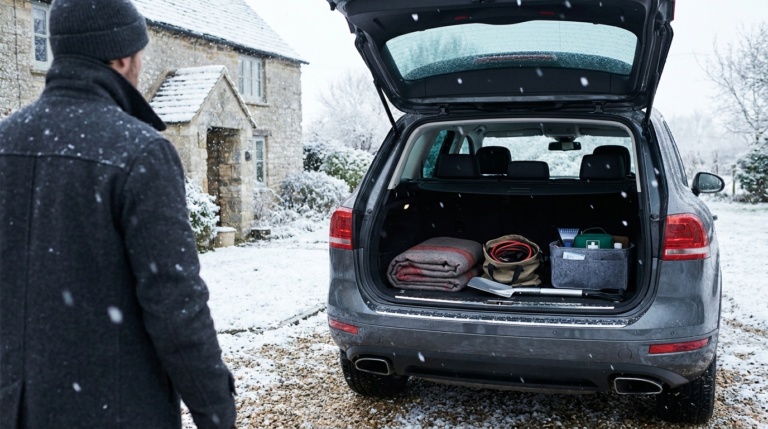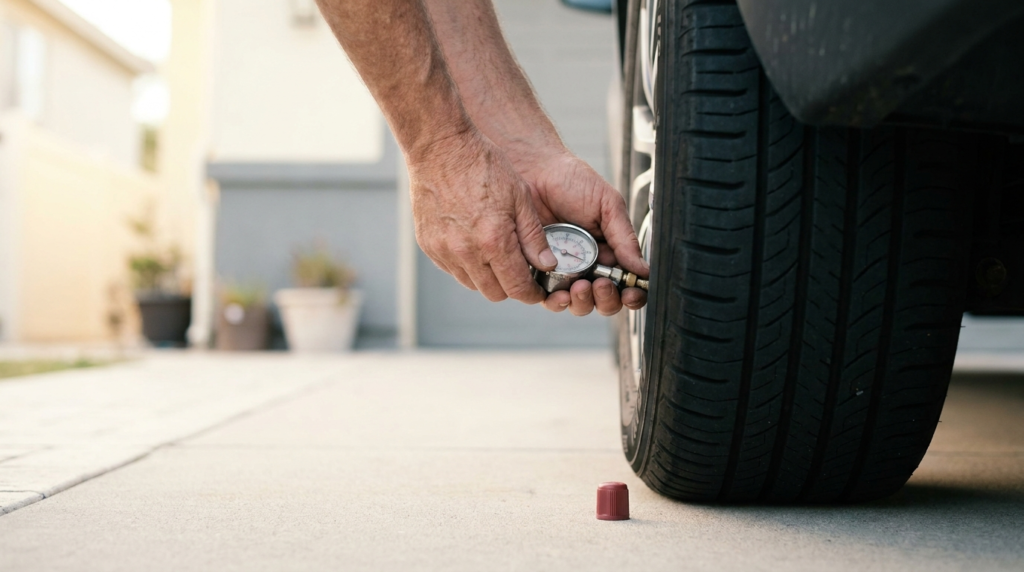
A monthly ten-minute check of pressure and tread, plus rotation on schedule, prevents most tire failures, and the sidewall number is not the pressure you want.
The short answer
Ten minutes a month, done consistently, covers almost everything that goes wrong with tires. You need a pressure gauge, a coin, and the willingness to walk around the car. The two checks that matter most are inflation pressure against the number on your door jamb, and tread depth measured in more than one spot on each tire. Rotation happens on a mileage schedule rather than a monthly one, and tire age is something you check once or twice a year.
The reason this matters is not abstract. NHTSA reports that 511 people died in tire-related crashes in 2024. Not all were preventable through maintenance, but a meaningful share of tire failures trace back to chronic underinflation, worn tread, or a tire too old to be trusted.
The ten-minute routine
Do this once a month, on the same day each month so you do not have to remember. Do it before you drive, or after the car has been parked for at least three hours.
- Find your placard pressure. It is printed on the Tire and Loading Information label, which NHTSA says is located on the driver’s side door edge or door post. Write the front and rear numbers on a note in your phone so you never have to look again.
- Check all five tires. Four on the ground plus the spare. NHTSA guidance is explicit that the spare counts, and a flat spare is worthless at the exact moment you need it.
- Set the pressure cold. Add air to reach the placard number. If you have already driven and the tires are warm, the reading will be high by several psi, and setting to the placard number while warm leaves you underinflated once they cool.
- Measure tread in three places per tire. Outer shoulder, center, inner shoulder. A single center reading hides the most common wear patterns.
- Look at the sidewalls and the tread face. Bulges, cuts, embedded objects, cracking. A bulge in the sidewall means the internal structure has failed and the tire should come off the car.
- Note the odometer, so you know when rotation is due.
Why the number on the sidewall is not your target
This is the most common tire mistake, and it is understandable. The sidewall carries a large, legible pressure figure. The door jamb label is small and easy to ignore. So people inflate to the sidewall number and assume they have done the right thing.
They have not. The placard number is the result of the vehicle manufacturer deciding how that specific car should ride, steer, brake, and wear, which is why many vehicles specify different pressures front and rear. Running to the sidewall maximum typically overinflates the tire relative to the load it actually carries, shrinking the contact patch and wearing the center of the tread faster than the shoulders. NHTSA states the position plainly: the correct pressure for your tire is what the vehicle manufacturer has listed, not what is listed on the tire itself. The sidewall figure is the maximum cold inflation pressure at which the tire is rated to carry its maximum load. It is a ceiling, not a recommendation.
Do not wait for the dashboard light
Modern vehicles have a tire pressure monitoring system, and many drivers treat it as the monthly check. It is not. Under Federal Motor Vehicle Safety Standard No. 138, the system is required to warn when pressure is 25 percent or more below the vehicle manufacturer’s recommended cold inflation pressure. Twenty-five percent is a great deal of air.
| Placard pressure | Earliest required warning point | Air you can lose with no warning |
|---|---|---|
| 30 psi | 22.5 psi | 7.5 psi |
| 32 psi | 24.0 psi | 8.0 psi |
| 35 psi | 26.3 psi | 8.8 psi |
| 38 psi | 28.5 psi | 9.5 psi |
| 42 psi | 31.5 psi | 10.5 psi |
A tire at 27 psi against a 35 psi placard is handling badly, wearing its shoulders, running hot, and burning extra fuel, and the light is legally permitted to stay off. The monitoring system is a failure alarm. Your gauge is the maintenance tool.
Reading tread depth, and why 2/32 of an inch is too late
NHTSA is clear on the legal floor: tires are not safe and should be replaced when the tread is worn down to 2/32 of an inch. The agency describes the penny test for confirming it, placing a penny in the tread with Lincoln’s head upside down and facing you, and replacing the tires if you can see the top of his head.
The problem is that 2/32 is the point at which a tire is declared worn out, not the point at which it stopped performing. Tire Rack published wet braking test results from 60 mph on standard non-draining asphalt that show how steeply performance falls away before the legal limit is reached.
| Tread remaining | Sedan, wet stop from 60 mph | Light truck, wet stop from 60 mph |
|---|---|---|
| New | 205 feet | 216 feet |
| 4/32 inch | 270 feet | 261 feet |
| 2/32 inch | 400 feet | 287 feet |
For the sedan, a legally acceptable tire needed 195 more feet of wet pavement than a new one. That is roughly the difference between stopping short of the car ahead and arriving at it near full speed. This is why Tire Rack recommends replacing at 4/32 of an inch if you regularly drive in rain, and around 5/32 if you deal with snow, where tread depth is needed to compress and release snow rather than to evacuate water.
A quarter is a useful second coin. Washington’s head reaching the tread surface corresponds to roughly 4/32 of an inch, which gives you a warning point rather than a death notice. A tread depth gauge costs little and removes the guesswork.
Read the wear pattern, not just the number
Measuring in three places per tire tells you something a single reading cannot. Wear concentrated in the center with deeper shoulders suggests sustained overinflation. Wear on both shoulders with a deeper center suggests sustained underinflation. Wear on one shoulder only, on both tires of an axle, points to an alignment problem that rotation will not fix and that will destroy the next set of tires just as efficiently. Uneven patchy wear often indicates a balance or suspension issue. Any of these is a reason to book an inspection rather than simply buy new tires.
Rotation: the same job, different patterns
Tires on one axle wear differently from those on the other, because the driven wheels transmit torque and the front wheels do the steering. On most vehicles the fronts wear faster, and on front-wheel drive cars considerably faster. Rotation moves tires so the set wears down together and reaches the end of its life together.
The interval depends on who you ask. NHTSA guidance is to rotate every 5,000 to 8,000 miles, or sooner if uneven wear appears. Tire Rack recommends every 3,000 to 5,000 miles. Your owner manual will specify its own figure, and that is the one to follow, because it is tied to the vehicle’s warranty terms. In practice, pairing rotation with every oil change is the habit that actually survives contact with real life.
| Configuration | Pattern | What it does |
|---|---|---|
| Front-wheel drive | Forward cross | Rear tires move forward and cross to opposite sides; fronts move straight back |
| Rear-wheel drive or four-wheel drive | Rearward cross | Front tires move back and cross to opposite sides; rears move straight forward |
| All-wheel drive | Rearward cross | Same pattern, with the additional goal of keeping all four depths close together |
| Directional tires | Front to rear, same side | Preserves the intended rolling direction, which crossing would reverse |
| Staggered sizes, front and rear different | Side to side | The only legal move, since the sizes cannot swap axles |
All-wheel drive deserves a specific warning. Tire Rack notes that including a full-size spare in the rotation on these vehicles prevents driveline damage by ensuring a brand new spare is not put into service alongside partially worn tires. The underlying issue is that an all-wheel drive system compares wheel speeds, and tires of different diameters turn at different rates. A significantly mismatched tire makes the system behave as though it is detecting slip, and sustained mismatch can damage expensive driveline components. On these vehicles, replacing one tire out of four is often not an option; you replace in sets, or you have the new tire shaved to match.
Tires age even when they are barely used
Rubber degrades with time, heat, and ultraviolet exposure, independently of mileage. A tire with generous tread that has spent eight years on a trailer or in a spare tire well is not a good tire. NHTSA notes that some vehicle and tire manufacturers recommend replacing tires that are six to 10 years old regardless of treadwear.
You can date any tire yourself. The Tire Identification Number is molded into the sidewall, and NHTSA explains that the last four digits indicate the week and year of manufacture. The agency’s example is a code reading 0308, meaning the third week of 2008. Check this when you buy tires, not only when you inspect them. New tires that have been sitting in a warehouse are already partway through their service life, and you are entitled to know how far.
The spare is where this bites hardest. It has full tread, it looks fine, and it may be a decade old. Check its date code and pressure together.
A decision rule you can apply in the driveway
Measure the shallowest point on the tire, not the deepest, and then apply this in order. The first line that matches is your answer.
- Wear bars flush with the tread, or 2/32 inch or less: legally worn out. Replace now.
- Tire is more than 10 years old by date code: replace regardless of tread.
- 3/32 inch: replace now if you drive in rain at highway speeds. Otherwise you have weeks, not months.
- 4/32 inch: begin shopping. Replace before winter or before any long trip.
- 5/32 inch and you face snow: begin shopping now.
- More than 2/32 inch difference between tires on the same axle: get an alignment and suspension inspection before rotating; rotation will hide the symptom without fixing the cause.
- 6/32 inch or more, even wear, correct pressure, under six years old: nothing to do. Check again next month.
What ten minutes a month does not catch
This routine will not detect a slow internal separation, a bent wheel, a worn strut, or an alignment that is a fraction of a degree off. It will not save a tire that has already been driven flat, because that damage is internal and permanent even if the tire holds air afterwards.
What it will catch is the slow leak before it becomes a blowout, the pressure drift before it costs you a set of shoulders, and the tread that has quietly crossed from adequate to marginal. Those three account for most of what drivers actually experience.
Where these figures come from
NHTSA TireWise tire safety guidance, including 2024 tire-related fatality data. Federal Motor Vehicle Safety Standard No. 138, tire pressure monitoring systems. Tire Rack published wet braking testing at 60 mph and Tire Rack rotation and tread depth guidance.
Ten minutes a month is a small enough commitment that most people agree to it and then stop after two months. The gap between knowing this and doing it is where the tire failures live, and no article closes that gap for you.
General information, current as of September 2026, and not personalised advice.
Frequently asked questions
Why not inflate to the pressure printed on the tire?
The sidewall number is the tire's maximum, not your car's specification. The correct pressure is on the driver's door jamb sticker, set for your vehicle's weight and handling.
Is the penny test still valid?
Yes, as a minimum: tread at Lincoln's head means 2/32, the legal wear limit. For wet braking, plan replacement around 4/32, testable with a quarter and Washington's head.