Frozen pipe risk begins around 20 degrees Fahrenheit, the vulnerable pipes are the ones outside your insulation, and the first move after a burst is the main shutoff valve.
The short version: the risk of a frozen pipe begins in earnest when the outdoor temperature falls to about 20 degrees Fahrenheit, the pipes that fail are almost always the ones sitting outside the building insulation rather than inside it, and the defenses that work best cost very little. If a pipe does burst, the first thing you touch is the main water shutoff valve, not the phone.
The temperature where the risk actually starts
Water freezes at 32 degrees Fahrenheit. A pipe inside a house does not, because the house is still bleeding heat into the spaces around it. Research by the Building Research Council at the University of Illinois at Urbana-Champaign, which is the work most state and utility guidance ultimately traces back to, monitored uninsulated pipes in unconditioned attics and found that the onset of freezing occurred when the outside temperature fell to 20 degrees Fahrenheit or below. That figure is now widely used as a temperature alert threshold: the point at which a household with exposed plumbing should act rather than hope.
Twenty degrees is not a guarantee of failure, and 25 degrees is not a guarantee of safety. Duration matters. Wind matters, because moving cold air strips heat from a pipe faster than still air does. The path a draft takes through a crawl space matters more than the number on a thermometer.
A second number governs the inside of the house. Both the American Red Cross and the Insurance Institute for Business and Home Safety advise keeping the thermostat set no lower than 55 degrees Fahrenheit, including when nobody is home. The Red Cross adds that during a cold snap you should hold the thermostat at the same temperature day and night. A night setback saves a small amount of fuel and costs you the thermal buffer that keeps a wall cavity above freezing at four in the morning, which is when pipes actually fail.
Which pipes freeze, and why it is not the obvious ones
The Red Cross groups vulnerable pipes into two categories. The first is plumbing exposed to severe cold by design: outdoor hose bibs, swimming pool supply lines, and irrigation lines. The second is plumbing in unheated interior areas, meaning basements, crawl spaces, attics, garages, and the runs hidden inside kitchen and bathroom cabinets on exterior walls.
The organizing principle is simpler than the list. A pipe is safe if it sits on the warm side of the building insulation and at risk if it sits on the cold side. This is why the geography of frozen pipe damage is counterintuitive. The Building Research Council work noted that in colder regions, plumbing is generally routed inside the insulation envelope because builders there have long assumed hard freezes. In warmer regions, pipes are far more likely to run through attics, crawl spaces, and uninsulated exterior walls, because for most of the year nothing bad happens there. When an unusual cold event reaches the South, the houses are not built for it.
The mechanism of the burst is also not what most people picture. Ice expanding does not split the pipe at the point where it forms. The Building Research Council research found that the pipe bursts where little or no ice has formed. Once a complete ice plug develops, continued freezing pushes water ahead of the blockage toward a closed faucet. Pressure builds in that trapped column until the weakest fitting or section downstream gives way. The failure is hydraulic, not a matter of ice pushing outward.
That single fact explains the advice everyone half-remembers. Leaving a faucet open does not stop ice from forming. It removes the closed end of the system, so pressure has somewhere to go.
The cheap preventive steps, in order of value
- Disconnect, drain, and store garden hoses. A hose left attached traps water in the bib and the short run behind it. The Red Cross specifies closing the interior valve that supplies each outdoor hose bib and then opening the outside bib so the line between them can drain.
- Drain irrigation and pool supply lines before the first hard freeze, following the manufacturer instructions.
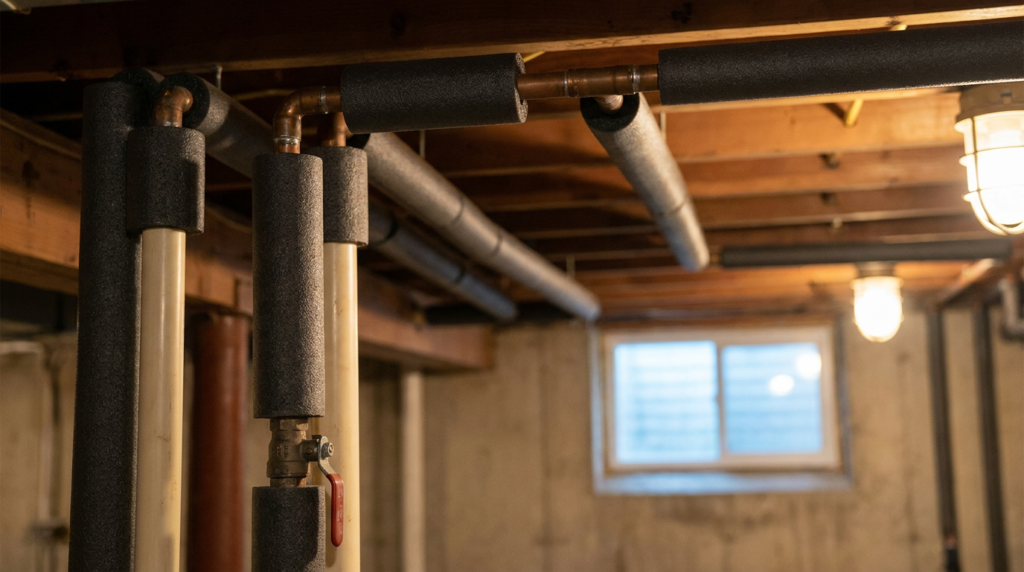
- Insulate the exposed runs. Foam pipe sleeves and heat tape are both named by the Red Cross. Michigan State Police Emergency Management, in its MIReady winter guidance, specifies that heat tape or thermostatically controlled heat cable should be UL approved. The Red Cross also notes that even a quarter inch of newspaper wrapped around a pipe provides significant protection, which is a genuinely useful thing to know at eight in the evening when the hardware store is shut.
- Seal the air leaks. IBHS emphasizes caulking and sealing cracks around exterior windows and doors and adding weatherstripping. MIReady specifically names air leaks around electrical wiring, dryer vents, and pipe penetrations. A pipe in an insulated wall that has cold outside air blowing directly across it is not an insulated pipe.
- Close crawl space vents temporarily during a hard freeze, as IBHS advises, and reopen them afterward.
- Open cabinet doors under kitchen and bathroom sinks so heated room air reaches the plumbing behind them.
- Let the cold water drip from faucets served by exposed pipes.
A decision rule for tonight
| Situation | What to do |
|---|---|
| Forecast low of 25 degrees, house occupied, all plumbing inside the heated envelope | Disconnect hoses if you have not already. Nothing further. |
| Forecast low of 20 degrees or below, house occupied, plumbing in exterior walls, attic, or crawl space | Open cabinet doors, run a trickle of cold water from the faucet served by the most exposed run, hold the thermostat steady overnight. |
| Forecast low of 20 degrees or below, house empty for a weekend | All of the above, plus heat set no lower than 55 degrees and someone asked to check the house. |
| Hard freeze forecast, house empty for weeks | Shut off water at the main and drain the system. Note that draining also disables a residential fire sprinkler system, so confirm before you do it. |
| A faucet has slowed to a trickle for no obvious reason | Treat it as a partial freeze in progress. Open the faucet and start applying gentle heat now. |
| Power outage during a hard freeze | Assume the house will drift toward outdoor temperature within hours. Arrange backup heat or drain the system. |
How to thaw a frozen pipe
- Keep the faucet open. As the ice plug melts, water needs somewhere to flow, and the moving water helps melt the remaining ice.
- Apply heat to the frozen section. Acceptable heat sources named by the Red Cross are an electric heating pad wrapped around the pipe, an electric hair dryer, a portable space heater kept well away from anything flammable, or towels soaked in hot water and wrapped around the pipe.
- Work from the faucet backward. MIReady advises warming the pipe as close to the faucet as possible and then working toward the coldest section. Heating the middle of a plug first can trap melted water between two ice blockages.
- Keep applying heat until full pressure returns. A trickle means the plug is still partly intact.
- Check the rest of the house. If one pipe froze, others in the same unheated space are candidates.
If you cannot find the frozen section, cannot reach it, or the pipe does not respond, call a licensed plumber. There is no prize for persistence here.
What not to do
The Red Cross is unambiguous: do not use a blowtorch, kerosene or propane heater, charcoal stove, or any other open flame device. MIReady repeats the warning against torches and open flames. The reasons are two. Open flame in a wall cavity or crawl space sets the house on fire, and frozen pipe season is a documented period of structure fires started during thawing attempts. A torch also heats copper far past the point where solder joints soften, which turns one problem into several.
MIReady adds a second warning that is easy to overlook in the panic: do not use electrical appliances while standing in water.
The first ten minutes after a pipe bursts
- Shut off the water at the main. Everything else is secondary.
- Open the lowest faucets in the house to drain the remaining pressurized water away from the break rather than through the ceiling.
- Cut power to affected areas at the breaker panel, if you can reach it safely and dryly.
- Call a plumber, then your insurer.
- Photograph and video everything before you clean up. IBHS recommends keeping a geo-tagged video inventory of your home stored in the cloud specifically so that claim documentation exists before the damage.
Where the main shutoff is
Find it before you need it. IBHS lists locating and learning to operate the home water shutoff valve as a distinct preparation step, and it is the one most households skip.
In colder regions the main shutoff is usually indoors, typically in a basement or utility room on the wall facing the street, near where the supply line enters. In warmer regions it is more often outside, near the meter or at a curb box close to the property line, sometimes under a small covered access lid. There may be two valves, one at the meter belonging to the utility and one on the house side belonging to you. Turn the handle yourself once, in daylight, while nothing is wrong. Valves that have not moved in fifteen years sometimes will not, and finding that out during a flood is not the moment.
What this actually costs
According to the Insurance Information Institute, drawing on data from ISO, a Verisk Analytics business, the average homeowners insurance claim for water damage and freezing over the period 2019 to 2023 was 15,400 dollars, at a frequency of 1.50 claims per 100 insured house-years. For comparison, wind and hail claims over the same period averaged 14,747 dollars, and fire and lightning claims averaged 88,170 dollars. Water damage is not the most expensive thing that happens to houses. It is one of the most common expensive things.
A worked example. MIReady states that a crack as small as one-eighth of an inch can leak up to 250 gallons of water a day. Suppose the split happens on a Friday evening in a crawl space and nobody notices until Sunday afternoon, roughly 44 hours later. At that rate the leak releases about 458 gallons. That water does not sit politely in the crawl space; it wicks into subfloor, insulation, and framing, and gravity moves it into whatever cavity is lowest. The difference between a 400 dollar plumbing repair and a five-figure claim is frequently nothing more than how many hours passed before somebody closed a valve.
One caveat on insurance. The Massachusetts Division of Insurance notes that most homeowners policies cover sudden and accidental water damage from a burst pipe, but that coverage generally assumes the home was adequately heated and not left unoccupied for an extended period. A house left cold and empty during a freeze is a claim an insurer may contest. That is another reason the 55 degree figure matters beyond the physics.
The part that does not resolve neatly
Prevention here is genuinely cheap and genuinely effective, and it still fails sometimes. A pipe in a wall cavity you have never seen, fed by a draft you did not know existed, can freeze in a house where you did everything on the list. The realistic goal is not to eliminate the risk but to shorten the time between a failure and somebody noticing it, which is why knowing where the shutoff valve is remains the single highest-value thing in this article.
Where these figures come from
American Red Cross, Preventing and Thawing Frozen Pipes. Insurance Institute for Business and Home Safety, Winter Weather Ready guidance, November 2024. Building Research Council, University of Illinois at Urbana-Champaign, research on freezing and bursting pipes. Michigan State Police Emergency Management and Homeland Security Division, MIReady winter preparedness guidance. Insurance Information Institute, Facts and Statistics: Homeowners and Renters Insurance, citing ISO, a Verisk Analytics business, five-year averages 2019 to 2023. Massachusetts Division of Insurance consumer advisory on cold snaps and frozen pipe claims.
General information, current as of September 2026, and not personalised advice.
Frequently asked questions
At what temperature should I start worrying?
Risk climbs sharply when outdoor temperatures fall to around 20 degrees Fahrenheit or below, especially with wind, and for pipes in unheated spaces even sooner.
How do I safely thaw a frozen pipe?
Keep the faucet open, warm the pipe gradually with a hair dryer or heating pad working from the faucet toward the blockage, and never use an open flame. If you cannot locate or reach it, call a plumber.