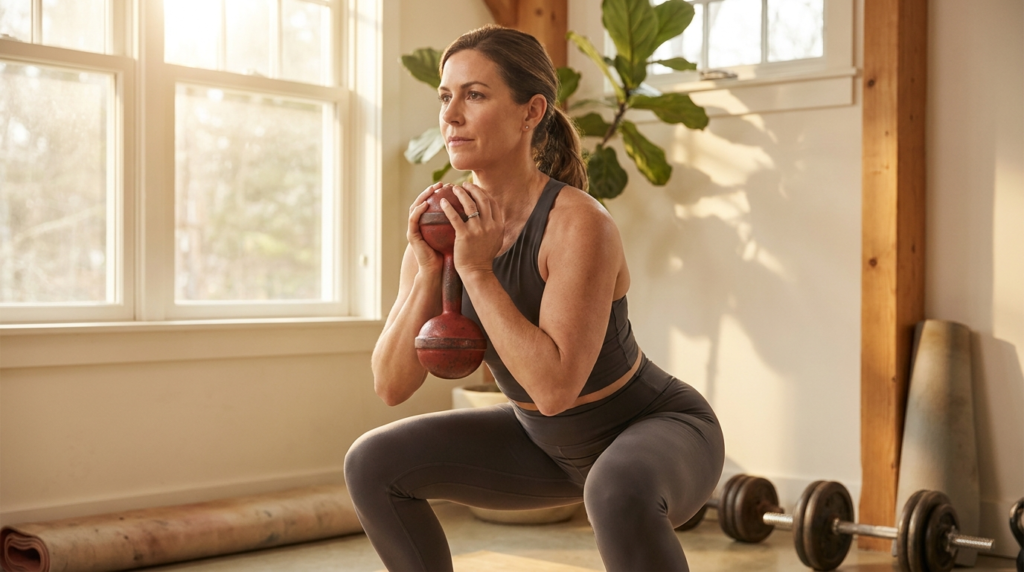
The federal guidelines ask every adult for muscle-strengthening work on two or more days a week, and roughly three quarters of American adults do not meet the full standard.
The short version: the federal physical activity guidelines ask every adult, at every age, for muscle-strengthening activity on two or more days a week, covering all major muscle groups. That recommendation does not change or soften after 40. Most American adults do not meet it, and the shortfall widens with age. The case for starting now is not that strength training reverses aging; it is that the guideline exists for adults of all ages and that most people over 40 are simply not doing the second half of it.
This site holds no medical or exercise-science credentials. What follows is a report of what the published federal guidelines and public health agencies actually say, with the figures attributed. It is not a prescription, and the section on who should speak to a clinician first is not a formality.
What the guidelines actually recommend
The governing document is the Physical Activity Guidelines for Americans, second edition, published by the U.S. Department of Health and Human Services in 2018. It remains the current federal standard, and it is what the Centers for Disease Control and Prevention cites.
For adults, the key recommendations are:
- Aerobic activity: at least 150 minutes to 300 minutes a week of moderate-intensity activity, or 75 minutes to 150 minutes a week of vigorous-intensity activity, or an equivalent combination.
- Muscle strengthening: muscle-strengthening activities of moderate or greater intensity that involve all major muscle groups on two or more days a week.
- A floor, not just a target: the guidelines state plainly that some physical activity is better than none, and that adults who sit less and do any amount of moderate-to-vigorous physical activity gain some health benefits.
For older adults, the guidelines add rather than subtract. They call for multicomponent physical activity that includes balance training as well as aerobic and muscle-strengthening activity. They note that older adults should determine their level of effort relative to their own fitness rather than to an absolute standard, and that adults with chronic conditions should understand whether and how those conditions affect their ability to be physically active safely.
Note what is not in there. There is no separate, reduced strength recommendation for people over 40, over 50, or over 65. The frequency is the same. What changes is the intensity that constitutes moderate effort for a given individual, and the addition of balance work.
What “all major muscle groups” means in practice
The CDC translation is more concrete than the guidelines document. The major muscle groups it names are the legs, hips, back, chest, abdomen, shoulders, and arms. On the question of how much, CDC guidance for adults 65 and over specifies 8 to 12 repetitions per activity for at least one set, with two to three sets producing greater benefit, and defines the necessary effort as continuing to the point where it is hard to do another repetition without help.
On what counts, CDC is deliberately broad: lifting weights, resistance bands, body-weight exercises such as push-ups and sit-ups, heavy gardening and digging, and some yoga postures all qualify. A gym membership is not part of the recommendation.
What happens to muscle with age, stated carefully
The most commonly cited figure comes from the HHS Office on Women’s Health, which states that beginning around age 30 the body naturally loses about 3 to 5 percent of its muscle mass per decade, with changes becoming more noticeable by age 60. NIH News in Health, in an April 2025 article on slowing sarcopenia, reports the same 3 to 5 percent per decade figure and estimates that 10 to 20 percent of older adults have sarcopenia, the age-related loss of muscle mass and strength.
That NIH article also reports consequences worth naming. People with sarcopenia face nearly double the hospitalization rate of those without it, along with increased risk of fractures and loss of independence. NIH-funded research analyzing thousands of adults aged 65 and over identified grip strength and walking speed, with a gait speed below 2.6 feet per second flagged as a marker, as practical indicators of sarcopenia risk linked to falls, mobility limitation, hip fracture, and mortality.
The arithmetic, and its limits
It is worth doing the sum, because the headline percentage sounds smaller than it is.
Take the cited range at face value and apply it to a person from age 30 to age 60, which is three decades. At 3 percent lost per decade, the compounding calculation is 0.97 multiplied by itself three times, giving 0.913, or roughly 9 percent less muscle mass. At 5 percent per decade, 0.95 cubed gives 0.857, or roughly 14 percent less. So the plausible range for a typical adult reaching 60 is somewhere around a tenth to a seventh of their muscle mass gone, without anything dramatic having happened.
Three honest caveats on that calculation. First, 3 to 5 percent per decade is a population average, and individual variation is large. Second, muscle mass and muscle strength are not the same thing, and strength typically declines faster than mass does. Third, the figure describes what happens on average, not what is inevitable for any individual; activity level is explicitly identified by the Office on Women’s Health as a factor, with less physically active people especially susceptible. The arithmetic above is illustrative of the cited range, not a prediction about any particular person.
How few people actually do the strength half
This is the part that reframes the question. The National Center for Health Statistics, in Data Brief number 443 published in August 2022 and based on the 2020 National Health Interview Survey, found that 24.2 percent of adults aged 18 and over met both the aerobic and the muscle-strengthening guidelines. Muscle strengthening alone was met by 31.0 percent of adults.
The age gradient is steep. The proportion meeting both guidelines was as follows.
| Age group | Men | Women |
|---|---|---|
| 18 to 34 | 41.3 percent | 28.7 percent |
| 35 to 49 | 29.4 percent | 22.7 percent |
| 50 to 64 | 21.6 percent | 17.6 percent |
| 65 and over | 15.3 percent | 10.8 percent |
Separate 2020 National Health Interview Survey figures reported by CDC for the muscle-strengthening guideline on its own show men aged 45 to 64 at 29.9 percent and women in that band at 23.8 percent, falling to 22.0 percent and 17.2 percent respectively at 65 and over.
The practical reading is straightforward. Among adults in their fifties and early sixties, roughly four in five are not doing the muscle-strengthening work the federal guidelines ask for. This is not a population that has optimized and now needs marginal gains. It is a population where a substantial share is at zero.
What the evidence supports, and where it stops
Be careful here, because this topic attracts overstatement.
The strongest formal recommendation in adjacent territory comes from the U.S. Preventive Services Task Force. In its 2024 recommendation statement on interventions to prevent falls in community-dwelling older adults, the Task Force gave a Grade B recommendation for exercise interventions in adults aged 65 and over who are at increased risk for falls. A pooled analysis of 29 trials found exercise reduced incident falls, with an incidence rate ratio of 0.85 and a 95 percent confidence interval of 0.75 to 0.96, and reduced injurious falls with an incidence rate ratio of 0.84, confidence interval 0.74 to 0.95. For context on why this matters, the Task Force noted that in 2018, 27.5 percent of community-dwelling adults aged 65 and over reported at least one fall in the past year, and that in 2021 an estimated 38,742 deaths resulted from fall-related injuries.
Read that precisely. It is a recommendation about exercise interventions, generally multicomponent programs including balance and gait work rather than resistance training in isolation. It applies to adults 65 and over at increased risk of falling. It is not a finding that lifting weights in your forties prevents falls in your seventies, and nobody should present it as one.
What can be said within the evidence: the federal guidelines recommend muscle-strengthening activity for all adults on two or more days a week; low muscle mass and low strength in older adults are associated with adverse outcomes including hospitalization, fracture, and mortality; and exercise interventions reduce falls in at-risk older adults. What cannot responsibly be said is that any particular training program produces any particular outcome for any particular individual. Claims of that specificity are marketing.
A week that meets the guideline
The following is one arrangement that satisfies the second edition guidelines for an adult. It is offered as an illustration of what the recommendation looks like when written onto a calendar, not as a program.
| Day | Activity | Which part of the guideline it satisfies |
|---|---|---|
| Monday | 30 minutes brisk walking | Aerobic, moderate intensity |
| Tuesday | Strength: legs, hips, back, chest, shoulders, arms, abdomen. One to three sets of 8 to 12 repetitions each | Muscle strengthening, day one of two |
| Wednesday | 30 minutes brisk walking | Aerobic |
| Thursday | Rest or light activity | |
| Friday | Strength, same coverage as Tuesday | Muscle strengthening, day two of two |
| Saturday | 60 minutes walking, hiking, or cycling | Aerobic |
| Sunday | Rest, or balance work if aged 65 and over | Balance and multicomponent activity for older adults |
That totals 150 minutes of moderate aerobic activity and two strengthening days, which meets the minimum on both counts. Two strength sessions covering all major muscle groups is the entire muscle-strengthening requirement. It is not a large ask, which is part of why the participation figures above are notable.
A decision rule for adding weight
The CDC intensity definition supplies one, and it is more useful than any percentage-of-maximum scheme for someone starting out.
The rule: a set is in the right range when the last repetition is genuinely hard to complete without assistance. If you finish 12 repetitions and could comfortably do several more, the resistance is too light for the stated intensity. If you cannot reach 8 repetitions with acceptable form, it is too heavy. Increase the resistance only when you can complete the top of the repetition range with good form on every set, and increase it by the smallest increment available rather than the next plate.
Form is the binding constraint, not load. A repetition performed badly is not a heavier version of a repetition performed well; it is a different and worse exercise. If you have never done these movements, supervised instruction for even a few sessions is worth more than any equipment purchase.
Who should talk to a clinician before starting
The Physical Activity Guidelines are explicit that adults with chronic conditions should understand whether and how their conditions affect their ability to be physically active safely, and should consult health care professionals about the types and amounts of activity appropriate for them. NIH guidance on sarcopenia similarly advises talking with a doctor if you think you may have it.
Speak to a clinician first if any of the following applies: existing cardiovascular disease, uncontrolled hypertension, diabetes, osteoporosis or a history of fragility fracture, joint replacement, chronic back or neck problems, a recent surgery, pregnancy or recent pregnancy, a balance or vision disorder, any condition affecting exertion tolerance, or if you experience chest discomfort, unusual breathlessness, dizziness, or fainting during exertion. This list is not exhaustive, and the general principle is simpler than the list: if you have a reason to wonder whether this is safe for you, that is the reason to ask someone qualified.
The honest bottom line
The federal guidelines do not promise that strength training after 40 will make you younger, and neither does the evidence. What the record supports is narrower and less exciting: muscle mass declines with age at a rate that compounds, low strength in older adults tracks with outcomes people care about, the federal recommendation for muscle-strengthening activity does not decrease with age, and most adults over 45 are not meeting it. The gap between doing nothing and doing two sessions a week is the part of this where the evidence is clearest and where almost all of the available benefit sits. Whether starting at 45 rather than 25 changes an individual outcome is not something anyone can tell you, and nobody honest will claim otherwise.
Where these figures come from
U.S. Department of Health and Human Services, Physical Activity Guidelines for Americans, second edition, 2018. Centers for Disease Control and Prevention, Physical Activity Basics guidance for adults and for older adults. National Center for Health Statistics, Data Brief number 443, August 2022, based on the 2020 National Health Interview Survey. Centers for Disease Control and Prevention QuickStats on adults meeting the federal muscle-strengthening guideline, National Health Interview Survey, 2020. HHS Office on Women’s Health, sarcopenia information. NIH News in Health, Slowing Sarcopenia, April 2025. U.S. Preventive Services Task Force, Interventions to Prevent Falls in Community-Dwelling Older Adults, recommendation statement, 2024.
General information, current as of September 2026. This is not medical advice; speak to a clinician before beginning a new exercise programme, particularly if you have existing health conditions.
Frequently asked questions
Is it too late to build muscle at 50 or 60?
No. Studies consistently show meaningful strength and muscle gains in beginners decades older than that. The adaptation machinery slows but never shuts off.
Do I need a gym membership?
No. Bodyweight movements plus a pair of adjustable dumbbells or resistance bands cover a complete beginner program at home.