Cooked meat keeps three to four days, so a Sunday cook does not safely reach Friday. The fix, the one hour component workflow, the temperatures that matter, and what the federal spending data actually shows about the savings.
Most meal prep advice fails on Thursday, and the usual explanation is boredom. Five identical containers of chicken and rice, and by midweek you would rather buy a sandwich. That is a real problem with a real fix. But there is a second problem underneath it that almost nobody mentions, and it is not a matter of taste.
Cooked meat and poultry keep for three to four days in a refrigerator. A Sunday cook does not safely reach Friday.
The five-day problem
The federal cold storage chart at FoodSafety.gov gives “cooked meat or poultry” three to four days in the refrigerator and two to six months in the freezer. Soups and stews with vegetable or meat added get the same three to four days. USDA’s Food Safety and Inspection Service repeats the window for cooked meat, poultry, fish, casseroles and cooked egg dishes.
Count forward from a Sunday afternoon cook and the arithmetic is unavoidable.
| Lunch | Days since cooking | Inside the 3 to 4 day window? | What to do about it |
|---|---|---|---|
| Monday | 1 | Yes | Refrigerate Sunday |
| Tuesday | 2 | Yes | Refrigerate Sunday |
| Wednesday | 3 | Yes | Refrigerate Sunday |
| Thursday | 4 | At the edge | Freeze Sunday, move to the fridge Wednesday night |
| Friday | 5 | No | Freeze Sunday, move to the fridge Thursday night |
This is the whole reason a freezer belongs in a meal prep system. FSIS states that “food stored constantly at 0 degrees F will always be safe. Only the quality suffers with lengthy freezer storage.” The freezer times published on the charts, two to three months for casseroles and cooked meat, four months for cooked poultry, are quality limits, not safety limits.
So the Sunday session produces five lunches, three of which go in the refrigerator and two of which go straight into the freezer before they have cooled to room temperature in a container on the counter. Moving Thursday’s box down to the fridge on Wednesday night is the only ongoing chore the system requires.
Two items on the chart do not appear anywhere: cooked rice and cooked vegetables. Neither FoodSafety.gov, FSIS nor the FDA publishes a separate line for them. They fall under the general leftovers rule of three to four days, with one important exception covered below.
The component method, which is the fix for boredom
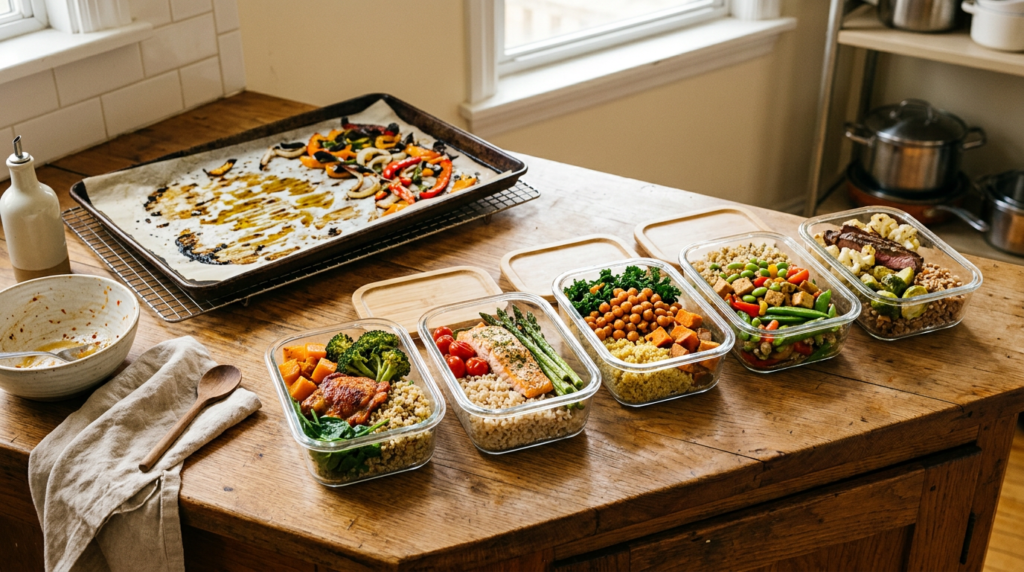
Instead of assembling five finished meals, cook parts: one protein, one grain, two vegetables, one sauce. Five different combinations come out of the same hour of work, and a component that is not wanted on Wednesday is not wasted, it simply appears on Thursday instead.
It also fixes a subtler problem. Finished meals commit you on Sunday to what you will want on Friday, which nobody can predict, and the container you do not want is the container that gets thrown away.
The hour, with the temperatures built in
Minutes 0 to 5. Oven to 425. Two sheet pans: protein on one, chopped vegetables on the other. Use separate boards and knives for raw meat and for produce. FSIS recommends “one cutting board for fresh produce and bread and a separate one for raw meat, poultry, and seafood.”
Do not rinse the chicken. FSIS is explicit: “washing or rinsing meat or poultry increases the risk for cross-contamination in the kitchen, which can cause foodborne illness,” and “cooking to the right temperature kills germs on meat and poultry, so washing these products is risky and not necessary for safety.”
Minutes 5 to 10. Grain on the stove. Rice, quinoa, farro, whatever you will actually eat.
Minutes 10 to 20. Wash the produce under running water. The FDA’s guidance is that “there’s no need to use soap or a produce wash,” that you should rinse before peeling “so dirt and bacteria aren’t transferred from the knife onto the fruit or vegetable,” and that drying with a clean cloth or paper towel further reduces bacteria. Make the sauce while you are waiting.
Minutes 20 to 40. Cooking finishes. Check with a thermometer, not by looking.
| Food | Safe minimum internal temperature |
|---|---|
| All poultry, including breasts, thighs and ground poultry | 165 F |
| Ground meats and sausage | 160 F |
| Beef, pork, veal and lamb steaks, chops and roasts | 145 F, then rest 3 minutes |
| Fish, whole or fillet | 145 F |
| Egg dishes such as frittata or quiche | 160 F |
| Casseroles and leftovers of any type | 165 F |
Those figures come from the FoodSafety.gov chart and FSIS’s equivalent. A digital thermometer is the cheapest piece of equipment in this entire system and the only one that is not optional.
Minutes 40 to 60. Portion and get it cold. This is the step people rush, and it is the step that matters most.
The two-hour clock
FSIS defines the danger zone as 40 to 140 F, noting that “bacteria grow most rapidly in the range of temperatures between 40 degrees F and 140 degrees F, doubling in number in as little as 20 minutes.” The rule that follows: “Never leave food out of refrigeration over 2 hours,” and “if the temperature is above 90 degrees F, food should not be left out more than 1 hour.”
Two hours is the whole window, and it starts when the food comes off the heat, not when you get round to dealing with it. The cook, the portioning and the refrigeration all have to fit inside it.
The instruction that surprises most people is that hot food can go straight into the refrigerator. FSIS states that “hot food can be placed directly in the refrigerator or it can be rapidly chilled in an ice or cold water bath before refrigerating,” and that “a large pot of food like soup or stew should be divided into small portions and put in shallow containers before being refrigerated.” The instruction to let food cool on the counter first is not federal guidance, and the counter is where the two-hour clock runs down.
FSIS recommends shallow containers specifically because a deep mass of hot food cools from the outside in, leaving the centre in the danger zone for hours. We looked for an official container depth in inches and there is not one. USDA and FDA both say shallow without giving a number.
Set your refrigerator to 40 F or below and your freezer to 0 F or below. Most people have never checked.
The rice problem
Rice deserves its own paragraph because it behaves differently from everything else on the sheet pan. A CDC investigation of a Bacillus cereus outbreak at two day care centres explains why: “B. cereus is frequently present in uncooked rice, and heat-resistant spores may survive cooking. If cooked rice is subsequently held at room temperature, vegetative forms multiply, and heat-stable toxin is produced that can survive brief heating, such as stir frying.”
The toxin survives reheating. That is the part that matters: for most foods, getting it hot again fixes a multiplication problem, and for this one it does not. In the outbreak CDC investigated, “the rice had been cooked the night of July 20 and cooled at room temperature before refrigeration,” and the recommendation was to “discontinue the practice of cooling rice or any food at room temperature.”
Cooked rice goes into shallow containers and into the refrigerator promptly, along with everything else.
Reheating
FSIS is specific: “when reheating leftovers, be sure they reach 165 degrees F as measured with a food thermometer.” In a microwave, “cover and rotate the food for even heating,” and “beware of cold spots; use a food thermometer to check the temperature in several places.” Sauces, soups and gravies should be brought “to a rolling boil.”
The office microwave is worse than yours and the cold spot is real. Stir halfway through.
Does it actually save money?
The honest answer is that the federal statistics do not let anyone prove a per-lunch saving, because the government does not publish the price of a bought sandwich. What it does publish is the shape of household spending, and that is informative enough.
The BLS Consumer Expenditure Survey for 2024 puts average annual household spending on food away from home at 3,945 dollars and food at home at 6,224 dollars. The away-from-home figure is about 76 dollars a week.
Against that, USDA’s cost of food at home report for July 2026 prices a week of food on the moderate-cost plan at 92.00 dollars for an adult male aged 19 to 50 and 77.80 dollars for an adult female. On the thrifty plan, 73.70 and 58.60 dollars.
So the average household’s entire restaurant and takeaway budget is roughly one adult’s weekly grocery bill on USDA’s moderate plan. Five weekday lunches are not that whole figure, but they are the largest regular, predictable, substitutable piece of it, and they are the piece you are deciding about on Sunday rather than at 12:30 on a Wednesday when you are hungry.
There is a second saving that is easier to overlook. The EPA’s April 2025 analysis of household food waste estimates that roughly 11 percent of an American consumer’s food expenditure is wasted, and puts the annual cost for a household of four at 2,913 dollars. Component cooking uses the vegetables you bought rather than discovering them liquefied in the drawer on day nine. That is not a headline saving, but it is a real one and it recurs weekly.
Why any of this matters
The CDC estimates that 48 million people get sick from a foodborne illness every year, that 128,000 are hospitalised and 3,000 die. Most of that is not home kitchens, and none of it should make anyone anxious about a container of chicken. It is the reason the three to four day rule exists rather than being a suggestion.
The thing nobody tells you
Meal prep is not a hack and it does not save time. It moves an hour from five weekday middays, where it did not really exist, to a Sunday afternoon, where it competes with something you would rather be doing. That trade is worth making for a lot of people, and it is worth being honest that it is a trade.
What makes it stick is not enthusiasm on the first Sunday. It is a system small enough to survive a bad week: one protein, one grain, two vegetables, a sauce, a thermometer, and two boxes in the freezer because the refrigerator clock does not care how organised you felt on Sunday.
General information, current as of September 2026, and not personalised advice. Food safety guidance is updated periodically; check the primary sources before relying on any figure here.
Frequently asked questions
How long do meal prep lunches last in the fridge?
Three to four days for cooked meat, poultry, fish, casseroles and soups, according to the federal cold storage chart.
Can I put hot food straight in the refrigerator?
Yes. USDA states hot food can be placed directly in the refrigerator, divided into small portions in shallow containers.
What temperature should I cook to?
165 F for all poultry and for leftovers and casseroles, 160 F for ground meats and egg dishes, 145 F with a three minute rest for steaks, chops, roasts and fish.
Why is rice treated differently?
Bacillus cereus spores survive cooking and produce a heat-stable toxin if rice sits at room temperature. Reheating does not undo it.
Sources
- FoodSafety.gov, Cold Food Storage Charts
- FoodSafety.gov, Safe Minimum Internal Temperatures
- USDA Food Safety and Inspection Service, Danger Zone 40 F to 140 F
- USDA Food Safety and Inspection Service, Refrigeration and Food Safety
- USDA Food Safety and Inspection Service, Freezing and Food Safety
- USDA Food Safety and Inspection Service, Leftovers and Food Safety
- USDA Food Safety and Inspection Service, Washing Food
- Food and Drug Administration, 7 Tips for Cleaning Fruits and Vegetables
- CDC MMWR, Bacillus cereus food poisoning associated with fried rice
- CDC, Facts About Food Poisoning
- Bureau of Labor Statistics, Consumer Expenditures 2024
- USDA, Cost of Food at Home monthly reports
- Environmental Protection Agency, Estimating the Cost of Food Waste to American Consumers