SAE Standard J537 rates a 500 CCA battery at 500 amps for 30 seconds at 0 degrees F without dropping below 7.2 volts, which is why marginal batteries fail on the first cold morning.
The short version: Most of what goes wrong with a jump start happens before the cables come out of the boot. A car that will not start has three common causes with three different noises, and only one of them is helped by a jump. If it is the battery, the connection order matters, and the reason the final clamp goes to a bare metal bracket on the engine rather than to the dead battery’s negative post is not superstition: a lead-acid battery vents hydrogen while it is charged and discharged, the last connection is the one that sparks, and you want that spark a foot away from the vent. Reversed polarity on a modern car is not a blown fuse and a laugh; it can take out the alternator’s diodes, fusible links and control modules in seconds. And on hybrids and electric cars the 12 volt system is jumped normally while the vehicle itself must never be used as the donor – Tesla’s owner’s manual for the Model Y states flatly that “Model Y cannot be used to jump start another vehicle. Doing so can result in damage.”
Work out what actually failed
Jump starting a car whose battery is fine is a waste of ten minutes at best and a way to strand yourself further from help at worst. The failure modes sound different, and the sound is diagnostic.
A discharged battery
Interior lights dim or dead, dashboard flickering or resetting when you turn the key, a slow laboured crank that gets slower, or a rapid clicking from the starter solenoid that cannot hold in because voltage collapses under load. If the headlights are bright before you turn the key and visibly dim to nothing when you do, that is the classic discharged-battery signature. This is the case a jump fixes.
A failing alternator
The car started fine this morning, then died while driving, or the battery warning light came on and the headlights faded on the motorway. A jump will start it and it will die again once the donor cables come off, because nothing is replacing the charge. If the car starts on a jump, runs, and then stalls within a few minutes of disconnection, stop jumping it and get it recovered.
A bad starter, or something else entirely
A single loud clunk with full-brightness lights and no cranking, or complete silence with a fully lit dashboard, points away from the battery. So does a car that cranks strongly and simply refuses to fire, which is a fuel or ignition problem. Corroded or loose battery terminals mimic a dead battery convincingly and are free to fix: if the clamp moves when you twist it by hand, tighten it and try again before doing anything else.
The connection sequence, and the reason for each step
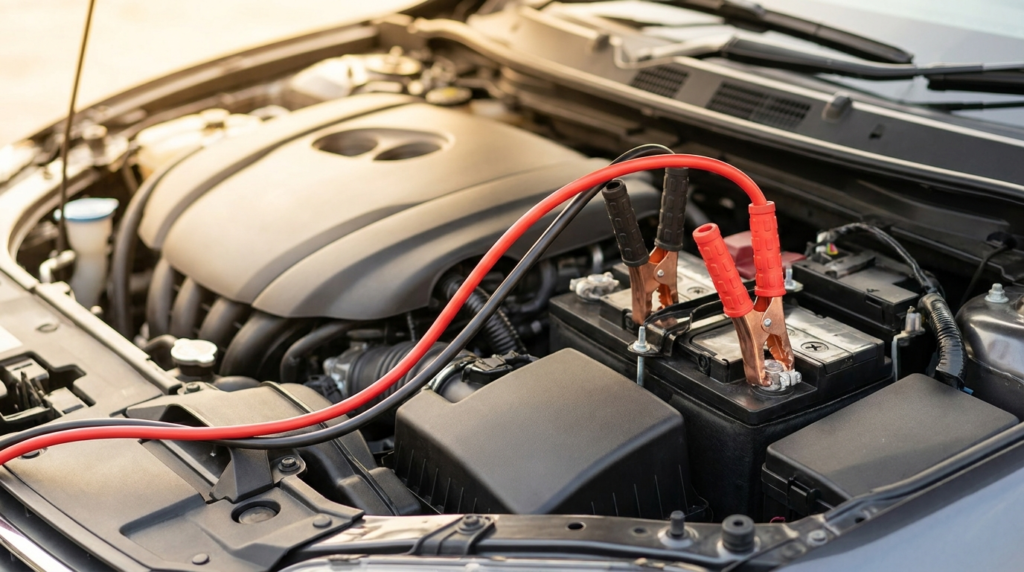
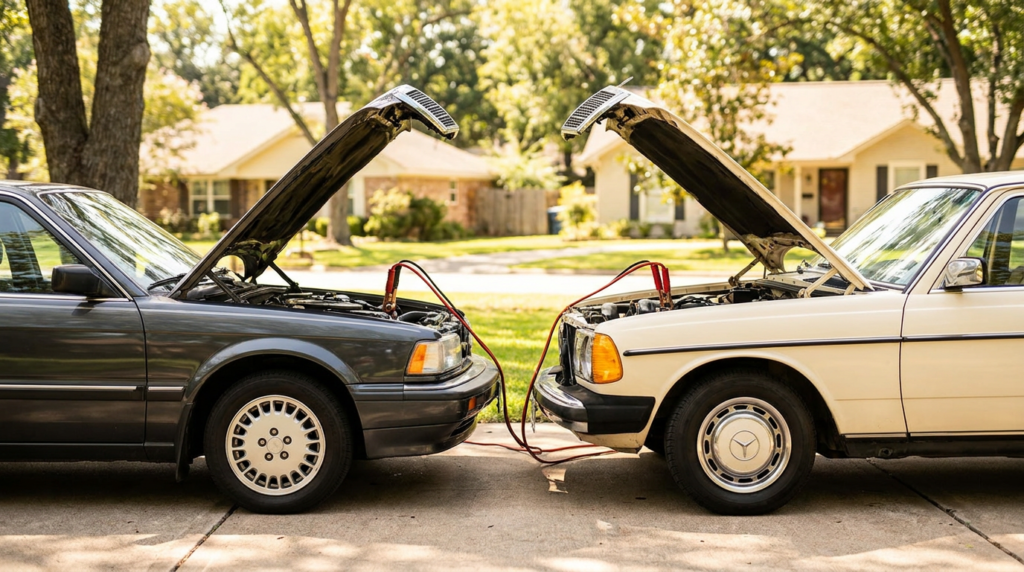
Every manufacturer publishes a version of this and they agree on the essentials. Ford’s owner support guidance tells you to position the booster vehicle “close to, but not touching” the disabled vehicle, and to connect the final clamp to “a large, unpainted metal surface in the disabled vehicle’s engine bay, away from the battery and the engine itself.”
| Step | Action | Why |
|---|---|---|
| 1 | Both vehicles off, in park or neutral, parking brakes on, cables untangled and clamps not touching | A live clamp touching the other clamp or a body panel is a direct short across a battery capable of hundreds of amps |
| 2 | Red clamp to the dead battery’s positive terminal or the vehicle’s designated remote positive post | Starting at the dead vehicle means the other end of the red cable is not yet energised |
| 3 | Red clamp to the donor battery’s positive terminal | The red circuit is now complete but no current flows without a return path |
| 4 | Black clamp to the donor battery’s negative terminal | Still no circuit; the dead vehicle is not yet connected to ground |
| 5 | Black clamp to an unpainted metal bracket or designated ground point on the dead vehicle’s engine, away from the battery | This connection completes the circuit and is the one that sparks. Placing it away from the battery keeps the spark away from vented hydrogen |
| 6 | Start the donor, let it run a few minutes, then start the dead vehicle | Surface-charging the flat battery reduces the current the cables must carry during cranking |
| 7 | Remove in exact reverse order, black from the dead vehicle first | Same logic reversed: break the ground path first so the remaining clamps cannot short |
The safety rule: the last connection you make and the first you break must be the ground clamp on the dead vehicle, and it must never be the dead battery’s negative post. A lead-acid battery gives off hydrogen, hydrogen ignites at very low energy, and the cell nearest a spark is the one that ruptures. This single habit removes the most serious hazard in the whole procedure.
Why reversed polarity is genuinely destructive
On a 1975 car, reversing the clamps blew a fuse. On a current vehicle it puts battery voltage backwards through a network of semiconductors. The alternator’s rectifier diodes conduct in the wrong direction and can fail almost immediately; fusible links and high-current fuses open, which is the system working as designed; and any module still connected to the bus can be damaged, which on a car with twenty or more control units is an expensive way to find out. Tesla’s manual makes the general point sharply, cautioning owners to “avoid short circuits when jump starting” because “connecting cables to the wrong jump post, touching leads together, etc., can damage” the vehicle. Check the marking on both terminals before the first clamp goes on. Red is not a guarantee; corrosion and aftermarket cables lie.
What is different about a modern car
Designated jump posts
Many vehicles no longer have an accessible battery under the bonnet. The battery may be under a seat, in the boot or in a wheel well, and the manufacturer provides a remote positive post under a red plastic cap plus a labelled ground stud. Use them. They are engineered to carry the current and they place the connection away from the battery by design. Tesla’s Model Y manual, for cars with the lithium-ion low-voltage battery, directs the red cable to the “red positive (+) jump post” and the black cable to the HEPA filter bolt serving as the negative jump post.
Start-stop, AGM and lithium low-voltage batteries
Vehicles with automatic engine stop-start use absorbed glass mat or enhanced flooded batteries designed for far more shallow cycling than a conventional battery. They can usually be jumped normally, but they must be replaced like for like and, on most cars, registered to the battery management system after replacement, or the charging strategy will cook them. A growing number of vehicles now use a lithium-ion 12 volt battery instead, which has its own charging behaviour and its own manufacturer procedure. This is the point where the owner’s manual stops being optional reading.
Hybrids and electric vehicles
The high-voltage traction pack has nothing to do with it. Hybrids and EVs fail to start for the same reason a petrol car does: the small 12 volt battery that wakes up the computers has gone flat. That 12 volt battery is jumped in the ordinary way, using the manufacturer’s designated posts. What you must not do is use a hybrid or an electric car as the donor vehicle. Its DC-to-DC converter is sized to run the car’s own accessories, not to deliver cranking current to someone else’s starter motor, and manufacturers prohibit it in plain language. Tesla’s Model Y owner’s manual is the example already quoted.
Lithium jump packs
Portable lithium jump packs have largely displaced cables for good reasons. There is no second vehicle, no risk of connecting two electrical systems together, and the better units include reverse-polarity protection and spark-proof clamps that will not deliver current until they detect a correct connection. The relevant safety standard is UL 2743, the Standard for Portable Power Packs published by UL Standards and Engagement, with a current edition dated 2025; certification to it is a meaningful thing to look for on the box. Keep the pack charged – a jump pack stored flat in a glovebox for two years is a paperweight – and keep it out of extreme heat.
The misconception: that idling in the driveway recharges the battery
This is the belief that sends people back out to a dead car the next morning. At idle, an alternator produces a fraction of its rated output while the cooling fans, lights, heated seats and infotainment draw current, so very little net charge reaches a deeply discharged battery. Recovering a flat starter battery through the charging system takes a long drive, and even that only partly works: modern smart charging strategies deliberately hold the battery below full charge to save fuel. Ford’s own guidance is blunt about the aftermath, warning that the battery “may not be able to start again under its own power, so keep it running until you reach your destination.”
The correct move after a successful jump is a proper mains battery charger overnight, ideally one with a maintenance mode. That is also when to have the battery tested. Any competent shop can measure state of health and load performance in a few minutes, and the relevant rating is the one on the label: SAE Standard J537 defines cold cranking amps such that a battery rated at 500 CCA can deliver 500 amps at minus 18 degrees C, which is 0 degrees F, for 30 seconds without falling below 7.2 volts. The equivalent IEC test requires the battery to hold above 8.4 volts for 60 seconds, and the DIN test above 9 volts for 30 seconds, all after the battery has been fully charged and soaked at that temperature for 24 hours.
That definition tells you why winter is when batteries die. The rating is measured at 0 degrees F precisely because that is when a battery is worst and the engine is hardest to turn, and a battery at 70 percent of health passes unnoticed all summer and fails on the first cold morning. AAA notes that car batteries generally last three to five years; a battery inside that window that has left you stranded once has told you something, and the second time will be less convenient than the first.
Stop and call for help if the battery case is swollen, cracked or leaking, if you smell rotten eggs, if the battery is frozen, if the terminals are heavily corroded, if two attempts of about ten seconds each produce nothing, or if you cannot identify the correct terminals with confidence. Repeated long cranking overheats the starter and the cables. None of that is a reasonable trade against a recovery call.
Where these figures come from
Cold cranking amp definitions are from SAE Standard J537, with the IEC and DIN comparison figures as documented by Battery University. The connection sequence language and the post-start guidance are from Ford Motor Company owner support material on jump starting a vehicle battery. The prohibition on using an electric vehicle as a donor, the lithium low-voltage jump post locations and the short-circuit caution are from the Tesla Model Y Owner’s Manual, United States edition. The portable jump pack standard is UL 2743, the Standard for Portable Power Packs, published by UL Standards and Engagement, current edition 2025. The three to five year battery life figure is from AAA consumer guidance on battery testing and replacement.
General information, current as of September 2026, and not a substitute for your vehicle’s owner’s manual; follow the manufacturer’s procedure, which overrides any general guidance.
Frequently asked questions
Can jump-starting damage my car's electronics?
Correct order and polarity make it safe on modern cars. Reversed polarity is the damaging mistake, which is why matching red to positive deserves your full attention both times.
Does it matter which car is bigger?
Engine size does not matter much; both systems are 12 volt. Do not attempt to jump a conventional car from specialized vehicles with different systems without checking the manuals.
How long should cables be, and does quality matter?
Cables of 12 to 20 feet with thick gauge wire, 6 gauge or heavier, carry current reliably. Thin bargain cables are a common reason a correct procedure still fails.