Every driver assist system sold to US consumers is Level 2 or below, whatever the badge says, and IIHS found most of them lack adequate safeguards against driver disengagement.
The short answer
Nothing you can buy as a consumer in the United States today drives the car for you. NHTSA states the position without hedging: you, as the driver, are responsible for driving the vehicle, and all vehicle features are assistive and do not operate the vehicle. The agency also states that Level 3 through Level 5 technologies are not available on today’s vehicles for consumer purchase.
Everything else is detail. But the detail matters, because manufacturers have given the same handful of functions dozens of trade names, chosen by marketing departments with an interest in making the systems sound more capable than they are.
Every system on sale is Level 2 or below
The industry taxonomy comes from SAE International standard J3016, which defines six levels of driving automation. NHTSA publishes its own plain-language version of the same scale.
| Level | NHTSA description | Who is driving |
|---|---|---|
| 0, momentary driver assistance | Driver is fully responsible while the system provides momentary driving assistance | You |
| 1, driver assistance | Driver is fully responsible while the system provides continuous assistance with either acceleration and braking or steering | You |
| 2, additional driver assistance | Driver is fully responsible while the system provides continuous assistance with both acceleration and braking and steering | You |
| 3, conditional automation | System handles all aspects of driving while the driver remains available to take over | The system, with you on standby |
| 4, high automation | When engaged, the system is fully responsible within limited service areas; a human driver is not needed | The system |
| 5, full automation | When engaged, the system is fully responsible under all conditions and on all roadways; a human driver is not needed | The system |
The jump that matters is between Level 2 and Level 3. At Level 2 the driver is fully responsible even while the car steers and manages its own speed. At Level 3 responsibility genuinely transfers for a period. Every consumer system described here sits at Level 2 or below. The wheel turning by itself does not move you up the scale.
The trade name problem
A single function acquires a new name at every manufacturer, and sometimes two names at one manufacturer. The IIHS evaluation published in March 2024 tested fourteen systems, and the list alone shows the scale of the problem. Among them were Tesla Autopilot, GM Super Cruise, Ford BlueCruise, Nissan ProPILOT Assist, Volvo Pilot Assist, BMW Driving Assistant Plus, and Lexus Teammate.
Those seven names describe one underlying combination: adaptive cruise control managing speed and following distance, plus lane centering managing steering position. They differ in execution and in how aggressively they check that the driver is still paying attention. They do not differ in what they fundamentally are. All are Level 2.
The practical translation rule is simple. Ignore the name on the badge. Ask two questions instead: does the system control speed, and does it control steering? If the answer to both is yes, you are looking at Level 2 partial automation regardless of what it is called, and you are still fully responsible for the vehicle.
What each function actually does, and does not do
NHTSA describes the individual driver assistance technologies in consistent terms. Here is what each one is doing, alongside the failure mode people most often assume away.
Forward collision warning
Detects a potential collision with a vehicle ahead and provides a warning to the driver. It warns. It does not brake. A vehicle with forward collision warning but no automatic emergency braking will alert you and then do nothing further.
Automatic emergency braking
Applies the brakes automatically when a forward collision is imminent. This is the most consequential feature in the list and the only one with a clearly established safety benefit. It is designed to reduce impact speed or avoid a collision, not to guarantee avoidance at any speed. Its performance degrades in heavy rain, snow, and low sun, and with a dirty or obstructed sensor.
Pedestrian automatic emergency braking
Detects a pedestrian in front of the vehicle and automatically applies the brakes if a collision is imminent. Pedestrian detection is substantially harder than vehicle detection, and performance in darkness is materially worse than in daylight. It is not a reason to relax at night.
Lane departure warning
Monitors the vehicle’s position within the lane and alerts the driver as the vehicle approaches or crosses lane markers. It warns only. It needs visible lane markings, which means it degrades on worn roads, in construction zones, in snow, and in heavy rain.
Lane keeping assistance
Automatically and gently steers to prevent the vehicle from departing the lane. It is a corrective nudge triggered by an impending departure, not continuous guidance. It is not designed to hold the car in the center of the lane.
Lane centering
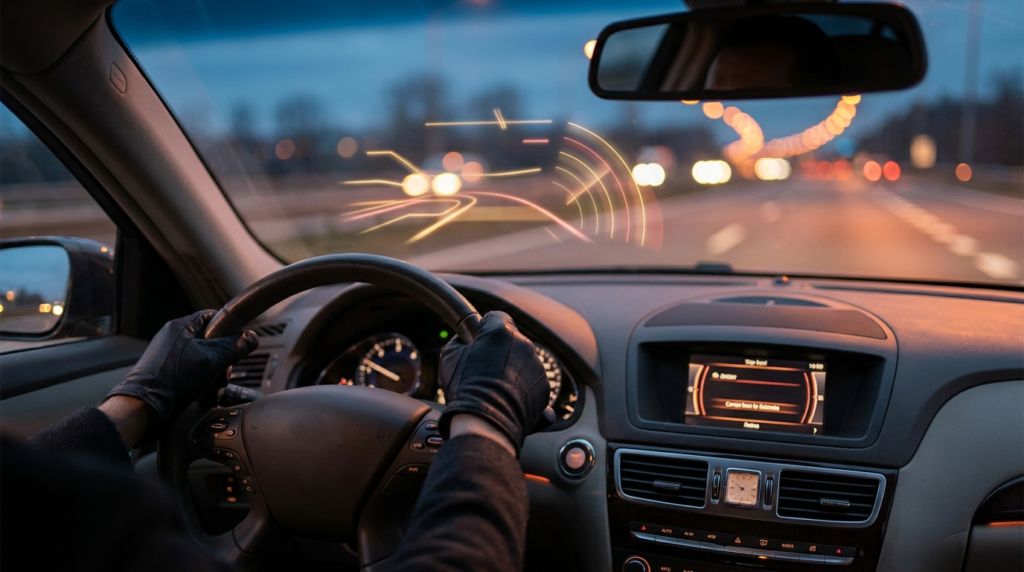
Continuously steers to keep the vehicle near the middle of the lane. This is the function most often mistaken for self-driving, because on a well-marked highway it looks like the car is driving. It is following painted lines. Where the lines end, split at an exit, or disappear under snow, it may hand control back abruptly or follow the wrong set.
Adaptive cruise control
Automatically adjusts the vehicle’s speed to keep a pre-set distance from the vehicle in front. The classic limitation is stationary objects. Many systems are tuned to track moving vehicles and may not respond to a vehicle that is already stopped in the lane, or to a stopped object the radar filters out as roadside clutter.
Blind spot warning and rear cross traffic warning
Blind spot warning warns of a vehicle in the driver’s blind spot. Rear cross traffic warning alerts to collisions while reversing, outside the backup camera’s view. Both cover a specific zone only. Neither reliably catches a fast-approaching motorcycle, and neither replaces turning your head.
The over-reliance problem is documented, not hypothetical
The concern that drivers over-trust these systems is not a matter of opinion. IIHS research published in 2024 found that people who regularly use partial automation often have a false sense of security about what the technology can do, and that over-trusting these systems can prevent drivers from intervening even when they can see a hazardous situation developing ahead.
The harder question is whether the systems earn that trust by preventing crashes. The answer, so far, appears to be no. IIHS and the Highway Loss Data Institute published research in July 2024 comparing insurance claims for vehicles with and without partial automation. For 2017 to 2019 Nissan Rogues, forward collision warning and automatic emergency braking reduced property damage liability claims by 8 percent, but there was no additional benefit associated with adaptive cruise control or ProPILOT Assist. For 2013 to 2017 BMW and Mini vehicles, forward collision warning and automatic emergency braking reduced collision claims by 7 percent and property damage claims by 13 percent, while BMW Driving Assistant Plus produced no additional statistically significant reductions.
IIHS president David Harkey characterized partial automation as a convenience feature like power windows or heated seats rather than a safety technology. IIHS research using police-reported crash data, reported in 2025, likewise found no crash-reduction advantage for vehicles equipped with partial driving automation compared with vehicles from the same manufacturers equipped only with crash avoidance technologies.
Note carefully what that research does and does not say. It does not say the underlying crash avoidance features are useless; those produced measurable reductions. It says the partial automation layer stacked on top of them added nothing detectable.
What IIHS found when it graded the safeguards
Because partial automation introduces a new failure mode, a disengaged driver, IIHS built a rating program specifically for the safeguards rather than the driving performance. The program was announced in January 2022 and the first results were published in March 2024.
The ratings evaluate four things: driver monitoring, including whether the system tracks eye direction, head position, and hand readiness; attention reminders, including whether alerts escalate through multiple channels within roughly ten seconds and trigger an emergency slowdown by around twenty seconds; driver involvement, including whether the driver must initiate lane changes and whether the system can resume automatically without confirming the driver is attentive; and integration with other safety features, including whether automation refuses to operate with seat belts unbuckled or automatic emergency braking and lane departure prevention switched off.
The results were poor. Of fourteen systems tested, one rated acceptable: Lexus Teammate as fitted to the LS. Two rated marginal: GMC Sierra Super Cruise and Nissan Ariya ProPILOT Assist. The remaining eleven rated poor, including systems from BMW, Ford, Genesis, Mercedes-Benz, Tesla, Volvo, and a second Lexus configuration. No system earned the top rating of good. IIHS summarized the problem as most systems lacking adequate measures to prevent misuse and keep drivers from losing focus on the road, while noting that the fixes are readily available and in some cases could be delivered by a software update.
The useful inference is not that one brand is safe and the others are not. It is that the safeguard designed to catch you when your attention drifts is, in most vehicles, weak. Do not plan around it catching you.
The one feature with a proven record
Automatic emergency braking is the outlier, and regulators have treated it accordingly. NHTSA issued Federal Motor Vehicle Safety Standard No. 127, which requires automatic emergency braking, pedestrian automatic emergency braking, and forward collision warning on new light vehicles, with a compliance date of September 1, 2029, and September 1, 2030 for small-volume manufacturers. The standard requires vehicles to achieve no contact with test devices in the specified test procedures, which is a substantially harder bar than merely reducing impact speed.
If you are comparing two vehicles and one has stronger automatic emergency braking while the other has a more elaborate lane centering system with a memorable name, the evidence points at the braking.
Five rules for living with these systems
- Treat Level 2 as cruise control that also steers. Your hands, eyes, and legal responsibility stay where they were.
- Find out what your specific system does before you rely on it. Read the section of the owner manual covering its limitations, not the brochure. The limitations section is where the manufacturer tells you the truth.
- Assume the system will not see a stopped object. Stationary vehicles, debris, and stopped traffic at the end of a queue are the classic failure case for adaptive cruise control.
- Distrust it most in exactly the conditions where you want it most. Heavy rain, snow, fog, worn lane markings, low sun, and construction zones all degrade the sensors and the lane markings these systems depend on.
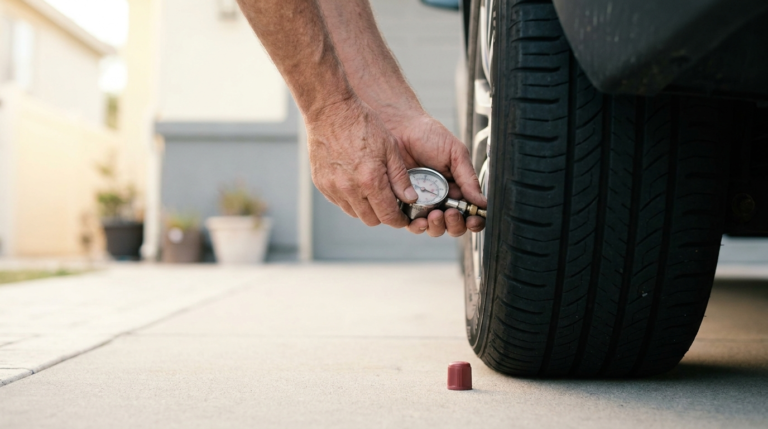
- Keep the sensors clean. Windshield camera area, front grille radar, and bumper corners. Mud, ice, and a badly fitted aftermarket bumper cover all disable these features, sometimes without a clear warning.
Where these figures come from
NHTSA driver assistance technologies guidance and NHTSA levels of automation reference. SAE International standard J3016 levels of driving automation. IIHS safeguard ratings for partial driving automation, announced 2022 and first results March 2024. IIHS and Highway Loss Data Institute research on partial automation and crash rates, July 2024, and IIHS analysis of police-reported crash data reported in 2025. NHTSA Federal Motor Vehicle Safety Standard No. 127, automatic emergency braking systems for light vehicles.
The uncomfortable conclusion is that the feature most likely to save your life is the one nobody markets with a name, and the features with the names are, on the current evidence, conveniences. That may change as the technology matures. It has not changed yet.
General information, current as of September 2026, and not personalised advice.
Frequently asked questions
Why did my safety features shut off in the rain?
Cameras and radar degrade with heavy rain, snow, fog, or grime and the system disables itself honestly. That is the reminder that the driver is, and remains, the system.
Why was my windshield replacement so expensive?
The camera behind the glass must be recalibrated to aim correctly, a required procedure after replacement. Skipping it can point safety systems in subtly wrong directions.