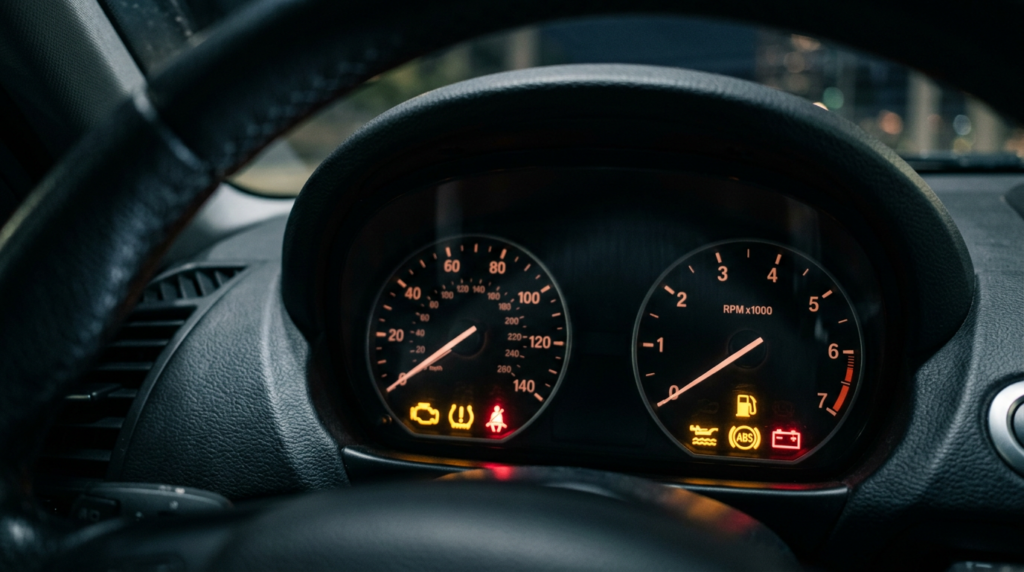
Red versus amber is federal law, not convention, and NHTSA published the reasoning. Also: one red brake lamp legally covers four different faults, one trivial and one an emergency.
The colours on your dashboard are not a styling convention. They are federal law, and the regulator has explained the logic.
Federal Motor Vehicle Safety Standard 101, which governs controls and displays, states that the light of each telltale listed in its Table 1 must be of the colour specified for that telltale. Not may be. Must be.
And in a 2004 rulemaking, NHTSA set out the reasoning in a sentence worth committing to memory: the use of the colour red usually is reserved for telltales warning of an imminent safety hazard. Explaining why the low tire pressure warning is yellow instead, the agency wrote that yellow is the appropriate colour because it conveys the message that the driver may continue driving, but should check and adjust the tire pressure at the earliest opportunity.
Red means the hazard is now. Amber means attend to it soon. That is not folk wisdom. It is the stated basis of the regulation.
The lights the government requires
Standard 101 lists a set of telltales that must appear and must not share a common display space with one another, which tells you which ones the regulator considers too important to be crowded out:
| Telltale | Required colour | What it actually means | Do what |
|---|---|---|---|
| Brake system | Red | Four different conditions, see below | Establish which one before driving on |
| Air bag malfunction | Red | The restraint system may not deploy | Drive to service; the car still works, the airbag may not |
| Low tire pressure | Yellow | At least one tire is 25 percent or more below the recommended cold pressure | Check and inflate at the earliest opportunity |
| Passenger air bag off | Yellow | The passenger airbag is disabled | Confirm this is what you intended |
| Electronic stability control malfunction | Amber | The stability system is not working | Drive gently, especially in poor conditions, and get it diagnosed |
| Check engine, or Service Engine Soon | Amber | A stored diagnostic trouble code | Diagnose soon; see the flashing case below |
The stability control telltale has been required on all covered vehicles since 1 September 2011, under Standard 126, following a phase-in that began in 2008. The tire pressure system has been required on all new light vehicles since 1 September 2007, under Standard 138, originating in the TREAD Act of 2000.
One red light, four different problems
This is the most useful thing in this article, and almost nobody knows it.
Under Standard 105, the brake indicator lamp must activate on any of four conditions:
- A gross loss of pressure, such as that caused by rupture of a brake line
- A drop in brake fluid in any master cylinder reservoir compartment below the recommended safe level
- A malfunction affecting the generation or transmission of signals in an antilock brake system
- Application of the parking brake
The same red lamp covers a fully engaged parking brake, which is trivial, and a ruptured brake line, which is an emergency. The regulation even specifies the word: the lamp must display “Brake” in letters not less than an eighth of an inch high, legible to the driver in daylight.
So the first thing to do when a red brake light appears is release the parking brake and see whether it goes out. If it does, you had a fully explicable warning. If it does not, you do not yet know which of the remaining three you are looking at, and one of them is a reason to stop. Pump the brake pedal: if it feels soft, sinks, or travels much further than usual, treat it as pressure loss and stop somewhere safe rather than driving to a garage.
The check engine light, and the one time it means stop
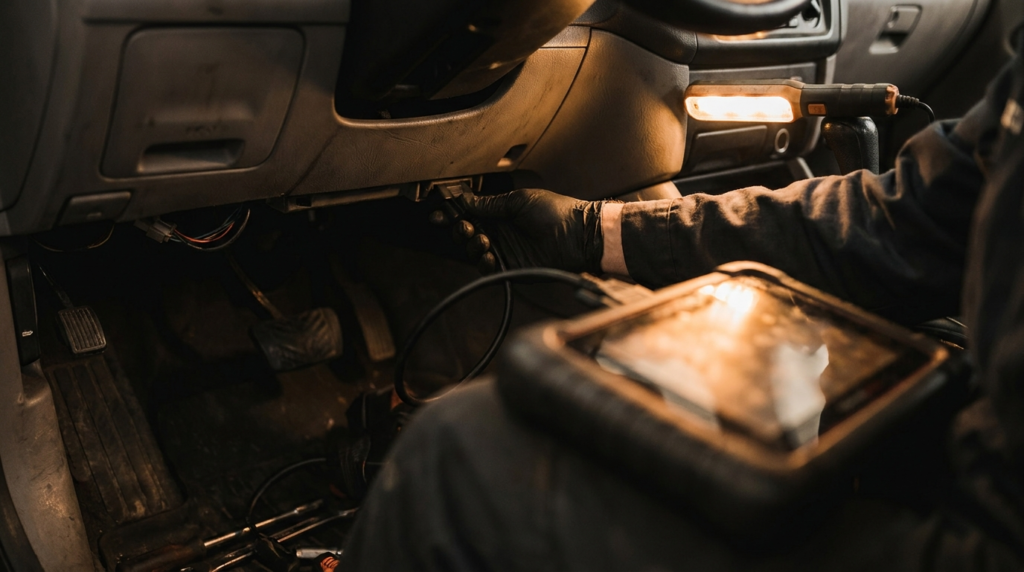
The EPA’s own fact sheet on on-board diagnostics describes what the light is doing: when the system determines a problem exists, a diagnostic trouble code is stored in memory, and the computer illuminates a dashboard light indicating Service Engine Soon or Check Engine.
A steady amber light means diagnose it soon, consistent with the colour rule. It is not an instruction to pull over.
A flashing one is different, and the EPA states the case precisely. Under certain conditions the light will blink or flash, and this indicates a rather severe level of engine misfire. The agency’s instruction: the driver should reduce speed and seek service as soon as possible, because severe engine misfire over only a short period of time can seriously damage emission control system components, especially the catalytic converter.
That is the one dashboard light that changes meaning based on behaviour rather than colour, and the cost of ignoring it for twenty minutes can be a catalytic converter.
On timing, a small correction to a widely repeated date. The EPA’s own wording is that its on-board diagnostics regulations applied to light-duty vehicles and trucks beginning with the 1994 model year. The 1996 date usually quoted is when the standardised connector and protocols applied across all light-duty vehicles, which is why the emissions inspection regulation refers to 1996 or newer vehicles.
What the tire pressure light is, and is not
The threshold is specific. Under Standard 138, the telltale must illuminate not more than 20 minutes after inflation pressure in one or more tires falls to 25 percent or more below the manufacturer’s recommended cold inflation pressure.
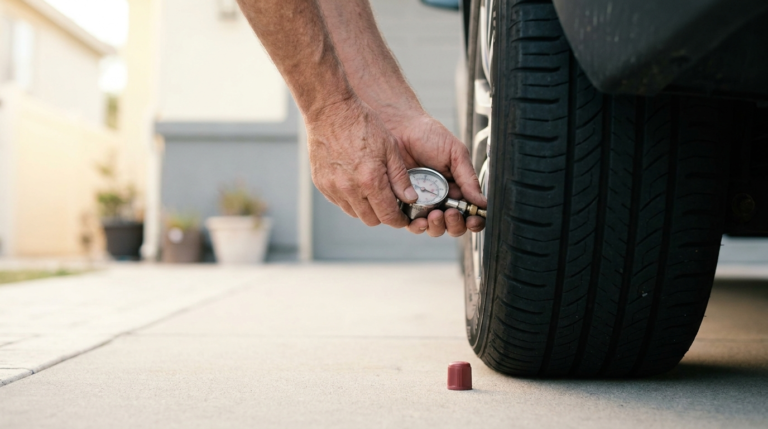
Twenty-five percent is a great deal of pressure. NHTSA is explicit about the consequence, stating that the system is not intended to be a substitute for regular tire maintenance, and that these systems only activate a warning when a tire is significantly underinflated, so you should still conduct a monthly tire pressure check. Its recommendation is to check all tires, including the spare, at least once a month when cold, meaning not driven on for at least three hours.
The system does work at what it was designed for. NHTSA’s 2012 technical evaluation found that among model year 2004 to 2007 vehicles, 23.1 percent without the system had one or more tires 25 percent or more underinflated, against 11.8 percent of those with it, which it calculated as a statistically significant 55.6 percent reduction in the likelihood of severe underinflation.
On fuel, the Department of Energy and EPA state you can improve gas mileage by 0.6 percent on average, and up to 3 percent in some cases, by keeping tires properly inflated, with roughly 0.2 percent lost per psi of underinflation across all tires. NHTSA reports that 511 people died in tire-related crashes in 2024.
One detail on the symbol itself: where a vehicle uses a single telltale for both low pressure and a system malfunction, the regulation requires it to flash for one minute at startup and then remain continuously illuminated. A light that flashes then stays on is telling you the sensor system has failed, not that a tire is flat.
The free self-test at every startup
Federal standards require these telltales to illuminate as a lamp check when the ignition is turned to the on or run position with the engine not running. Standard 105 requires it for the brake lamp, Standard 126 for the stability control telltale, Standard 138 for tire pressure.
Which means the brief flare of warning lights when you turn the key is a mandated self-test, and you should watch it. If a light that should appear never does, the bulb may be dead or the circuit disconnected, and you have lost the warning rather than the problem.
This matters beyond safety. Under the federal emissions inspection standards at 40 CFR 85.2207, a vehicle fails if the malfunction indicator light is commanded to be illuminated and is not visually illuminated on inspection. A removed bulb is itself a failure, not a workaround.
The same regulation provides that a 1996 or newer vehicle fails if the connector is missing, tampered with or otherwise inoperable, and fails if the light is commanded on for one or more diagnostic trouble codes. So a lit check engine light is not merely advisory in states with inspection programmes; it is a scheduled failure with a date attached.
What is not on your dashboard
Two things worth knowing about lights the car cannot tell you about.
Open safety recalls do not appear. NHTSA offers a free lookup by VIN, covering unrepaired safety recalls only, and repairs are free at a dealership. Its limits: it excludes already-repaired recalls, recalls more than fifteen years old unless a manufacturer extended coverage, very recent recalls where VINs are not yet loaded, and some very small manufacturers.
Emissions recalls are not in that database at all, since they are an EPA and manufacturer matter. A dashboard light caused by an emissions defect may be covered by an emissions recall or the federal emissions warranty and will not show up in a safety recall search.
What to do, in order
- Watch the startup light show. It is a federally required self-test, and a light that never appears is a warning you have lost.
- Treat red as stop and assess, which is the regulator’s own stated basis for the colour.
- For a red brake light, release the parking brake first, then check the pedal feel before driving any distance.
- For a flashing check engine light, reduce speed and seek service immediately. This is the EPA’s instruction and the catalytic converter is the thing at risk.
- Treat the tire pressure light as already serious, since it only illuminates at 25 percent or more below the recommended pressure, and check pressures monthly regardless.
- Run your VIN through the free recall lookup, because the most important fault on your car may be one the dashboard has no light for.
What is genuinely awkward about dashboard warnings is how much information the regulation compresses into how few lamps. One red light covers a parking brake and a ruptured brake line. One amber light covers a loose fuel cap and a failing sensor. The colours tell you the urgency, which the government took care to standardise, and nothing at all tells you the cause. That is why the honest answer to most of these lights is still a diagnostic reader or a mechanic, and why the only two that carry unambiguous instructions, a red brake warning and a flashing check engine light, are the two worth memorising.
Where these figures come from
- Federal Motor Vehicle Safety Standard 101, Controls and Displays, 49 CFR 571.101
- Federal Motor Vehicle Safety Standard 105, 49 CFR 571.105, brake system indicator requirements
- Federal Motor Vehicle Safety Standard 126, 49 CFR 571.126, electronic stability control
- Federal Motor Vehicle Safety Standard 138, 49 CFR 571.138, tire pressure monitoring systems
- NHTSA, Federal Register rulemaking on Tire Pressure Monitoring Systems, Controls and Displays, September 2004
- NHTSA, TireWise tire safety guidance, and Technical Report DOT HS 811 681, November 2012
- US Environmental Protection Agency, Frequently Asked Questions About On-Board Diagnostics, EPA 420-F-97-003
- 40 CFR 85.2207, onboard diagnostic test standards
- US Department of Energy and Environmental Protection Agency, fueleconomy.gov vehicle maintenance guidance
- NHTSA recall lookup guidance
General information, current as of September 2026, and not personalised advice. Your owner’s manual describes the specific telltales fitted to your vehicle and overrides anything here.
Frequently asked questions
Can I keep driving with a steady check engine light?
Usually yes for a short period if the car drives normally, but read the code soon; some codes are trivial and some are early warnings of costly damage.
Why did my light turn off by itself?
Codes clear after a fault stops recurring for a set number of drive cycles. The event is still stored in history and readable at a shop; intermittent faults tend to return.
Do warning lights get checked in state inspections?
In many states with inspections, an illuminated check engine light is an automatic emissions failure. Fix the cause, not the bulb.