The 2017 ACC/AHA guideline moved the hypertension threshold to 130/80, taking US prevalence from about one-third of adults to nearly half without anyone's arteries changing.
The short version: The top number is the pressure in your arteries while the heart contracts, the bottom number is the pressure between beats, and both are measured in millimeters of mercury. The 2017 American College of Cardiology and American Heart Association guideline, published in November 2017, moved the threshold for stage 1 hypertension down to 130/80, which took the share of US adults classified as hypertensive from roughly one-third to nearly half overnight without anyone’s arteries changing. The 2025 AHA/ACC guideline, released on 14 August 2025, kept those same category boundaries. The most consequential thing in this article is not a threshold, though: it is that a single reading taken in a clinic, on an exam table, with your arm hanging by your side, is close to worthless as a basis for diagnosis. This site holds no medical credentials; what follows reports what agencies and published trials say, with attribution, and is not a personal recommendation.
What the two numbers actually measure
Blood pressure is reported as two numbers because arterial pressure is not constant. Systolic pressure, the higher figure, is the peak reached when the left ventricle contracts and pushes blood into the aorta. Diastolic pressure, the lower figure, is the trough between beats, while the heart refills. The unit, millimeters of mercury, is a holdover from the mercury column manometers that set the standard and are now largely gone from clinical use.
Which number matters more
Both carry risk information, but not equally at all ages. The American Heart Association states that systolic pressure tells more about cardiovascular risk for people over about 50, because arteries stiffen with age and the systolic figure rises while diastolic often flattens or falls. In younger adults, an isolated high diastolic reading is more likely to be the meaningful finding. A widening gap between the two, called pulse pressure, is itself a marker of arterial stiffness.

One thing neither number tells you is how you feel. Hypertension is essentially asymptomatic until it is severe. The American Heart Association is explicit that headaches, nosebleeds and flushing are not reliable indicators of elevated blood pressure, which is precisely why screening exists.
The categories, and what the 2017 reclassification did
| Category | Systolic (mm Hg) | Diastolic (mm Hg) | |
|---|---|---|---|
| Normal | Less than 120 | and | Less than 80 |
| Elevated | 120 to 129 | and | Less than 80 |
| Stage 1 hypertension | 130 to 139 | or | 80 to 89 |
| Stage 2 hypertension | 140 or higher | or | 90 or higher |
| Hypertensive crisis | Higher than 180 | and/or | Higher than 120 |
Note the conjunctions. For elevated blood pressure both conditions must hold; for stage 1 and stage 2, either number on its own puts you in the category. These thresholds are from the 2017 ACC/AHA guideline and were carried forward unchanged in the 2025 AHA/ACC guideline.
What lowering the line to 130/80 did
The previous standard, dating to 2003, set hypertension at 140/90. The American College of Cardiology, announcing the change on 13 November 2017, stated that the new definition would raise the proportion of US adults with high blood pressure from about one-third to nearly half, with the prevalence expected to triple among men under 45 and double among women under 45. Crucially, the guideline did not recommend medication for most of the newly reclassified group; the intent was earlier lifestyle intervention, not mass prescribing.
This is worth sitting with. A reclassification of that scale changes what “having hypertension” means as a statistic, which makes comparisons across time periods and across countries treacherous unless you check which threshold was used.
Prevalence and control today
The CDC National Center for Health Statistics, in Data Brief 511 published in October 2024 and covering August 2021 to August 2023, reported that 47.7 percent of US adults had hypertension under the 130/80 definition. By age, the figure was 23.4 percent for adults 18 to 39, 52.5 percent for 40 to 59, and 71.6 percent for 60 and over. Among those with hypertension, 59.2 percent were aware of it, 51.2 percent were taking medication, and 20.7 percent had blood pressure controlled below 130/80. That last figure is the one that should hold attention: roughly one in five people with hypertension are at the target their own guideline sets.
The misconception: one clinic reading is not a diagnosis
The most common misunderstanding is that a number read off a machine in a doctor’s office is a measurement of your blood pressure. It is a measurement of your blood pressure in that room, in that chair, in that arm position, with that cuff, in the minute after you walked in. Blood pressure varies by 20 mm Hg or more over a day, and the measurement itself is unusually easy to get wrong.
White coat and masked hypertension
White coat hypertension is high readings in clinic with normal readings elsewhere. The 2017 ACC/AHA guideline put its prevalence at 13 percent to as high as 35 percent in some populations. Masked hypertension is the reverse, and is more dangerous precisely because it is invisible in clinic: the guideline notes that cardiovascular and all-cause mortality risk in masked hypertension is similar to sustained hypertension and about twice that of people with normal blood pressure.
What the Task Force says
The US Preventive Services Task Force, in its 2021 reaffirmation recommendation, gave screening for hypertension in adults a grade A and stated that it “recommends obtaining blood pressure measurements outside of the clinical setting for diagnostic confirmation before starting treatment.” Its screening intervals are annual for adults 40 and over and for younger adults at increased risk, and every three to five years for adults 18 to 39 at low risk with previously normal readings. That confirmation step, using ambulatory or home monitoring, is routinely skipped in practice.
The errors that inflate a reading
Two randomized crossover trials published in JAMA Internal Medicine quantify how large these effects are. The Cuff(SZ) trial, published on 7 August 2023 with 195 participants, tested a regular-size cuff against the correct one. For people who needed an extra-large cuff, the regular cuff overestimated systolic pressure by 19.5 mm Hg. For those needing a large cuff it overestimated by 4.8 mm Hg; for those needing a small cuff it underestimated by 3.6 mm Hg. The ARMS trial, published on 7 October 2024 with 133 adults, tested arm position against the standard of the arm supported on a desk at heart level. Resting the arm in the lap overestimated systolic pressure by 3.9 mm Hg and diastolic by 4.0. Letting the arm hang unsupported at the side overestimated systolic by 6.5 mm Hg and diastolic by 4.4.
The American Medical Association, summarizing the American Heart Association’s 2019 scientific statement on blood pressure measurement, notes that talking during a measurement can raise the reading by as much as 10 mm Hg, and that taking a reading on an exam table rather than a straight-backed chair can elevate it by 6 mm Hg or more. An unsupported back, crossed legs, a full bladder, recent smoking, recent caffeine and a cuff applied over clothing all push in the same direction. These errors stack.
The decision rule: before you accept any single reading as meaningful, check five things. Correct cuff size for your arm circumference, back supported, feet flat on the floor, arm supported at heart level, and five minutes seated in silence beforehand with an empty bladder. If any one of those was missing, the number is not evidence, and a repeat measurement done properly is the right next step rather than a change in treatment.
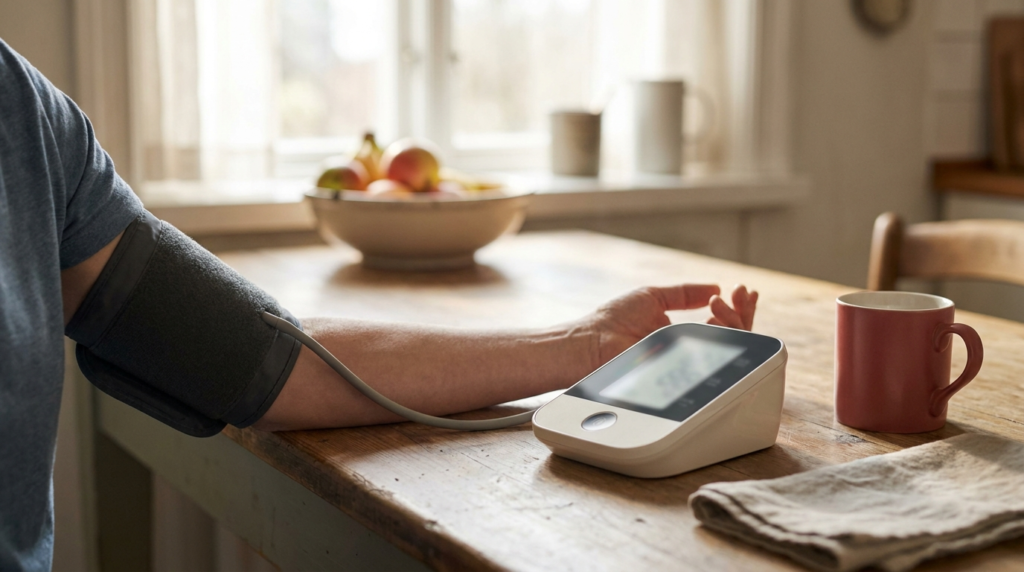
One further point about home readings: a diagnosis is built from an average, not a best or worst number. The American Heart Association’s home monitoring guidance is to take two readings a minute apart, morning and evening, over roughly a week, and to average them rather than react to individual values. People who take one reading, dislike it, and take four more until they get one they prefer are not measuring their blood pressure, they are sampling the low tail of their own distribution. Bring the whole log to the appointment, including the readings you did not like.
Device validation
Most home monitors sold online have never been independently tested for clinical accuracy. The US Blood Pressure Validated Device Listing, developed by hypertension experts who began meeting in 2015 and administered by NORC at the University of Chicago as an independent third party, lists devices that have passed clinical validation testing. As of the American Medical Association’s account, it contains 57 validated devices across home and office upper-arm monitors, wrist cuffs, kiosks and 24-hour ambulatory monitors. Look for an upper-arm cuff device on that listing, and check the cuff size range against your own arm. The 2025 AHA/ACC guideline notes that smartwatches and cuffless devices are not yet reliable enough for clinical use.
When a high reading is an emergency
The American Heart Association’s guidance for a reading above 180/120 is to wait a minute and take it again. If the second reading is similarly high and you have chest pain, shortness of breath, back pain, numbness or weakness, vision changes or difficulty speaking, that is a hypertensive emergency and the instruction is to call 911. If the second reading is similarly high and you have none of those symptoms, contact your doctor promptly; that is severe hypertension needing a treatment adjustment, not an ambulance.
Lifestyle measures and medication
The 2025 AHA/ACC guideline keeps a treatment target of below 130/80 for adults and recommends limiting sodium to less than 2,300 milligrams a day, moving toward an ideal limit of 1,500 milligrams, and limiting alcohol to no more than two drinks a day for men and one for women. Its significant procedural change is the use of the PREVENT risk equations rather than the older pooled cohort equations to decide who needs medication: for stage 1 hypertension with an estimated ten-year cardiovascular risk below 7.5 percent by PREVENT, lifestyle change comes first, with medication added if blood pressure does not reach goal.
The framing to resist is lifestyle versus medication as alternatives. The guideline treats them as complementary, and the honest summary is that lifestyle measures reliably lower blood pressure by useful amounts in people who sustain them, that sustaining them is the hard part, and that neither the 2017 nor the 2025 guideline treats a stage 2 reading as something to manage with diet alone.
Where these figures come from
Category thresholds and the reclassification figures are from the 2017 ACC/AHA high blood pressure guideline and the American College of Cardiology announcement of 13 November 2017, with the categories reaffirmed in the 2025 AHA/ACC guideline of 14 August 2025. Prevalence, awareness, treatment and control figures are from the CDC National Center for Health Statistics, Data Brief 511, October 2024, covering August 2021 to August 2023. Screening and confirmation guidance is the US Preventive Services Task Force reaffirmation recommendation statement of 2021. Cuff size figures are from the Cuff(SZ) randomized crossover trial, JAMA Internal Medicine, 7 August 2023; arm position figures from the ARMS crossover trial, JAMA Internal Medicine, 7 October 2024. Talking and seating effects are from the American Medical Association’s summary of the American Heart Association 2019 scientific statement on measurement of blood pressure in humans. White coat and masked hypertension prevalence and risk are from the 2017 ACC/AHA guideline as summarized in American Family Physician, March 2018. Emergency thresholds and symptom guidance are from the American Heart Association. Device validation details are from the American Medical Association and the US Blood Pressure Validated Device Listing.
General information, current as of September 2026. This is not medical advice; discuss your own blood pressure readings and treatment with a clinician.
Frequently asked questions
Why is my blood pressure different at the doctor's office?
Some people read higher in clinical settings, sometimes called white coat effect, and some read higher only at home. This is precisely why clinicians value a log of properly taken home readings.
Does drinking water lower blood pressure quickly?
No reliable quick fix exists. Hydration supports overall health, but blood pressure control comes from sustained habits and, when needed, medication.
At what numbers should I call a doctor today?
Repeated readings at or above 180/120 warrant immediate medical attention. Consistent readings in stage 1 or 2 ranges warrant a scheduled visit soon.