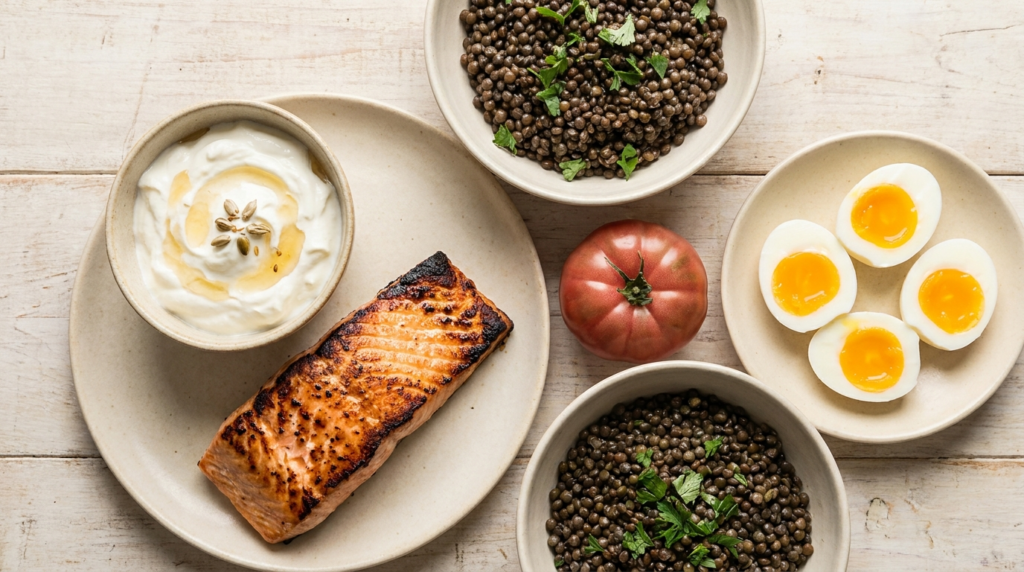
Federal guidance doubled the protein target in January 2026, to 1.2 to 1.6 grams per kilogram. Here is what that means in grams for your body weight, how far the average American already is from it, and why the label on the packet disagrees.
The official answer to this question changed in January 2026, and most of the advice still circulating has not caught up.
For decades the reference figure was the Recommended Dietary Allowance: 0.8 grams of protein per kilogram of body weight per day, set by the National Academies in its Dietary Reference Intakes for macronutrients. Then the Dietary Guidelines for Americans, 2025 to 2030, published by the Department of Health and Human Services and the Department of Agriculture in January 2026, printed a different number: “Protein serving goals: 1.2 to 1.6 grams of protein per kilogram of body weight per day, adjusting as needed based on your individual caloric requirements.”
That is roughly double the RDA, and it is now the operative federal guidance for the general adult population. It also happens to sit close to what sports nutrition has recommended for years, which is why a great deal of internet advice suddenly looks less like hype than it did in 2024. Some of it still is.
What the RDA was actually measuring
The 0.8 figure was never an optimum, and reading it as one is the oldest error in this subject. The National Academies defines an RDA as “the average daily dietary intake level sufficient to meet the nutrient requirements of nearly all (97 to 98 percent) healthy individuals in a group.” It is a floor set high enough that almost nobody falls below their requirement. It is a deficiency-prevention number.
Expressed in grams, that RDA works out to 56 grams a day for men and 46 for women. It has not been withdrawn. The Academies has not revised the DRI. What has happened is that the dietary guidance built on top of it now points at a higher band.
The numbers for your body
Converting grams per kilogram into something you can act on requires one division. The table below does it for a range of body weights. The arithmetic is ours; the multipliers are the ones cited in each column heading.
| Body weight | RDA, 0.8 g/kg | New federal target, low end, 1.2 g/kg | New federal target, high end, 1.6 g/kg | Upper athlete figure, 2.0 g/kg |
|---|---|---|---|---|
| 130 lb (59 kg) | 47 g | 71 g | 94 g | 118 g |
| 150 lb (68 kg) | 54 g | 82 g | 109 g | 136 g |
| 170 lb (77 kg) | 62 g | 92 g | 123 g | 154 g |
| 190 lb (86 kg) | 69 g | 103 g | 138 g | 172 g |
| 220 lb (100 kg) | 80 g | 120 g | 160 g | 200 g |
The gap between the second and third columns is the part worth noticing. For a 170 pound adult, the old floor was 62 grams and the new target begins at 92. That is not a rounding difference. It is an extra meal’s worth of protein.
Where Americans actually are
The USDA’s Agricultural Research Service reports actual intakes from the What We Eat in America survey. Its data brief on protein intake of adults found that “males consumed about one-third more protein than females (97 grams versus 69 grams, respectively),” and that “the percentage of energy intake provided by protein was 16 percent among all adults.” By age, men aged 20 to 39 averaged 106 grams and men over 60 averaged 82; women aged 20 to 39 averaged 83 grams and women over 60 averaged 73.
Put those against the table. A man eating the male average of 97 grams clears the 1.2 g/kg line at any body weight up to about 178 pounds. A woman eating the female average of 69 grams clears it only if she weighs about 127 pounds or less. That single comparison is the most useful thing in this article: the new guidance is not a stretch for the average American man, and it is a meaningful increase for the average American woman.
The arithmetic there is ours, dividing the published average intakes by 1.2. The intake figures are the USDA’s.
Why the nutrition label says something different
If you check a food package, the percent Daily Value for protein is calculated against 50 grams. The FDA’s interactive Nutrition Facts label guide states it directly: “The Daily Value for protein is 50 g per day. This is based on a 2,000 calorie daily diet.” The figure is codified in federal regulation at 21 CFR 101.9.
Fifty grams is 10 percent of 2,000 calories. It is a labelling convention anchored to an older reference, not a recommendation, and it is now well below the dietary guidance. If you have been reading percentages off packets and concluding you are comfortably over target, check the grams instead.
What the target looks like on a plate
Abstract grams are useless without portions attached. The figures below come from the USDA’s FoodData Central database, calculated from its published per-100-gram protein values and its own listed portion weights.
| Food | Portion | Protein |
|---|---|---|
| Chicken breast, meat only, roasted | 3 oz (85 g) | 26.4 g |
| Ground beef, 85 percent lean, pan-browned | 3 oz (85 g) | 23.5 g |
| Cottage cheese, creamed | 1 cup (210 g) | 23.3 g |
| Salmon, Atlantic, farmed, cooked | 3 oz (85 g) | 18.8 g |
| Lentils, cooked | 1 cup (198 g) | 17.9 g |
| Greek yoghurt, plain, lowfat | 6 oz (170 g) | 16.9 g |
| Black beans, cooked | 1 cup (172 g) | 15.2 g |
| Tofu, firm | 1/2 cup (126 g) | 11.4 g |
| Milk, 2 percent | 1 cup (244 g) | 8.1 g |
| Egg, whole | 1 large (50 g) | 6.3 g |
| Almonds | 1 oz (28 g) | 6.0 g |
Assemble a day for the 170 pound adult in the first table, whose target band is 92 to 123 grams. Two eggs at breakfast is 12.6. Six ounces of Greek yoghurt is 16.9. A cup of lentils at lunch is 17.9. Three ounces of chicken at dinner is 26.4. A cup of milk is 8.1 and an ounce of almonds is 6.0. That totals 87.9 grams, and it is still short of the bottom of the band. Add a three ounce portion of salmon and the day reaches 106.7 grams, comfortably inside it.
Notice what that day does not contain. No powder, no bar, no fortified snack. The target is reachable on ordinary food, and it takes deliberate effort rather than supplementation. This is the honest form of the advice: most people who need more protein need another serving of something they already eat, at a meal where they currently eat none.
Is there an upper limit?
Not a formal one. The National Academies has never set a Tolerable Upper Intake Level for protein. Its 2022 evidence scan, commissioned by USDA, states that “there was not enough information to establish specific Tolerable Upper Intake levels (UL) for dietary protein or the indispensable amino acids.” An absence of a limit is not a safety endorsement; it is an absence of evidence sufficient to set one.
Two practical ceilings do exist. The Acceptable Macronutrient Distribution Range for adults puts protein at 10 to 35 percent of calories. And the NIH Office of Dietary Supplements, in its fact sheet on supplements for exercise and athletic performance, reports “no safety concerns reported at daily recommended intakes for athletes of up to about 2.0 g/kg body weight.” The same sheet gives the athlete range as “0.55 to 0.9 g/lb body weight (1.2 to 2.0 g/kg body weight).”
Above 2.0 grams per kilogram, you are in territory where no authoritative body has published either a recommendation or a safety assessment. The marketing that implies otherwise is selling a product, and the FDA is clear that “FDA does not approve dietary supplements before they are sold to consumers.”
Two groups who should not use the table above
People with chronic kidney disease. The NIDDK’s guidance on healthy eating with CKD states that “some people with CKD may need to consume moderate amounts of protein so waste doesn’t build up in the blood,” while warning that “too little protein may lead to malnutrition.” It deliberately gives no gram figure, directing readers instead to “work with a dietitian or health care professional.” People on dialysis may need more, not less, because “the dialysis treatment removes protein from the blood.” This is individualised clinical territory and a table cannot substitute for it.
Worth saying clearly: no NIH or NIDDK source we found states that high protein intake causes kidney disease in people with healthy kidneys. The restriction advice is for people who already have the condition.
People who are pregnant or lactating. The DRI sets 71 grams a day, equivalent to 1.1 g/kg, for both. The 2025 to 2030 guidelines do not give a separate protein figure for pregnancy.
The question nobody official will answer
Timing. Whether protein should be spread evenly across meals, whether there is an anabolic window after training, whether 30 grams per sitting is a threshold worth engineering your day around. We looked for an authoritative answer and there is not one. The nearest statement is from the NIH Office of Dietary Supplements, on branched-chain amino acids: “it is not clear from existing research whether consumption of protein and BCAAs before versus after a workout affects their ability to maximize muscle protein synthesis and reduce protein catabolism.” No federal source sets a per-meal target.
Which means the people building elaborate schedules are working from something other than published guidance, and you are not failing by eating your protein whenever you eat.
What has actually changed
It would be tidy to say that the supplement industry was right all along. It was not. It was selling a much higher number than 1.2 to 1.6 grams per kilogram, and it was selling a delivery mechanism, powders and bars, that the new guidance does not require and does not mention. Federal guidance moved toward the middle of a debate, not toward the end the marketing occupies.
The useful takeaway is narrower and duller. Work out your own body weight in kilograms, multiply by 1.2, and compare the result to what you ate yesterday. For roughly half the adult population the answer will be that nothing needs to change. For the other half it means one more ordinary serving of eggs, beans, dairy, fish or meat, at whichever meal currently has none. That is the whole intervention, and it costs less than a tub of anything.
General information, current as of September 2026, and not personalised advice. Nutrient recommendations change; check the primary sources and speak to a qualified professional about your own circumstances.
Frequently asked questions
How much protein do I need?
Divide your weight in pounds by 2.2 to get kilograms, then multiply by 1.2 and by 1.6. That band is the target set by the Dietary Guidelines for Americans 2025 to 2030.
Is there an upper limit?
The National Academies has never set a Tolerable Upper Intake Level for protein. The NIH reports no safety concerns at athlete intakes up to about 2.0 grams per kilogram.
Do I need powders or bars?
No. A day of eggs, yoghurt, lentils, chicken, milk and nuts reaches about 88 grams before any supplement is involved.
Does high protein harm the kidneys?
No NIH source we found states that high protein causes kidney disease in healthy people. NIDDK advice on moderating protein applies to those who already have chronic kidney disease.
Sources
- Dietary Guidelines for Americans, 2025 to 2030
- National Academies, Dietary Reference Intakes for macronutrients
- Food and Drug Administration, Interactive Nutrition Facts Label, Protein
- USDA Agricultural Research Service, Protein Intake of Adults, What We Eat in America
- USDA FoodData Central
- NIH Office of Dietary Supplements, Dietary Supplements for Exercise and Athletic Performance
- NIDDK, Healthy Eating for Adults with Chronic Kidney Disease
- Food and Drug Administration, Questions and Answers on Dietary Supplements