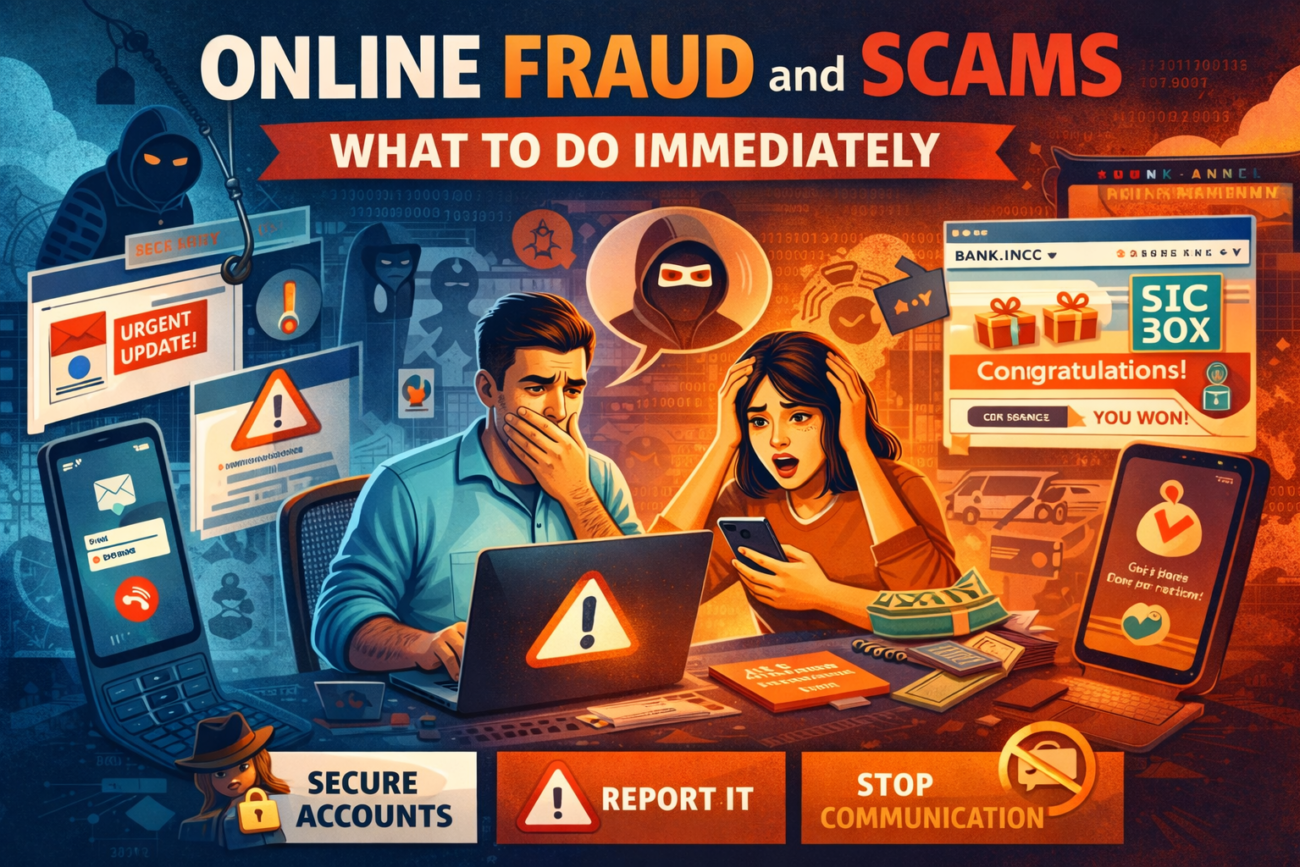
Online scams are rising in 2026 because money moves faster than ever. UPI and instant bank transfers, card-on-file payments, fake delivery links, “customer care” impersonation, and OTP tricks have made online fraud easier to execute and harder to reverse. The most important thing is not to panic. The second most important thing is to act fast.
If you’re asking what to do after being scammed, here’s a clear, step-by-step plan you can follow.
[Insert emergency contacts box here]
First 30 Minutes: What to Do Immediately
1) Stop the transaction and cut contact
- If you’re still on the call or chat, end it immediately.
- Do not share any more OTPs, PINs, passwords, or screen-share access.
- If you clicked a link, close the page and do not enter any details again.
2) Block or freeze your payment method
Do this based on what was used:
- Card: freeze/block the card in your banking app or call the bank helpline.
- Bank transfer: call your bank immediately and request an urgent hold/reversal attempt.
- Wallet/UPI/instant payments: lock the wallet or UPI profile and disable “collect” requests if possible.
Speed matters. Many banks/payment providers can act better within minutes than hours.
3) Change passwords (starting with email and banking)
Your email is the key to everything. If a scammer controls your email, they can reset your bank and social accounts.
- Change email password first
- Then banking/payment apps
- Then social media accounts
Enable two-factor authentication (2FA) immediately.
4) Check for “new device logins” and remove unknown access
Look for alerts like:
- “New login from another device”
- “Your number/email changed”
- “New beneficiary added”
If you see anything suspicious, remove it and notify the provider.
5) Capture evidence before it disappears
Take screenshots and save:
- Phone numbers and usernames used
- Chat messages and emails
- Website URL, social profile links, and fake app name
- Transaction ID, UTR/reference number, time, and amount
- Any OTP messages (do not share OTP publicly, just save proof)
This evidence strengthens your case when you report cybercrime and when you dispute the transaction.
Next 24 Hours: Reporting and Documentation
1) Raise a complaint with your bank/payment provider in writing
Even if you called, also:
- email customer support or use in-app support
- request a complaint reference number
- clearly mention: “suspected financial fraud” and “urgent investigation”
Written proof creates a timeline.
2) Report to cybercrime / police channels
Since processes vary by country, use the official cybercrime reporting portal or local police cyber cell where available. Provide:
- your complaint summary
- transaction details
- screenshots and URLs
- scammer contact details
This step matters even if you think the money is gone. It creates an official record.
3) Secure your phone and devices
Many scams involve malware or remote access apps.
- uninstall any unknown apps installed recently
- run a trusted security scan
- check app permissions (SMS access, accessibility access, screen overlay)
- update your phone OS and banking apps
If you screen-shared or installed remote-control software, take this seriously.
4) Inform the merchant/platform (if applicable)
If the scam happened through:
- an e-commerce marketplace
- social media platform
- delivery/ride-hailing impersonation
report the account and share transaction proof.
Some platforms can freeze suspicious seller accounts or assist investigations.
If Money Was Transferred: What Recovery Is Possible?
Be realistic but act fast.
Recovery is more likely when:
- you report immediately (minutes to a few hours)
- the money is still in the first recipient account
- the bank/provider can place a hold or flag the transaction
- the scam account is already under watch
Recovery is harder when:
- money is moved through multiple accounts quickly
- it’s withdrawn as cash
- it’s converted into crypto or transferred overseas
Even if recovery is uncertain, reporting quickly improves the chance and helps prevent future victims.
Common Scam Types and Warning Signs (Quick List)
Common scams in 2026
- Fake customer care numbers and “support” accounts
- OTP and “KYC update” scams
- Fake delivery links and missed parcel messages
- Job scams asking for “registration fee”
- Investment scams promising guaranteed returns
- QR code scams and UPI “collect” request tricks
- Remote access app scams (screen share / control)
Warning signs
- Urgency and pressure: “Do it now or your account will be blocked”
- Requests for OTP, PIN, CVV, or screen sharing
- Links that look similar but slightly wrong
- Payments demanded to “release” refunds or prizes
- Messages claiming you “won” something you didn’t enter
How to Protect Yourself Going Forward
- Turn on transaction alerts (SMS/email/app notifications)
- Set daily spending limits where possible
- Use strong unique passwords + a password manager
- Enable 2FA on email and banking apps
- Block unknown UPI collect requests (if your app allows)
- Don’t install apps from random links
- Be cautious with public Wi-Fi for payments
- Ask your telecom provider about SIM swap protections (where available)
Fraud Response Checklist
- Block/freeze cards and accounts immediately
- Call bank/payment provider and log a complaint
- Change email and banking passwords + enable 2FA
- Save evidence: screenshots, URLs, transaction IDs
- Report cybercrime / police channels within 24 hours
- Scan devices and remove suspicious apps
- Monitor accounts daily for a week
[Insert CTA here: save this checklist]
FAQ
What if I shared an OTP by mistake?
Contact your bank/payment provider immediately, block access, and change passwords. OTP sharing is often the turning point in a scam, so treat it as urgent.
What if the scammer has my ID details?
Watch for unusual account changes, new loans, or SIM swap attempts. Inform your bank, enable additional verification, and consider reporting identity misuse through local channels.
Should I pay money to “recover” my money?
Be cautious. “Recovery scams” are common. Real banks and authorities do not ask you to pay a fee to release your own money.
Online scams succeed because they create panic. Your best defense is fast action and a clear process: stop access, secure accounts, collect evidence, and report quickly. That combination gives you the best chance of limiting damage and improving recovery outcomes.
Disclaimer: This is general information, not legal advice. For urgent cases, contact local authorities and your bank immediately.